| Release List | Reviews | Price Search | Shop | Newsletter | Forum | DVD Giveaways | Blu-Ray/ HD DVD | Advertise |

| Reviews & Columns |
|
Reviews DVD TV on DVD Blu-ray International DVDs Theatrical Reviews by Studio Video Games Features Collector Series DVDs Easter Egg Database Interviews DVD Talk TV DVD Talk Radio Feature Articles Columns Anime Talk DVD Savant HD Talk Horror DVDs Silent DVD
|
 DVD Talk Forum |
|
|
| Resources |
|
DVD Price Search Customer Service #'s RCE Info Links |
|
Columns


|
 |
Suddenly
|
||||
This 1954 thriller registers the Cold War backwash differently than the mostly ineffectual "I Was a Commie" films of the time. A direct assassination story contrives to have ordinary Americans terrorized by a maniac killer in the person of Frank Sinatra. The next year's The Desperate Hours is a more reasoned reaction to the perceived threat of instability that was worrying the American family; this hysterical film wants us to think that crazed communist killers are everywhere and that all of us have to be cold warriors in our own living rooms.
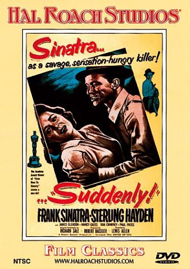
The script for Suddenly is a simplistic condemnation of pacifism aimed specifically at women. The entire first reel shows us young mother Ellen Benson, who lost her husband in Korea (fighting Reds) and now tries to keep her son Pidge from playing with guns. She thinks that she's trying to subdue his fighting instincts, but her father-in-law Pop undermines her judgment with the argument that Pidge must be raised to be a fighter in future wars, or just in life in general. Ellen's beau Sheriff Tod also feels it's his prerogative to override Ellen by buying Pidge a cap gun behind her back. Mom just doesn't get it - she simply doesn't understand that the world is a dangerous place and that men have to prepare for battle. Those freedoms we enjoy require constant vigilance and struggle, you know. Pop thought he was through fighting (he took a bullet near the heart defending the President and had to retire early) but all of the Bensons are put on the spot when John Baron commandeers their picture window to shoot the President (presumably, Eisenhower). Pop and Tod conspire to counteract the swaggering, ruthless Baron while Ellen mostly worries unhelpfully in a corner. Pidge is immature - he "threatens" Baron with his cap gun - but clearly has the right stuff. He's later tested when the cap gun proves useful in confusing the bad guys. What kind of cold-blooded ruthless killer is Sinatra's John Baron? He's the kind that needs to talk. Instead of hog-tying them on the floor with gags in their mouths, or even more logically, killing them, John Baron allows his hostages to roam freely and chit-chat. John Baron is supposed to be the best in his business but as soon as Sheriff Tod gets him talking, he starts revealing his neuroses and complexes in time-proven 50s psychodrama style. In this case, the seige analysis reveals Baron to be a hateful and selfish liar who likes to push people around for profit. While not particularly well made, Suddenly has the kind of built-in suspense factor that makes it hard to resist, which is why I won't go into the wild shenanigans that occur in the last few minutes before the President's train arrives. The ruthless logic of the opening (even though the potential witnesses are foolishly told the killer's full plans) gives way to a silly telegraphed trick using a broken television and Pidge's cap pistol. The tone of the standoff faults Ellen for wanting to survive, as Pop and Tod prepare for a showdown that will probably be a suicidal gesture, the kind that Real Men have to make. The impression is that molly-coddling mothers are the biggest problem facing America, as they might prevent young boys from growing up macho and joining the battle against Communist Evil. It's sort of a subdued version of what the Hitler Youth are shown going through in the Disney Docu Education for Death on the Disney Treasures The War Years on the Front Lines. Just like Grace Kelly in High Noon, Ellen eventually picks up a gun. "Your dead husband would want you to," says fast-talking Tod about letting her boy play with guns, and the implication is that Ellen ought to start conforming, fighting Commies and sleeping with Tod right away. Killer John Baron is just hired muscle for the presumed Commies who want our president killed, a gangster doing the job of an assassin-spy. We know this is so because Baron and Tod have a discussion about how careful Baron will have to be when the job is done - his foreign puppet masters will be anxious to cover their tracks. This leads into the overall assassination aspect of the story. Making movies about attempts on the life of a present-tense President weren't common, and this might have actually been the first. The Tall Target starred Dick Powell as an 1860s G-Man trying to protect Lincoln, but that had ninety years of history as a buffer. Suddenly has a conservative Republican president put in the crosshairs by unnamed foreign enemies, when the later real assassinations of the Kennedys were of a completely opposite persuasion - domestic killers hitting liberal Democrats. Sinatra of course continued into similar territory with 1962's paranoid conspiracy thriller The Manchurian Candidate, which has foreign Commies using carefully pinpointed assassinations to put their own deep-cover candidate in the White House, a candidate whose Conservative Red-hating personality is a sham. Legend has it that Sinatra, feeling somehow responsible for his friend Kennedy's assassination, had The Manchurian Candidate voluntarily removed from circulation. It was also rumored that Suddenly was pulled as well. To set the record straight, The Manchurian Candidate was pulled by producer Sinatra but the reason was financial, because of problems Sinatra saw in his deal with United Artists. Suddenly never really went away, it was just semi-abandoned to infrequent TV airings until it entered the Public Domain. As further argument against the "contrite Sinatra" theory, in 1967 Frank appeared in yet another movie about an assassin with a high-powered rifle, The Naked Runner. There he plays a businessman forced to carry out a killing on the autobahn (shades of Dr. Mabuse) when the bad guys kidnap his son. Sinatra wasn't morally opposed to stories exploiting deadly snipers. Put together at the same time as Sinatra's success with From Here to Eternity, Suddenly lets John Baron chew the scenery too much. At least five times, he walks into a close-up and delivers a ponderous speech to the camera. The relatively inexpensive show opens up what is really a one-set one-act, and it's possible that Sinatra had a bit too much control. The rest of the casting is fine, if a little obvious. Sharing top billing is the dependable Sterling Hayden, here a likeable pro who has a way with lines that might be wooden in less charismatic hands. Nancy Gates (Comanche Station) is excellent as usual, almost selling the author's thesis about meddling females. James Gleason (Here Comes Mr. Jordan) and Willis Bouchey are obvious as the agents, and king of the narrators Paul Frees is Sinatra's number one henchman. Image's release of Suddenly comes from Film Classics, a Hal Roach outfit. The print is better than okay and the non-enhanced transfer crops off nicely to 1:78 on a widescreen TV, so this should be a good show, especially with all the crummy PD versions around. But the movie here is visibly and annoyingly time-compressed. The whole film is there, but instead of being 76 minutes long, it's 72, indicating that it's a conversion of a PAL transfer for foreign use. The picture isn't badly affected but the pacing of fast scenes is ruined, with people darting too quickly around rooms. Worst of all, pitch is not corrected on the sped-up soundtrack. Everyone sounds shrill, artificial and staccato. In some of his speeches Sterling Hayden normally talks very quickly, and here he sounds ridiculous. Whenever I hear of some desirable American film coming out in region 2, I never react. Why would anybody want to watch a movie sped up by 4%? Would we tolerate our favorite old records reproduced that way? This is a shame because Suddenly is a film that won't be easy to find looking this good. Film Classics clearly meant to save money, but they've just made an inferior product. All the ad art for Suddenly uses an exclamation point on the main title, but the film itself does not.
On a scale of Excellent, Good, Fair, and Poor,
Suddenly rates:
Review Staff | About DVD Talk | Newsletter Subscribe | Join DVD Talk Forum |
|

| Release List | Reviews | Price Search | Shop | SUBSCRIBE | Forum | DVD Giveaways | Blu-Ray/ HD DVD | Advertise |