| Release List | Coupons | Shop | Reviews | SUBSCRIBE | Forum | Video Games | Price Search | Advertise |

| DVD & MOVIE REVIEWS |
|
|
 DVD TALK FORUM |
| REVIEWS & COLUMNS |
|
• DVD Reviews • Theatrical Reviews • Video Game Reviews • Adult DVD Reviews • DVD Interviews • The Aisle View • The Blue Room • Cinema Gotham • CineSchlock-O-Rama • DVD Savant
|
| SHOP |
|
• Adult DVD Empire • Amazon.com (DVD) • Buy.com • DeepDiscountCD • DeepDiscountDVD • DVD Empire • DVD Overnight • DVD Planet • Ebay • Half.com • HKFlix.com • HTMarket.com • Complete List of Stores |
| DVD RESOURCE |
|
• DVD Talk Forum • DVD Price Search • Store Ratings • Customer Service #'s • DVD FAQ • Regional Encoding Info • Search Toolbar • Links |
| DVDTALK INFO |
|
• About DVD Talk • Advertise • Contribute • Tell A Friend • Newsletter Subscribe • Join DVD Talk Forum |
 |
The Prime of |
|
The Prime of Miss Jean Brodie Fox Home Entertainment 1969 / Color / 1:85 anamorphic 16:9 / 115 min. / Street Date July 6, 2004 / 14.98 Starring Maggie Smith, Robert Stephens, Pamela Franklin, Gordon Jackson, Celia Johnson Cinematography Ted Moore Production Designer Brian Herbert, John Howell Film Editor Norman Savage Original Music Rod McKuen Written by Jay Presson Allen from her play from the novel by Muriel Spark Produced by James Cresson, Robert Fryer Directed by Ronald Neame |
The Prime of Miss Jean Brodie is the exact opposite of Jean Vigo's Zero for Conduct, the old French film about adolescent rebellion. Improving on her play, Jay Presson Allen presents a teacher who is a real menace to society. With Brodie's penchant for aligning herself with fascist dictators like Mussolini and Hitler, is easy to extrapolate the concept into a wider distrust of irresponsible political advocacy. This film is the career peak for the great Maggie Smith, that angular beauty still appearing on screen in the Harry Potter movies. It also represents the best work of the remarkable Pamela Franklin, who would certainly have become a major star if the British film industry hadn't cooled off in the early 1970s.
With veteran director Ronald Neame on board The Prime of Miss Jean Brodie is an intelligent and progressive - yet old fashioned - English film. Its strikingly original central character is known to each and every person who ever attended a school, the teacher that feeds his/her ego by encouraging the adulation of students. The fact that Jean Brodie seems like a flighty libertine doesn't make her a "dangerous liberal', for her philosophy is a crazy mess all across the spectrum. She's a sexual adventurer but also an ardent cheerleader of Mediterranean Fascists. She rhapsodizes over great art, extolling her favorite (Giotto) while dismissing famous names like Leonardo da Vinci. Brodie feeds her impressionable schoolgirls maudlin, probably faked romantic reveries, instilling daydreams of passion and doomed affairs. 1 She encourages her schoolgirls to conspire with her against the school's straight-laced but likeable headmistress.
In 1969 we inexperienced teens thought Jean Brodie represented leftist radicalism, when she's really a Fascist. Fascism exalts the idea that there are natural, born leaders among us who have rights higher than the average man. The rules don't apply to them. Of course, Jean places herself at the top of this heap. Self-appointed leaders sometimes have charisma and social skills that gather followers (like movie stars, perhaps?) but more often than not simply have a knack for exploiting positions of power. Mussolini used a newspaper as his pulpit and Jean Brodie uses/abuses her authority in the classroom. She flaunts that authority by dictating every detail of the schoolroom experience, down to how many inches the windows should be left open. All attention must be focused on her and all appreciation filtered through her. If something is good, it's not good for its own sake but because Brodie says it is so.
Headmistress MacKay (played by the great Celia Johnson of Brief Encounter) initially comes off as the enemy, someone to be fooled and derided. Miss Brodie is bright, surprising and easy to find amusing so we naturally side with her. Brodie's girls dote on her, notably the Brodie Four led by the precocious Sandy. Brodie tries to mold them into extensions of her own personality, "assigning" them qualities as if they were born to fulfill roles predetermined by her. In Brodie's egoist world, Mary Macgregor (Jane Carr) is the dim but loyal footsoldier. Sandy is the dependable secret agent, good at covering for Jean's subterfuge. Things become perverse when Jean nominates Jenny (Diane Grayson) as a "lady of affairs," encouraging her to become the lover of the school's art teacher. These kids from sheltered backgrounds naturally accept Brodie's authority. Even as they mature, only Sandy sees things for what they are. Only she questions the status quo.
Petty politics are the order of the day. Mrs. MacKay gathers gossip in hopes of an excuse to dismiss the teacher, but Jean's outraged defense overwhelms her. Meanwhile, Jean's personal life is a mess. Too egotistical to deal with a man on equal terms, Brodie toys with the adulterous art teacher and the foolish music master until they're both eating out of her hand. She's not after security, because the rich Mr. Lowther could provide that. he prefers that poor Mr. Lloyd to suffer from afar, to better enrich her self-styled legend.
The story finally becomes overtly political in an episode involving the Spanish Civil War that shows how dangerous a teacher's influence over her students can be. And Sandy finally comes to a conclusion about Brodie that puts her in the role of "assassin." It's a stagy but impressive finale that held 1969 audiences breathless.
Maggie Smith is a wonder as Jean Brodie, her expansive personality easily leading the average viewer astray. Another actress would let the loud wardrobe and the brogue do the work; Smith puts a spirit behind Brodie that is undeniably sympathetic. Her Brodie is a "character" that can't be reasoned with.
With this film Pamela Franklin graduated from child actor to adult star in one fell swoop. She has a nude scene that upstages Hayley Mills in 1966's The Family Way. It's so discreet and civilized that won the approval of the rube audience I saw the film with (me included). After an initial gasp, that is; the movie was a good example of nudity that was rightly given a PG rating. Franklin covers a range from age twelve to eighteen quite convincingly, and delivers her dialogue with such precision and impact that it's obvious she could play anything.
Robert Stephens (The Private Life of Sherlock Holmes) and Gordon Jackson (The Great Escape) are the spineless men in Jean Brodie's life. Marcia Blaine school is a definite matriarchy and there's sufficient ambiguity in the characterizations to make it a great discussion tool: Who's right and who's wrong? Headmistress MacKay eventually wins our vote by default - Brodie is too much of a hazard. MacKay uses prudery against Brodie because it's the only weapon she has. 2
Of the dramas and screenplays that make a case for informing, The Prime of Miss Jean Brodie is the most compelling. As Sandy asserts, Brodie shouldn't be around impressionable little girls and someone has to put a stop to her. Children need exposure to spirit and individualism, but not Brodie's narcissistic manipulation. Too much inspiration quickly becomes indoctrination.
Fox's Studio Classics DVD of The Prime of Miss Jean Brodie does this genuine modern classic proud. The color is far more accurate than earlier videos and Rod McKuen's haunting melodies (from back when movie music had original melodies) are well recorded - television prints tended to warble on those sustained notes in the main theme.
Ronald Neame is still going strong in his 90s and fills commentary track with precise memories, like holding auditions by having hundreds of girls giggle, twenty at at time. With him on the track is Pamela Franklin, who concentrates on this movie and not her kiddie career in weird films like The Innocents ("I became typecast as the evil child!"). She remembers the relative tyranny of the set, with assistant directors entreating her not to speak to the director unless spoken to, even though she had third billing.
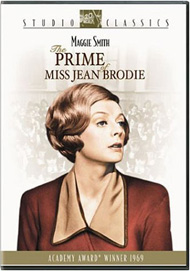
There's also a theatrical trailer and a still gallery. Fox has put an image of Maggie Smith on the cover; she won the best actress Oscar for the role.
On a scale of Excellent, Good, Fair, and Poor,
The Prime of Miss Jean Brodie rates:
Movie: Excellent
Video: Excellent
Sound: Excellent
Supplements: Commentary, Stills, Trailer
Packaging: Keep case
Reviewed: July 1, 2004
Footnotes:
1. The romantic title song would seem to be a valentine from "Hugh of Flanders Field," the lover-for-the-ages who is for Jean conveniently where he belongs, six feet under.
Return
2. Miss MacKay's secretary Miss Gaunt (Ann Way) is one heck of a weird character, a constantly-alert woman with huge eyes - all pupil, no iris - that make her look like the sister of The Man With the X-Ray Eyes. It's hard to tell if she's like that or if they gave her false contact lenses!
Return
|
|
| Coming Soon |
|
|
| Special Offers |
|
|
| Columns |





|
| Home | Release List | Coupons | Shop | Reviews | Forum | Video Games | Price Search | Advertise |