| Release List | Reviews | Price Search | Shop | Newsletter | Forum | DVD Giveaways | Blu-Ray/ HD DVD | Advertise |

| Reviews & Columns |
|
Reviews DVD TV on DVD Blu-ray International DVDs Theatrical Reviews by Studio Video Games Features Collector Series DVDs Easter Egg Database Interviews DVD Talk TV DVD Talk Radio Feature Articles Columns Anime Talk DVD Savant HD Talk Horror DVDs Silent DVD
|
 DVD Talk Forum |
|
|
| Resources |
|
DVD Price Search Customer Service #'s RCE Info Links |
|
Columns

  

|
 |
Incubus
|
||||
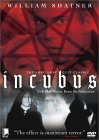
Famous as the 'lost Esperanto masterpiece' of Leslie Stevens, the oddball writer-producer who created the television series The Outer Limits, Incubus just barely survived being truly lost for all time. Everything about this picture is haunted and strange, from the way it was shot to the fates of its actors.
In the land of Nomen Tuum, Marc (William Shatner) lives a happy existence with his sister Arndis (Ann Atman), trying to forget his war experiences. But evil forces are afoot in the form of a pair of succubi, whose Earthly mission is simply to harvest corrupt men. Ambitious phantom Kia (Allyson Ames) makes the mistake of seducing a Good man, Marc (William Shatner) and falling in love with him. In retribution, her superior Amael (Eloise Hart) dispatches an Incubus (Milos Milos, aka Milosevicz) to attack the innocent Arndis. Why would anyone want to shoot a movie in Esperanto, that living-dead generic romance-based language promoted by the United Nations as a possible One-World universal tongue? Savant knows the answer immediately, having shot his UCLA project 2 in Spanish language back in the 1970s: to aestheticize and abstract the 'text' of the movie. Ever notice how foreign films are slightly distanced by the language barrier? We have to read the movie, an active role, instead of just passively watching it, and reading words actually makes us more susceptible to ideas than watching literal actors saying literal lines. The film plays at a perceptual remove, where even a silly story seems more serious. 2Leslie Stevens wanted to tell an allegorical story, the kind where people don't say realistic dialogue because they are obviously meant to represent ideas, and not be real people in the real world. When you have actors on a stylized stage, the barrier to this kind of drama is already down, but with real movie actors in real settings, the abstract speech comes off as preachy, forced. This problem brings down many a self-important movie. 3 By removing the necessity of sustaining a naturalistic veneer to his film, Leslie Stevens jumps right to this elevated plane, transporting us to a strange world of moral conflict.Incubus was made practically as an offshoot from The Outer Limits, which itself had a number of episodes which were abstract to the point of total confusion. The artistically ambitious Stevens took his favorite Limits cameraman, Conrad Hall to the Big Sur locales and created what looks like a Satanic passion play as envisioned by Ingmar Bergman, but with fewer introspective closeups. Dominic Frontiere music cues from the television show were repurposed, and with the capper of a 'Control Voice'- like narrated introduction, the sense of deja-vu is striking. As a horror film Incubus is unique. The shallow seriousness of William Shatner is nowhere near as impressive as in Corman's The Intruder, but he's still very moving. These demonic women are an excellent horror threat of the repressive, conservative kind that identifies sensuality with Evil. Our hero is too good to be suspicious of Evil until it is too late, and the dark implication is that there is something amiss with the idea of an affair with a beautiful stranger. Morally speaking the tale is more than a little oppressive, but the stylized performances draw us in. The succubi are strange creatures with very human egos and problems. But they're no creampuffs - - they drown hapless mortals for sport. Unpredictable yet familiar, Incubus has a frightening rape scene, and the suffering of Marc's innocent sister demands our sympathy. The movie was never released in America and for decades survived only as a rumor. Leslie Stevens' daughter worked at Cannon Films for a while in the late '80s, and when we were tipped to her identity, the first thing Todd Stribich and I asked her was if her father had a print of the movie. She had never seen it herself, and was terribly curious about it at the time. 4 This is a major rediscovery for all of us.Video Watchdog magazine offered a great article in 1999 1 about the producer's struggle to revive the movie. The elements were all vaulted at a lab called C.F.I. in Hollywood, which any film student could tell you was the kiss of death: It was always extremely disorganized. If your friend's dailies couldn't be located, CFI was Can't Find It. If your dailies were lost, it was Chicken F%#& Incorporated. The producer left his original negative, from which a very few screening copies were made, at CFI and returned 27 years later expecting it all to be safe and sound ... and of course the whole thing was long gone. A French print was located and used to make a video transfer element, with the unfortunate side effect that large black boxes had to be superimposed on the screen for the English subtitles, to cover up the burned-in French ones. (There's always a drawback, isn't there? Brenda Starr is of course in absolute perfect shape ... but if Savant likes a movie ...)Also noted in most discusssions of Incubus is the strange fate that befell the largely unknown cast. Shatner immediately stepped into history on the bridge of the Enterprise but the rest of the very interesting group had fates as strange as the movie itself. Allyson Ames made just a few more films. The intriguing Ann Atmar took her own life less than a year later. And Milos Milos died in a notorious murder-suicide, also in 1966, with Mickey Rooney's fifth wife. Fox Lorber's DVD of Incubus is the same good master used for the VHS that came out a year ago. Conrad Hall's very interesting photography looks simply terrific, making us want to see those great old Outer Limits episodes again. The extras on the DVD will make VHS purchasers want to revisit the title. A video interview is provided with producer Taylor and cameramen Conrad Hall and Bill Fraker; it's terribly edited but interesting anyway. Interviewer David J. Schow (author of the fascinating Watchdog article) talks too much and Conrad Hall not enough. A commentary is included with the three above, and a second with actor William Shatner that will surely draw fan interest. A special 'Curse of Incubus' menu choice unfortunately puts the demise of Leslie Stevens' production company on the same level as the spooky deaths of its cast members. The best extra is an entire second copy of the film, the French-subtitled version, which, if you read French, has the advantage of not having the obscuring black boxes that sometimes hide actors' mouths.
On a scale of Excellent, Good, Fair, and Poor,
Incubus rates:
Footnotes:
1. Video Watchdog #53, 1999.
2. Try watching Mothra, a Japanese fairy tale monster movie, dubbed. It's almost embarasssing to be be caught in the same room with it. In the original Japanese it's another experience altogether, utterly charming. It's the 'foreign-ness' of the language barrier that removes the immediate reflex to judge, pigeonhole and dismiss the so-called puerile story of a giant moth and its tiny princess guardians.
3. The mood and sincerity of Herk Harvey's Carnival of Souls almost but not quite sustains a story where all the actors must speak a constant line of ponderous, 'meaningful' dialogue. Genre conventions go a long way toward making this kind of dialogue work, by providing an abstract proscenium where the story can be more ritualized. Gunfighters practically talk in poetic cadence in Sergio Leone's Once Upon a Time in the West. We accept the action as taking place on an elevated plane of existence.
4. She may have been Allyson Ames' daughter, I'm not sure. It's a good date line: "Have I told you that I'm the daughter of a succubus from Hell?"
|
| Coming Soon |
|
|
| Special Offers |
|
|
| Columns |



|
| Home | Release List | Coupons | Shop | Reviews | Forum | Video Games | Price Search | Advertise |