| Release List | Reviews | Price Search | Shop | Newsletter | Forum | DVD Giveaways | Blu-Ray/ HD DVD | Advertise |

| Reviews & Columns |
|
Reviews DVD TV on DVD Blu-ray International DVDs Theatrical Reviews by Studio Video Games Features Collector Series DVDs Easter Egg Database Interviews DVD Talk TV DVD Talk Radio Feature Articles Columns Anime Talk DVD Savant HD Talk Horror DVDs Silent DVD
|
 DVD Talk Forum |
|
|
| Resources |
|
DVD Price Search Customer Service #'s RCE Info Links |
|
Columns


|
 |
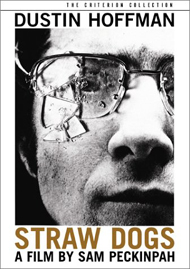
Straw Dogs
|
||||
The cult of Sam Peckinpah has waned of late mainly because the excesses of violence that marked his best films have long since been eclipsed by decades of graphic action films. But none can touch Peckinpah's best work, because he had a theme and an attitude that were more important to him than success itself. Violence eventually became his only stock-in-trade. There's no denying that his masterpiece The Wild Bunch is a film torn between character study and a glee at blowing away audience preconceptions of what real killing is like. Peckinpah made a name for himself by pontificating on the subject of violence for every reporter and interviewer he met. After cleaning house with the Western traditions of John Ford, Peckinpah's next major move was to England, to make a violent fantasy central to his personal philosophy and more accessible to contemporary audiences. 1971 was the year that the production code taboos were finally broken in creative ways, where excess didn't necessarily mean exploitation - in pictures like The Devils and A Clockwork Orange. Unfettered by good taste or studio conventions, Sam fashioned a nasty tale that waved male rage around as a challenge to the universe. Some of Straw Dogs is just as poorly judged as Peckinpah's later, patchy work, but for the sheer power to rev up audience bloodlust, there had yet been nothing like it.
Savant saw (the shorter American cut of) Straw Dogs at least five times on its release in 1971; I had just become a life convert to The Wild Bunch and was eager to bolster my longhaired, unemployable film-student impotence with a strong dose of Peckin-testosterone. I soon stopped attending the kind of films that attracted audiences in need of violent catharsis, but the screenings of Straw Dogs I remember were marked by genuine bloodlust from theaters-full of people who shouted at Dustin Hoffman to blow people away. I remember hearing cries of, 'Kill the bitch!' more than once. Peckinpah impressed critics and producers with his gift of directing ordinary scenes with uncommon sensitivity, and his effortless creation of tension and conflict. Some of his highest praise was earned for television shows like The Westerner and the TV play Noon Wine. To its credit, Straw Dogs retains the same quality, a sharp dramatic edge that grabs the attention and holds on tight. The introduction of the basic situation in the Cornwall town, with its jobless malcontents and bitter pub crawlers reacting with predictable meanness to the intrusion of wimpy American Dustin Hoffman, is economical and effective. Susan George's insolent cheap-tease Amy Sumner may inflame feminists, but Peckinpah and scenarist David Zelag Goodman (The Stranglers of Bombay) deserve credit for having the guts to depict such a destructive female character. PC or no PC, created by male oppression or not, Amy Sumners do exist, and their taunting can indeed cause havoc. Straw Dogs even offers an Amy Junior character, a younger local tease who clearly sees the American's wife as a role mode. In a screenplay perhaps a little top-heavy with symbolic portent, the two of them are introduced carrying a giant iron man-trap, the kind used to catch poachers. This teen tease is associated with the village kids seen playing in a graveyard, continuing the Buñuel- Los Olvidados link to The Wild Bunch: children are neither innocent nor virtuous by nature. Straw Dogs boils twin pots of discontent. Troublemaker Amy stirs up bad vibes at home with her taunts and jabs at David's lack of macho possessiveness. A generic 'intellectual' meant to symbolize liberal non-violence and tolerance, poor David is the repository for everything Peckinpah sees as lacking in modern Americans - he's a cheek-turning wimpus who doesn't understand that this 'older' (and by Straw Dogs' thin logic, more primitive) culture operates on an Alley Oop level of brute force. And Amy is no different: repeatedly compared to the cat, she saunters and flaunts herself in petulant protest. If Peckinpah used his Westerns to disembowel John Ford's notion of an honorable and utopia-building society, he here does a hatchet job on the quaint fantasies of The Quiet Man. The other source of tension in Straw Dogs is the excellently rendered social situation. An editor friend of mine was in Ireland dating a local girl - the local 'lads' let him buy beers at the pub and then showed their contempt by battering his rental car to an un-drive-able pulp while he slept. Peckinpah's quaint town has its sheriff-like constable and its ineffectual churchman, but neither can control the 30ish young men, frustrated by unemployment and ready to lash out to take what they want. Even if Amy had handled the situation better, she and David might still expect trouble, but her ambivalence towards the attentions of Charlie Venner (Del Henney) invites sexual violence. Charlie's friends vary in their hostility and charm; one is a 'ratter' who goads the others on. And they have backup in the drunken Tom Hedden, an aging beast of a man. The maladjusted Tom baits the constable and threatens to brain the bartender over a pint of spirits. Like papa Clanton in My Darling Clementine, Tom's rebelliousness gives the younger men an authority figure to help them set aside their better natures. They don't need to be united by blood oaths like the Hammonds or the Confederates of Major Dundee - they're an informal group of similarly resentful louts. The second act shockeroo is a rape scene that, even when trimmed, was rougher than anything yet seen on American screens. Amy clearly wants Venner to attack her, a nasty gauntlet Peckinpah throws at the foot of the then-new feminist movement. She pays dearly when a second rapist moves in to violate her anally - with her previous 'beau' held off at shotgun point. She's thus damned thrice over as 1) a pussy tease (pardon) to poor cuckolded David, 2) a faithless bitch in her open invitation and eventual welcoming of rape, and 3) the worthless tramp who is given what she deserves in the roughest way possible. Pauline Kael, if I recall correctly, labeled Straw Dogs a fascist film for this scene, setting it next to Dirty Harry as a manipulative counterattack on liberal values. Unfortunately, violence and sexual sadism were a winning combo that year. The action predictably spirals to a bloodbath -- the situation is credible enough, and complex enough, to engage any viewer. The trigger turns out not to be Amy, but Henry Niles, a mental deficient and town fool. Like Steinbeck's Lennie, and perhaps inspired by the sexual violence all around him, Niles accidentally kills a young girl. The necessity of protecting Niles from Tom Hedden's lynch mob provides American Sumner with the moral hook that all Americans seek -- the pretext to take a stand for rigid righteousness. David Sumner defends his self-identity with stubbornness and then with grave oaths - the kind that in Peckinpah's world can lead only to violent death. Hedden's lynch mob lays siege to Sumner's strong-as-a-castle stone house. David learns the truth about Amy's connection to the boys outside when she tries to let them in. Alley Oo - I mean David - grabs Amy by the hair and orders her upstairs. He locks Niles in the bathroom and prepares for battle. "I will not allow violence against this house" is Sumner's oath, one that every Anglo-American male has entertained when contemplating riots or civil insurrection. David's not flush with guns, but he's got a massive door that can't be battered in, water and lye to boil, and a number of other improvised weapons to wield. With the entire audience behind this Lochinvar as he battles foes outside and an intimate traitor within, the stage is set for a killing spree we can all get behind ... as in United We Stand. The ending is a hip combination of directorial strength and weakness. Amy gets left behind with a houseful of stiffs while David takes Niles to the authorities, mumbling a fairly lame 'I don't know where home is anymore' line that tries too hard to be enigmatic. Straw Dogs' excellent character direction is periodically undercut by a new Peckinpah tendency to lean on obvious symbols and lame directorial touches, such as the 'clacking ball bearing' novelty item on David's desk. As David and Amy argue, it clacks away as a detail in the frame, an okay echo of their conflict. Peckinpah ruins the moment by later cutting to it for a close-up, grabbing us by the back of the neck and pushing our noses into his symbol. Bad form, and the sign of a director who's now decided he's an 'auteur'. But this violent film heightened and honed Peckinpah's montage cutting to delirious heights. When the distraught post-rape Amy sits with her husband watching a miserable church variety show, Peckinpah and his editors inter-cut violent flashbacks to the rape with Amy's reactions to the performances onstage, raising the tempo until the tensions in the cross-cut scenes bleed into each other. It's showy, but it works like a charm. 1 In 1971, the dynamic flow of violence was hypnotizing, sustained for a full reel and more intense and less lyrical than the aesthetic ballets of death in The Wild Bunch. Seeing the film again in 1980, it still carried a basic, undeniable kick. But action cutting has become so fast in recent years, with martial arts and crime films artificially stimulating us to higher levels of agitation, that it's possible that jaded 2003 viewers might wonder what the fuss was about. I still think the immediacy of a drunk getting his foot blown off, and the identifiably real idea of being snared and wired to a window casing lined with jagged glass, still carries a jolt. 2 For Savant, Straw Dogs is Peckinpah's last good violent film. The pretension factor and a cartoonish awkwardness cripple The Getaway until the slow-mo bullet count takes over. Junior Bonner is a fine low-key drama, but still burdened with post- Hud pretensions. After that, there's the out-of-control lunacy of Bring Me the Head of Alfredo Garcia. With its 'Poe meets Harry Dobbs' mayhem Garcia should have been a classic, but it instead plays like a crude plea to Stop Me Before I Direct More Movies. Unlike many, I see only a few scattered grace notes in Pat Garrett and Billy the Kid. The rest is repetitive boredom and more pretension. The Killer Elite is a bad self-parody, and the ambitious Cross of Iron a disappointing muddle. Straw Dogs is ugly and morally questionable, but it's still Peckinpah working at the height of his powers, expressing his antisocial outrage in original and interesting ways. Criterion's Special Edition DVD of Straw Dogs will hit the spot for the Peckinpah faithful. The transfer is excellent, eclipsing the earlier Anchor Bay disc that came out before that company had established its high standards. The extras are many and thorough, starting with a scholarly audio commentary. There's an isolated music and effects track that will partly compensate for my foolishly trading in my old laser disc with its discrete Jerry Fielding score. Two new interviews debut here with Susan George and producer Daniel Melnick, yet another faithful Peckinpah supporter he self-destructively turned against. The 1974 Playboy Peckinpah interview is reprinted, and another gallery includes his acidic responses to film critics and ordinary viewer criticism. A featurette from the time profiles Dustin Hoffman, and shows Peckinpah directing (he looks deceptively sane). What looks like material for an unfinished show is some raw B&W behind the scenes footage. There are also some trailers and TV spots. The big show is a strong 82-minute docu called Sam Peckinpah: Man of Iron produced by the BBC and partly line-produced by Katy Haber, Peckinpah's frequent assistant in the 70s. She and a dozen other actors, writers and Sam fans (like Mort Sahl) paint a picture of a beloved unholy monster. Writer James Silke's testimony of his attempts to revive the broken director is heartbreaking, but many of the others revel in explaining what an all-consuming rattlesnake Peckinpah was. James Coburn laughs, Kris Kristofferson offers songs (good ones) to Sam's vices, and actor R.G. Armstrong will shake your television with his earth-shattering oratory. A disclaimer up front explains that the docu has necessarily been shortened by the removal of almost all its film clips from studios that would ask a killer's bounty for their use. The deletions make the docu easier to watch for Peckinpah fans that have seen the films so often we resent having them interpreted for us. Likewise, Jason Robards' lighthearted reading of selected Peckinpah letters works much better than the fawning, adulatory attitude struck by Ed Harris in the Wild Bunch short subject from a few years back. By all accounts Peckinpah was a great talent who could easily have parlayed his cult popularity into a much more prolific and rewarding career. Drugs, drink, paranoia and an inability to get along with people short-circuited all that, and we're left contemplating his masterpieces, embarrassments, and the ruins of a few pictures that can still be restored.
On a scale of Excellent, Good, Fair, and Poor,
Straw Dogs rates:
Footnotes:
1. Peckinpah intended to use this cutting pattern for the legendary deleted opening to Major Dundee, where an Apache raid interrupts a frontier Halloween party. Kids run around dressed as ghosts and Indians, as adults carouse and soldiers sing, all inter-cut madly. Glimpses of very-convincing Apache makeup are also seen, and then it is suddenly revealed that real Indians have infiltrated the party. We're as surprised as the rapidly-slaughtered homesteaders and soldiers.
2. Feature film editor and pal Steve Nielson found another big difference between the fast cutting here and in contemporary films. Peckinpah's violent cuts use mostly static, often locked-down angles. There's motion on masters, yes, but not the 'every cut is a movie unto itself' Michael Bay ethic. This can be good when the angles are rightly chosen, but a few details of the final battle become confusing. Despite Peckinpah's attempt to spell everything out clearly, we're not always sure how many assailants are still functional, where they are, or who they are.
Review Staff | About DVD Talk | Newsletter Subscribe | Join DVD Talk Forum |
|

| Release List | Reviews | Price Search | Shop | SUBSCRIBE | Forum | DVD Giveaways | Blu-Ray/ HD DVD | Advertise |