| Release List | Reviews | Price Search | Shop | Newsletter | Forum | DVD Giveaways | Blu-Ray/ HD DVD | Advertise |

| Reviews & Columns |
|
Reviews DVD TV on DVD Blu-ray International DVDs Theatrical Reviews by Studio Video Games Features Collector Series DVDs Easter Egg Database Interviews DVD Talk TV DVD Talk Radio Feature Articles Columns Anime Talk DVD Savant HD Talk Horror DVDs Silent DVD
|
 DVD Talk Forum |
|
|
| Resources |
|
DVD Price Search Customer Service #'s RCE Info Links |
|
Columns

  

|
 |
Never on Sunday
|
||||
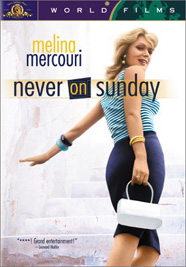
A big hit, at least in art house terms, Never on Sunday is an entertaining but dated star vehicle for Greek powerhouse Melina Mercouri and the music of Manos Hadjidakis. The song is by now much more famous than the movie, which was considered daring in 1960 because it openly courted the (not very tenable) assertion that prostitution was natural and healthy. Despite nice location shooting and atmosphere, this broken-down fable never faces its own issues. But it charms audiences immediately with its infectious music and charismatic leading lady. The movie is a valentine to Greece. American writer and Greco-phile Homer (Jules Dassin) comes to Pireaus in search of philosophical truths and dedicates himself to the reform of Illia, an earthy, independent and very popular prostitute (Melina Mercouri). The local pimp-master wants Illia out of business so he can continue to charge high rents to the rest of his girls. Homer uses the gangster's money to buy all of Illia's time, and dedicates himself to her re-education. Illia's steady/possible boyfriend Tonio (George Foundas) doesn't mind, as Homer's attentions are platonic, but her customers don't like the 'closed' sign on her door. Director Jules Dassin had perhaps the happiest story of any blacklisted Hollywood director: after kicking around Europe trying to stay afloat, he had a monster hit bigger than anything he'd done in America, Rififi. This enabled him to make the kind of personal films he would never have been able to do back home, and it also led him to Greece, where he wooed the love of his live, fiery actress (and later politician) Melina Mercouri. Dassin was a liberal firebrand whose films Thieves' Highway and Brute Force are grim criticisms (if not accusations) against American business and justice. In exile in England, he made one of the most extreme films noir, Night and the City. Two films after Rififi had highly politicized scripts. By contrast, Never on Sunday is a vehicle meant to make Melina Mercouri an international star. Compared to his earlier films, it has no politics. Illia is the free spirit of Piraeus, a happy hooker who beds hundreds, loves life and resists the advances of a half-Italian ship worker who wants to take her out of the business. We see dozens of sailors and dockworkers that appear to have no families or wives, and just happily visit the prostitutes, of whom Illia is the queen. The local Uzo hangout is an all-male dive where Illia seems to be the only woman with visiting privileges; being plump and unsightly, the other prostitutes would mar the film's idyllic veneer. The only activity we see them doing is organizing a labor action (so there is some politics here after all) against their landlord-pimps. It's a squeaky-clean life of sin without alcoholism, drugs, crime, blackmail, or even visible sexual activity. There's also no sign whatsoever of the Church in this fairy-tale story. We do see Illia take one homesick English sailor to bed. She treats him so tenderly, we think she's going to start reading him Winnie the Pooh. Illia has her Sunday (the day off) boyfriend, and their scenes are a little earthier. Following the example of Never on Sunday, prostitution is the solution to all problems. I guess when the women become too old to work, the Mediterranean breeze blows them away, like the elephants and hippos in Fantasia. Whether jumping into the harbor in her underwear or facing off with any man in port, the confident and hearty Melina Mercouri makes all this foolishness work on the surface. Mercouri has very hard, extreme features, and an occasionally scary smile, but her eyes flash with a playful fire that always looks authentic. She also has a natural feminine grace of movement that's not dainty in any way -- it's completely opposed to the rules of discreet femme deportment. This makes her seem very modern, even when the story is a crock. Illia stands on her own two feet, is not ashamed of her body, and takes nothing from nobody. Director Jules Dassin must have enjoyed acting; he's excellent in his Rififi role. As a rule, it doesn't bode well when husbands direct their own wives, and Dassin goes a step further here and acts a major role as well. I doubt anybody encouraged him to continue (he has a smaller role in his delirious romance Phaedra, again starring Mercouri). He's certainly not very good-looking, but he is lively in kind of a broad way, popping his eyes at this and that and following Mercouri around like a lost dog. (spoiler) Screenwriter Jules Dassin turns the usual reformer script upside down. We fully expect Homer's Pygmalion-like education to make a big change in Illia's life, but she rejects cold culture in favor of the old, harmonious ways, and Homer is eventually sent packing. As Tonio carries Illia away, Homer finally realizes he did want her body all along, making nonsense of his professed commitment to philosophical truth. Homer's supposed higher ideals are a life-killer anyway, as shown when he stupidly demoralizes the local top musician because he can't read music. It's a 100% victory for Illia and her primitives, who at least know how to live. Not that audiences ever paid attention to any of these concerns, as the film has a constant background of seductive Manos Hadjidakis music so attractive and catchy, it would transform any picture into a feel-good hit. The film is practically a musical, with Mercouri singing the title tune 1 and a lusty dance or song coming along every ten minutes or so. The only film with a more inseparable score is Carol Reed's The Third Man. Dassin, Mercouri, Hadjidakis and UA gave us another notable film, the comedy-thriller Topkapi. The other minor success of Never on Sunday is actor Titos Vandis, a swarthy Zorba stereotype who found many European roles before coming to America for bits in Everything You Wanted to Know About Sex and The Exorcist. His face became familiar in American television series and commercials, too. MGM's DVD of Never on Sunday is a pleasing non-enhanced transfer that looks too cramped when cropped to 1:78. The image is in excellent shape and exhibits little noticeable damage or signs of age. The soundtrack, which was often distorted on older VHS releases, is cleaner as well, but this may be the result of digital tricks as opposed to the location of a better sound element. There's a trailer that touts Dassin as the director of Rififi and the relatively obscure He Who Must Die!. Alternate tracks are offered in French and Spanish, but a quick listen to either makes one miss Melina Mercouri's throaty but youthful voice. Subtitles are removable, for those who understand Greek ... large portions of the film are in English, by the way. The cover photo appears to be authentic but doesn't remind us of the movie -- Mercouri's Illia doesn't flirt and isn't coy, so the otherwise pretty image comes off as false.
On a scale of Excellent, Good, Fair, and Poor, Footnotes:
1. Translated from Greek, the title song appears to have nothing to do with 'Sunday'. The naughty 'never on sunday' title may have been a clever United Artists marketing ploy imposed on the film via the rewritten
English lyrics. Never on Sunday was released through UA's side-entrance distribution arm, Lopert, the art house moniker given racy or gruesome product, like UA's import of Eyes Without a Face, The Horror Chamber of Dr. Faustus. When Billy Wilder's Kiss Me, Stupid ran into censor trouble, UA avoided direct controversy by using the Lopert label to disassociate the makers of The Greatest Story Ever Told from a film Condemned by the Catholic Church.
Note from Matt Hough, 7/08/03: Did you know that Dassin, Mercouri, and Hadjidakis turned the movie into a Broadway musical? Illya Darling was nominated for six Tony Awards in the 1967-1968 season (won none) and ran 318 performances, not long enough to turn a profit but long enough to generate a cast album that's today one of the rarest of all Broadway LPs. The film's title song was used in the stage score, but the rest of the songs were all-new with lyrics by Joe Darion. Orson Bean played the part on stage that Dassin played in the movie. Dassin also wrote the book for the musical and directed the show on stage. Sincerely, Matt Hough
Review Staff | About DVD Talk | Newsletter Subscribe | Join DVD Talk Forum |
|

| Release List | Reviews | Price Search | Shop | SUBSCRIBE | Forum | DVD Giveaways | Blu-Ray/ HD DVD | Advertise |