| Release List | Reviews | Price Search | Shop | Newsletter | Forum | DVD Giveaways | Blu-Ray/ HD DVD | Advertise |

| Reviews & Columns |
|
Reviews DVD TV on DVD Blu-ray International DVDs Theatrical Reviews by Studio Video Games Features Collector Series DVDs Easter Egg Database Interviews DVD Talk TV DVD Talk Radio Feature Articles Columns Anime Talk DVD Savant HD Talk Horror DVDs Silent DVD
|
 DVD Talk Forum |
|
|
| Resources |
|
DVD Price Search Customer Service #'s RCE Info Links |
|
Columns

  

|
 |
House of Wax |
|
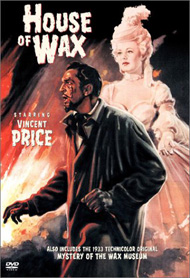
House of Wax Warner Home Entertainment 1953 / color / 1:37 full frame / 90 min. / Street Date August 5, 2003 / 19.98 Starring Vincent Price, Frank Lovejoy, Phyllis Kirk, Carolyn Jones, Paul Picerni, Roy Roberts, Angela Clarke, Paul Cavanagh, Dabbs Greer, Charles Buchinsky Cinematography Bert Glennon, Peverell Marley Art Direction Stanley Fleischer Film Editor Rudi Fehr Original Music David Buttolph Written by Crane Wilbur from a play by Charles Belden Produced by Bryan Foy Directed by André De Toth |
Savant's never been a huge fan of this breezy thriller, as it wasn't very scary when we saw it on television. Vincent Price's horror makeup is too clearly revealed at about the midpoint, which dulls the impact of the climax. For the first time, however, we see Price at his full power, chortling over his victims and making morbid speeches about art and destiny. There's an attempt to get some quaint charm from the thick-headed cops, who come roaring to the rescue in horse-drawn wagons. The film is without a strong male lead, leaving Price with no real competition. Sincere but colorless cop Frank Lovejoy struggles to find out what we already know, and the female lead's boyfriend almost gets his head lopped off in a guillotine. A young Carolyn Jones is fine as an unlucky girlfriend, and an even younger Charles Bronson (billed as Buchinsky) is instantly recognizable as granite-faced, deaf mute henchman.
The original big draw was the 3-D gimmick. Savant saw a 1971 reissue at Grauman's Chinese. I thought it was the true old-fashioned Polaroid system, but it wasn't. It looked pretty good anyway. The frequent lunges at the camera during fights, and obvious gags like the paddleball barker at the front of the Wax Museum worked well, but the really effective scenes were the opening conflagration and some atmospheric fog scenes about halfway through. The fog appeared to extend into the theater, just as claimed in the propaganda, making us feel as if we really were in a dark nighttime street. The original directional stereo sound helped, too.
Phyllis Kirk, a fine actress is often misidentified as being one of the original Lois Lanes in the Superman television show - that was Phyllis Coates; and the man behind the camera of this 3D extravaganza was André De Toth, a noted one-eyed film director.
|
|
Mystery of the Wax Museum Warner Home Entertainment 1933 / color / 1:37 full frame / 77 min. / Street Date August 5, 2003 / 19.98 Starring Lionel Atwill, Fay Wray, Glenda Farrell, Frank McHugh, Allen Vincent, Gavin Gordon, Arthur Edmund Carewe Cinematography Ray Rennahan Production Designer Art Direction Anton Grot Film Editor George Amy Original Music Cliff Hess Written by Carl Erickson, Don Mullaly from a play by Charles Belden Produced by Henry Blanke Directed by Michael Curtiz |
The real thrill in this two-movie set is Mystery of the Wax Museum, the Michael Curtiz version made twenty years earlier. Set in contemporary New York, this version has smooth-talking Lionel Atwill for its horror star, waxing enthusiastic over the beauty of gorgeous Fay Wray. The script has a great mix of German-expressionistic visual touches, contrasted with early Warners wisecracking banter supplied by the unstoppable Glenda Farrell, an almost-forgotten leading lady who would soon be eclipsed by Joan Blondell. Many horror purists decry the smart talk, but the pre-code attitude (at one point she comes this close to saying, 'Son of a b ...') is delightful, especially the way Farrell stands up to her verbal matchmate, editor Frank McHugh.
Other pre-code themes run wild in the crazy plot. A master sculptor (Arthur Edmund Carewe, from Paul Leni's silent The Cat and the Canary) is also a heroin addict, and besides craving his fix like a rabid dog, the movie shows cops brutally interrogating him while making rough comments about his addiction with words like 'junkie'. The force is tainted with corruption - when Farrell uncovers a coffin packed with bootleg liquor, she demands her share before the cops can take it all!
Mystery of the Wax Museum is designed by the great Anton Grot (A Midsummer's Night Dream, The Sea Hawk, Mildred Pierce) and looks terrific in 2-strip Technicolor. Most hues are either a dirty-looking peach color, or a sickly blue green, but Grot has arranged his stylized sets to good effect. Igor's underground lab below the Wax Museum is a riot of strange staircases, weirdly-lit cubistic corridors, and a steel-and-concrete 'waxitorium' where a giant vat of pinkish wax boils, ready to engulf the next victim. The limited hues give the film the look of a faded vintage magazine.
The museum abounds in wax exhibits, that couldn't be made of wax because of the hot Technicolor lighting. Instead, real actors are used in tableaux vivants. In giant closeups, the supposed wax statues are seen to wiggle their lips and eyes, right in the middle of shots. Either the early moviolas weren't good for seeing such details, or the makers figured nobody would notice, but the motions are so frequent and obvious, it's almost funny. One figure of Queen Victoria blinks visibly in longshot. These aren't subtle details, either.
That detail doesn't affect the excitement of the story, which plays really well even when there's no soundtrack score. Curtiz's direction is always dynamic, especially the ending fight. The highpoint is the unmasking of the villain, whose identity has been fairly-well hidden up until a great Phantom-of-the-Opera moment. Faye Wray lets loose with a terrific shriek, certainly one of horror's top ten. "You Fiend!", she screams, and she looks so scared, we forget this is a situation that must have been a cliché in 1933. This is great pulp horror.
Warners double-bill of House of Wax and Mystery of the Wax Museum is on a flipper disc, one feature to a side. House looks fine in warmish Warner color, with its brassy 2.0 track blasting out very clearly. Some premiere footage (showing Bela Lugosi in attendance!) and a trailer hyping the 3D process are included as extras.
Mystery was considered a lost film until a single perfect print showed up. It was re-premiered at Filmex in 1971 (where we saw it with Ms. Wray in attendance), and has its share of scratches, especially around reel changes. But it is complete and intact, and the Warner engineers have carefully refurbished its thin soundtrack.
House of Wax & Mystery of the Wax Museum are two very different versions of the same story. The remake is a light thriller for kids, and the original is a stunning horrorshow from a time in Hollywood when the genre was 'A' picture subject matter. Warner home video has delivered a pair of delicacies, for connoiseurs of shock.
On a scale of Excellent, Good, Fair, and Poor,
House of Wax rates:
Movie: Excellent
Video: Excellent
Sound: Excellent
Supplements: premiere footage, original trailer
Mystery of the Wax Museum rates:
Movie: Excellent
Video: Good
Sound: Excellent
Packaging: Keep case
Reviewed: August 12, 2003
Footnote:
1. There's more than one viable
home video 3D system at present, but we don't see any big studios jumping into the fray with titles
like this one, Kiss Me Kate,
or It Came from Outer Space.
Spy Kids 3D might give some of them ideas, but Savant thinks the reason studios haven't
done this is inertia - they don't know anything about it. Second possible reason - they aren't
willing to put cash into anyone else's proprietary systems ... if they don't own it outright, no dice.
Return
Review Staff | About DVD Talk | Newsletter Subscribe | Join DVD Talk Forum
Copyright © MH Sub I, LLC dba Internet Brands. | Privacy Policy | Terms of Use
|

| Release List | Reviews | Price Search | Shop | SUBSCRIBE | Forum | DVD Giveaways | Blu-Ray/ HD DVD | Advertise |