| Release List | Reviews | Price Search | Shop | Newsletter | Forum | DVD Giveaways | Blu-Ray/ HD DVD | Advertise |

| Reviews & Columns |
|
Reviews DVD TV on DVD Blu-ray International DVDs Theatrical Reviews by Studio Video Games Features Collector Series DVDs Easter Egg Database Interviews DVD Talk TV DVD Talk Radio Feature Articles Columns Anime Talk DVD Savant HD Talk Horror DVDs Silent DVD
|
 DVD Talk Forum |
|
|
| Resources |
|
DVD Price Search Customer Service #'s RCE Info Links |
|
Columns

  

|
 |
Targets |
|
Targets Paramount Home Entertainment 1968 / color / 1:85 anamorphic 16:9 / 90 min. / Street Date August 12, 2003 / 9.99 Starring Tim O'Kelly, Boris Karloff, Nancy Hsueh, Peter Bogdanovich, Tanya Morgan, Sandy Baron Cinematography Laszla Kovacs Production & costume Designer Polly Platt Film Editor Peter Bogdanovich Written by Polly Platt and Peter Bogdanovich Produced and Directed by Peter Bogdanovich |
I saw Targets on a double bill with The Manchurian Candidate in 1973, at what was touted as a once only screening: both films were at the time officially withdrawn from distribution. The Frankenheimer film was of course more impressive, but Peter Bogdanovich's premiere effort just happens to be one of the better director debuts of the 60s. Its concept is a clever critique of the place of Horror in the modern world, built around a terrific sunset role for screen legend Boris Karloff. Paramount's new DVD looks far better than the reamed print I saw, and is being sold at an amazing low price (to match Roman Polanski's The Tenant).
The classiest no-budget AIP film that AIP never released, Targets is literally one of those Roger Corman concoctions made from available found items: five days of Boris Karloff's time and stock footage from The Terror, an earlier Corman feature that had itself been shot with 'extra' days owed by the great Karloff.
Although not billed, Roger Corman was the original producer, and to direct gave the nod to his ambitious acolyte Peter Bogdanovich, who at the time operated as a creative team with his wife Polly Platt. They concocted a brilliant movie idea from Corman's impossible recipe -- make The Terror a film-within-a film, with Karloff more or less playing himself as an aging actor who comes face-to-face with a new kind of real life horror. It's a screenwriting dodge worthy of Singin' in the Rain's Cosmo Brown.
Bogdanovich's idea of heaven was to hang out with famous directors 24-7. Some of the details and story points were provided by friend Sam Fuller, but the central material in Targets are modest but substantial scenes that might have come from a '30s script -- the argument in the projection room, the drunk scene in Orlock's hotel. Bogdanovich himself plays a young director and doesn't embarrass himself. One can tell that this ex-critic moviemaker wanted it all, the sooner the better.
The other half of the movie, the story of the mad sniper modeled on the Whitman Texas killings, is done in an impressive montage style that mixes silent masters with odd details. The introduction of the wholesome-looking Bobby Thompson (supposedly suggested by Fuller) is clean and precise, and there are excellent creative touches that must have thrilled Corman, such as the clever reveal of Thompson's suicide note in his final scene at home.
Bogdanovich and Platt make sure their sniper never has a motivation, never is explained in the slightest. He just flips and goes about his business, after a brief moment where he barely mentions a problem to his young wife. For all we know, the 'modern' streets of the San Fernando Valley and the drone of surf music on the radio are what have driven Bobby Thompson mad.
The production shows Bogdanovich out-doing Corman at his own guerrilla-filmmaking game. The scenes 'stolen' on the 405 Freeway and Reseda Boulevard in the then much less dense Valley involve shenanigans like skidding cars off the shoulder and having people pretending to be shot in clear view of other drivers. Bogdanovich's actors had to run for cover as soon as a shot was made, with the crew atop the water tower hiding at the approach of the curious California Highway Patrol. One motorcycle officer can be seen rushing to see what the disturbance is!
Polly Platt later did terrific work in Bogdanovich's '70s pictures, but here she must cope with several sets that are barely adequate. The nightclub and Bobby's house look terribly phony, which in the case of the house adds to the weirdness of those scenes. Laslo Kovacs' budget camerawork is exceptionally good, even when a close-up cruise across the Thompson's floor reveals the carpet to be poorly patched undercarpet padding.
For a conclusion Bogdanovich gives himself an extended action scene, finishing out Boris Karloff's contractual obligation and disguising the fact that the barely-mobile star is barely shown. But Karloff is there to tie up the two threads of the story in a very satisfying way.
All in all, Targets is that lucky kind of cheapie picture where even the padding seems part of the 'good stuff'. Bogdanovich uses details of the drive-in filling up and the projectionist at work, mundane material that tells us that violent action is on the way.
Clips of The Terror are part of this padding, but also an essential part of the theme. We see a lot of the Karloff/Nicholson/Miller feature projected at the drive-in, which really isn't padding at all. The screenwriting conceit pays off when the killer Thompson is confused by alternating visions of Karloff that close in on him -- the figure on the screen, and the 'real' actor hobbling along on his cane. Surely Bogdanovich thought himself the cleverest guy in Hollywood, but in this brilliant moment, he justified the claim.
Bogdanovich doubles as his own editor. He begins his show with a screech of a bird that comes out of nowhere, which might be an open nod to his hero's Citizen Kane.
Paramount's DVD of Targets probably looks better than it has since 1968, when the Martin Luther King and Robert Kennedy assassinations reportedly kept the studio from giving it a wide release. The enhanced image shows every detail of the sometimes-cheap sets, but also restores Bogdanovich's careful framing of shots.
I don't believe there's a music score excepting Ronald Stein's track on The Terror. But the picture has a complex sound mix with radios and TVs frequently intruding. Verna Fields created many of the soundscapes out of whole cloth, as much of the film was shot without audio.
Peter Bogdanovich provides an interesting commentary that spreads the responsibility for Targets' critical success far and wide. He also sits for a Laurent Bouzereau interview that covers all the bases on the unique little film, including most of the facts related above. The movie works great by itself, but the director's hindsight impressions of efforts like his first major feature (Women of the Prehistoric Planet, anyone?) make the film even more satisfying.
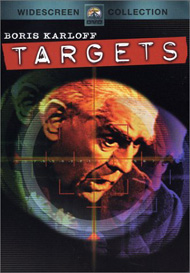
Paramount is showing us it has guts this year. Of the three studios putting out vintage Boris Karloff features (Columbia will soon give us The Devil Commands and MGM the rare The Ghoul), only Paramount dares front an image of Karloff on the package cover. One doesn't know if the reticence is because marketers think that Karloff = old, dull movie, or if the Karloff estate is intimidating studios from using the likeness of the Master of the Macabre.
On a scale of Excellent, Good, Fair, and Poor,
Targets rates:
Movie: Very Good
Video: Excellent
Sound: Excellent
Supplements: Bogdanovich commentary and interview docu.
Packaging: Keep case
Reviewed: August 12, 2003
Review Staff | About DVD Talk | Newsletter Subscribe | Join DVD Talk Forum
Copyright © MH Sub I, LLC dba Internet Brands. | Privacy Policy | Terms of Use
|

| Release List | Reviews | Price Search | Shop | SUBSCRIBE | Forum | DVD Giveaways | Blu-Ray/ HD DVD | Advertise |