| Release List | Reviews | Price Search | Shop | Newsletter | Forum | DVD Giveaways | Blu-Ray/ HD DVD | Advertise |

| Reviews & Columns |
|
Reviews DVD TV on DVD Blu-ray International DVDs Theatrical Reviews by Studio Video Games Features Collector Series DVDs Easter Egg Database Interviews DVD Talk TV DVD Talk Radio Feature Articles Columns Anime Talk DVD Savant HD Talk Horror DVDs Silent DVD
|
 DVD Talk Forum |
|
|
| Resources |
|
DVD Price Search Customer Service #'s RCE Info Links |
|
Columns

  

|
 |
In Cold Blood
|
||||
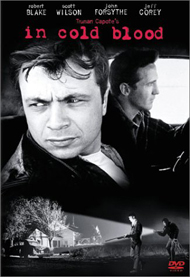
Truman Capote's book In Cold Blood was a sensation of the 60s. Readers were used to emotionalism and polemics when reading about crime. Capote took one of the more notorious mass murders of the late 50s and approached it from dual perspectives -- the hard, adult facts of the case down to the tiniest detail, and a parallel philosophical investigation of the meaning, if any, to be found behind the crime. The talented writer-director Richard Brooks tended to over-write and overstate his case time and again, saving himself through excellent story judgment and great casting. In Cold Blood is one of his best and most controversial films. His docu detachment is true to Capote's unemotional aim, and his 'psychological' embellishments work rather well most of the time. Forty years later there's an entire shelf-ful of 'semi-documentary' serial killer movies that catalog heinous true crimes without comment, and they're taken as horror entertainment. Like Capote, Brooks may have been a progressive eager to pose Big Questions - "Is capital punishment murder?" -- but at least he saw that there were questions to ask.
1967 reviews of In Cold Blood treated it as a horrible, taboo-breaking semidocu for which ordinary citizens weren't ready. They praised its realism, the excellent acting, and especially Richard Brooks' unusual script. But the grim subject matter wasn't something to get excited about; most coverage treated the film as a symptom, not a movie. This was the year of Bonnie & Clyde and Point Blank, and many reviewers were concerned that movies in general were taking a turn toward pornographic extremes of violence. One review I read of In Cold Blood talked more about the real crimes than those on screen. I got an image of one of Hickok and Smith's victims head's being blown off as they sat up in bed, with the gore splattered across two yards of wallpaper. For years I thought a scene like that was in the movie. That kind of excess doesn't happen in In Cold Blood, not a bit. But the atmosphere of incipient violence makes Brooks' reserve seem horrible just the same. One of the killers describes himself almost immediately as a 'natural born killer', but it would be decades before a filmmaker would make the subject into a circus-y celebration of bloodlust. Brooks' approach was to film his crime saga in the actual locations where the crime happened, including the murder house. This was promoted in the advertising and added both to the macabre atmosphere and the docu aspect. We see big stretches of Kansas and pieces of various deserts (that all look to have been filmed just North of LA; in one roadside view I can see the hill that the Tarantula! crawls over). But Brooks doesn't use non-actors. Robert Blake and Scott Wilson are excellent as the pitiful losers who only become lethally murderous when linked as a pair, feeding on each other's psychopathology. Wilson (The Gypsy Moths) is a slick hick, smooth enough to con unsuspecting store clerks but also enough of an idiot to fall for tall tales of farmers hiding loot in their houses. Blake is a thoroughly pathetic sad sack with complexes about his miserable family life and his lack of height. He's so naïve, he believes in a screwy treasure hunt idea off the coast of the Yucatan. Equally good are the killers' fathers. nNir veterans Jeff Corey and Charles McGraw are given solid parts. Without making sentimental cases, they remind us that even the killers have family members who think about them. The Clutters seem like non-actors but three out of four were stage veterans that went on to extensive film careers as character actors. On the side of the law we have familiar G-Men character actors taking the roles of the cops and agents searching for the killers, but Brooks gives them more sympathetic parts to play. The main sleuth is John Forsythe, then well-known as the genial star of TV's Bachelor Father. He's an agent of a federal law-enforcement agency called the FKI. 1 Forsythe is often as tight-lipped and task-oriented as the rest of the cast, but on more than one occasion he's used to voice 'author's opinions', as when he takes a newspaperman to task for how the police are characterized during crimes like this one. The real author's mouthpiece is Paul Stewart's Jenson, a reporter affiliated with a major magazine but covering the crime on his own. Jenson is clearly the Truman Capote figure. He makes himself an objective fly on the wall and from time to time delivers up sage pronouncements about capital punishment. In a movie bereft of moral judgment and editorial comment, we snap up these nuggets like wisdom from the mount. Brooks pulls a narrative trick that sustains suspense while increasing the dread factor. The film skips over the actual crime just as the killers are arriving at the Clutter spread, cutting instead to the panicked reaction the next morning when their bodies are discovered. Thus, the growing awe around the murders is reflected in the faces of the locals and cops who must clean up the mess and sift through the clues. Since we haven't seen their murders, the foolish fugitives retain a modicum of sympathy as they criss-cross the country in stolen cars. Then, when one of them makes a full narrative confession during a nighttime car trip, we finally see the crime itself, as the opening curtain of the third act. After that, the trial and the execution wait are uneventful formalities that seem unrelated to the tragedy and carnage. The intent seems to be to show the state's parallel brutality in 'murdering' the criminals, but if Brooks wanted to push the anti-capital punishment issues, he makes few converts. Pitiful though they may be, Hickock and Smith are dangerous vermin and we want them safely dead. We start In Cold Blood thinking we're in for a sleazy ride, but it turns out to be artistically valid and socially responsible. Under the self-restraint of his docu format, Richard Brooks' direction here is excellent. We expect the film to fall apart every time we go into a flashback or one of Robert Blake's fantasies, but the tangent just enriches the experience. Robert Blake is given an elaborate background of bad parenting and adolescent trauma, but the treatment is so expert, it doesn't come off as bad liberal excuse-making. The only shot I just don't understand is an angle of a high-speed train dropping off mail bundles as it roars through the Holcomb station, seen just as emergency vehicles are rushing to the crime scene. Is it just an irrelevant tension builder? Some kind of link to Bad Day at Black Rock? Or is it the most exciting event in Holcomb on days that horrible murders don't occur? Conrad Hall's B&W images are practically perfect. Hitchcock designer Robert Boyle makes every setting more than believable, especially the Clutter house with its drab basement and (?) upstairs kitchen. Best of all is Quincy Jones' light jazz score, that never intrudes but has a subtle effect on many tense scenes. Columbia Tristar's DVD of In Cold Blood is a good transfer of a clean B&W Panavision element. The grayscale is full, and the image reasonably sharp. Audio is very good as well. The only extra is an attention-grabbing trailer.
On a scale of Excellent, Good, Fair, and Poor,
In Cold Blood rates:
Footnote: 1. An alteration made after input from reader "Chris", April 25, 2010: Hey Glenn, I watched In Cold Blood earlier today and really enjoyed it. I decided to see if you had a review on it, and you did - one that, par usual, squared with my opinion. I did however notice one flaw: you comment that Al Dewey was a member of the fictional "FKI", presumably because the FBI wouldn't endorse the film. Actually Dewey was a member of the KBI - the Kansas Bureau of Investigation, a state-level organization not affiliated with the Federal Bureau. They're apparently still around today, though their website doesn't seem to have anything on the Clutter murders.
Sorry if this has been pointed out to you already (it likely has given how old the review is) but it was just something that bugged me. Regards, Chris.
Review Staff | About DVD Talk | Newsletter Subscribe | Join DVD Talk Forum |
|

| Release List | Reviews | Price Search | Shop | SUBSCRIBE | Forum | DVD Giveaways | Blu-Ray/ HD DVD | Advertise |