
| Reviews & Columns |
|
Reviews DVD TV on DVD Blu-ray 4K UHD International DVDs In Theaters Reviews by Studio Video Games Features Collector Series DVDs Easter Egg Database Interviews DVD Talk Radio Feature Articles Columns Anime Talk DVD Savant Horror DVDs The M.O.D. Squad Art House HD Talk Silent DVD
|
 DVD Talk Forum |
|
|
| Resources |
|
DVD Price Search Customer Service #'s RCE Info Links |
|
Columns


|
|
|
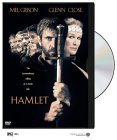
Hamlet (1990)
The Tragedy of Hamlet, Prince of Denmark is perhaps the most celebrated of all Shakespeare's plays, and for good reason: apart from its fascinating story of a young man fired with the desire for revenge, but torn by indecision, Hamlet is a showpiece for some of Shakespeare's most stunning writing. So it takes, I'd say, a certain amount of self-confidence to create a film adaptation of the Bard's most famous play: luckily for us, director Franco Zeffirelli took the plunge in 1990 with a star-studded cast, and the result is a most excellent Hamlet indeed.
An important thing to remember about Shakespeare is that, apart from his wonderful use of the language, he wrote really gripping stories, and Hamlet is no exception. This adaptation, like almost all film adaptations of Shakespeare's plays (except for Kenneth Branagh's version of Hamlet, which has yet to come to DVD), abridges the original play significantly. Many scenes and sub-plots are removed entirely, which streamlines the story considerably; in this case, the removal of characters like Fortinbras and his associated plot elements serves to focus the viewer on the core elements of the story: Hamlet's personal dilemma about his stepfather, and the effects of his behavior on those who love him.
The editing and condensing, however, most appropriately stops short at the dialogue: Shakespeare's lines may be trimmed, but they are never changed. It's amazing to watch Hamlet and realize just how many of the lines from this play have become famous, quoted and quoted again (and occasionally misquoted: if you hear a few phrases in Hamlet that don't sound the way you expect, be reassured that you're hearing them the correct way at last). Though the dialogue is written in blank verse (iambic pentameter), which is the poetic meter that most naturally approximates the rhythms of normal speech, Shakespeare's dialogue is no walk in the park for modern actors. It's great to see, then, that the cast of Hamlet handles their lines very well, with natural pacing and a delivery that draws our attention to the meaning and emotional force of their dialogue, not the archaisms.
The one weak point, though, is Mel Gibson in the title role; he does a respectable job of fulfilling the acting requirements for Hamlet, but his accent just doesn't fit, and he doesn't always seem to get the rhythm of the lines right. While all the other actors (including Glenn Close) sound just right, Gibson stands out: whenever he speaks, the fact that this is a modern-day actor speaking Shakespeare's lines seems to jump out and override the sense of immersion in the scene.
Visually, Hamlet looks superb. The location, sets, and costumes perfectly capture the feel of Shakespeare's medieval Denmark: that is, while the story itself has a timelessness about it (unlike Shakespeare's more time-specific history plays), the film's attention to appropriate period detail provides an additional layer of depth. One of the most interesting things about Hamlet, in terms of its style, is how active it is. Director Franco Zeffirelli isn't shy about having his characters move from one location to another as they converse, and even the famous soliloquies are far from static. It makes sense, after all: there's no reason to assume that the scenes have to be totally static, just because of the limitations of live theater, or because Shakespeare didn't happen to include stage directions in his scripts. The combination of excellent editing and well-handled cinematography make for a very well-paced Hamlet: it runs two hours and 15 minutes, but it seems shorter than that, while at the same time never feeling rushed.
The DVD
Video
Hamlet's DVD transfer is truly impressive, offering a viewing experience that matches the grandeur of the story. The image is presented in its original theatrical aspect ratio of 1.85:1, and is anamorphically enhanced. Edge enhancement is totally absent, with the result that the image is extremely sharp and clear, even in very challenging situations with dark objects silhouetted against a brighter background. The print is also extremely clean and clear, with virtually no noise or print flaws appearing at all. The film's colors are rich and natural; the palette focuses on browns and black tones, but these colors look remarkably vibrant. The only slight qualm I have with the transfer is that some of the darkest scenes are a bit too black; while I think the overall "look" of the film is certainly intended to be a dark one, the contrast is perhaps a bit too heavy at times. But that's really the only minor issue in a splendid transfer: Hamlet looks superb.
Audio
The Dolby 2.0 soundtrack for Hamlet offers a reasonable listening experience for the majority of the film. Ennio Morricone's excellent score is incorporated into the overall soundtrack quite well, so that it supports the non-dialogue portions of the film while never intruding when we're listening to the characters speak.
The clarity of the dialogue is a critical point in a Shakespeare film, since more than anything else, the language is central to the film... and it's here that the soundtrack falters. For the most part, the dialogue is handled reasonably well, but it does have a generally flat sound to it, and on a number of occasions it's even a bit muffled. If this were just another modern film, I wouldn't be as critical of this particular flaw, but in Hamlet, we're hanging on every word, and trying to follow fairly complex dialogue in blank verse; we need a crystal-clear treatment of dialogue, and we don't get it.
Extras
A theatrical trailer and two featurettes are included as bonus material. The first featurette is "Hamlet: An Actor's Journey"; this eleven-minute piece is an interview with Mel Gibson in which he discusses his thoughts on the film and the making of the film. While there's no date given, it appears to have been done recently, not at the time the film was made. (It's curious to note how Gibson's Australian accent, which is noticeable in the second featurette, seems to have disappeared over time, leaving Gibson with a blander-sounding voice.)
The second featurette is a 51-minute behind-the-scenes piece called "Mel Gibson: To Be or Not to Be." It's a combination of a look at Gibson in general (including interview clips from his parents, who visited the set), and a general overview of the process of making the movie. Some of the narration is apparently taken from a journal that Gibson kept during the filming, intercut with interview clips from other members of the cast, along with clips from the film. All in all, these two featurettes are mildly interesting, and offer a reasonably detailed look at the making of the film without a lot of promotional fluff.
Final thoughts
This 1990 version of Hamlet achieves what all Shakespeare plays have always set out to do: it entertains. With its story pared down to the essentials, this Hamlet moves swiftly along, keeping viewers intrigued by the story while also preserving the elegance and power of Shakespeare's dialogue: while the play has been cut down, it has not been re-written. Though Mel Gibson never quite sounds right as Hamlet, as a whole, the star-studded cast (including Glenn Close, Helena Bonham-Carter, Alan Bates, and Paul Scofield) does an excellent job bringing Hamlet to the screen. Though the sound quality in Warner's DVD presentation isn't as good as I'd have hoped for, the image quality is certainly outstanding. Highly recommended.
|



| Popular Reviews |
| Sponsored Links |
|
|
| Sponsored Links |
|
|
| Release List | Reviews | Shop | Newsletter | Forum | DVD Giveaways | Blu-Ray | Advertise |
|
Copyright 2024 DVDTalk.com All Rights Reserved. Legal Info, Privacy Policy, Terms of Use,
Manage Preferences,
Your Privacy Choices 
| |||||||