
| Reviews & Columns |
|
Reviews DVD TV on DVD Blu-ray 4K UHD International DVDs In Theaters Reviews by Studio Video Games Features Collector Series DVDs Easter Egg Database Interviews DVD Talk Radio Feature Articles Columns Anime Talk DVD Savant Horror DVDs The M.O.D. Squad Art House HD Talk Silent DVD
|
 DVD Talk Forum |
|
|
| Resources |
|
DVD Price Search Customer Service #'s RCE Info Links |
|
Columns
  


|
|
|
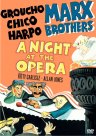
Night at the Opera, A
The first movie the Marx Brothers did for MGM under the watchful eye of Irving Thalberg, A Night at the Opera is a comedic tour de force that was not only one of the Brother's funniest films, but also one of the most successful.
The plot to this movie, like all of the Marx brothers' best films, is really only there as a backdrop, a reason for all the zaniness to take place. This film starts in Milan. Otis B. Driftwood (Groucho Marx) is the publicity manager for Mrs. Claypool (Margaret Dumont,) a rich widow who wants to be a member of society. Otis has arranged for Mrs. Claypool to donate $200,000 to Herman Gottlieb (Sig Ruman) of the New York Opera so that they may hire a famous tenor Rodolfo Lassparri (Walter King.) As Otis puts it: "Don't you see, you'll be a patron of the opera. You'll get into society. Then, you can marry me and they'll kick you out of society, and all you've lost is $200,000."
Added to this a typical love triangle. The tenor Lassparri is infatuated with the female lead in the opera he is appearing in, Rosa Castaldi (wonderfully played by Kitty Carlisle.) But Rosa loves the equally talented, but still unknown, singer Ricardo Baroni (Allan Jones.) Baroni's manager is Fiorello (Chico Marx) who pals around with Tomasso (Harpo Marx.)
Gottlieb hires Lassparri at $1000 a week, and Baroni is hired by Driftwood at $10 a week. The entire group then sails off to New York, but this being a Marx brothers' movie, it is anything but smooth sailing.
This film has some of the boys best comedy bits in it. It has the contract-tearing scene where Chico and Groucho tear out the clauses in a contract that they don't understand, and the famous crowded state-room sketch where more and more people keep entering Groucho tiny room on board the ship. There is also a lot of the fast banter that the Marx brothers are famous for. Take this exchange between Groucho and Margaret Dumont from the beginning of the film:
Mrs. Claypool: Mr. Driftwood, three months ago you promised to put me into society. In all that time, you've done nothing but draw a very handsome salary.
Driftwood (insulted): You think that's nothing, huh? How many men do you suppose are drawing a handsome salary nowadays? Why, you can count them on the fingers of one hand, my good woman.
Mrs. Claypool: I am not your good woman!
Driftwood (tenderly): Don't say that, Mrs. Claypool. I don't care what your past has been. To me, you'll always be my good woman. Because I love you! There. I didn't mean to tell you, but you...you dragged it out of me. I love you!
Mrs. Claypool: It's rather difficult to believe that when I find you dining with another woman.
Driftwood: That woman? Do you know why I sat with her?
Mrs. Claypool: No.
Driftwood: Because she reminded me of you.
Mrs. Claypool: Really?
Driftwood: Of course, that's why I'm sitting here with you. Because you remind me of you. Your eyes, your throat, your lips! Everything about you reminds me of you. Except you. How do you account for that? (To the camera) If she figures that one out, she's good.
One actress that really stuck out to me was Kitty Carlisle. I had mainly known her from her many game show appearances, but she did an excellent job in this film, and even sang her own songs. I was surprised that she didn't make more movies after this one.
One of the things that Thalberg did with the Marx Brothers was to make their movies less frantic, and give them higher production values. This approach worked, and the box office receipts rose. All of their movies had musical numbers and this one is no different. They wisely added some comedy bits in the middle of the songs so that the movie wouldn't grind to a halt, and that seemed to work well.
This movie was cut be censors during WWII. Since the movie was going to be shown overseas to servicemen, all references to Italy were removed, about three minutes worth all together. Unfortunately, the preformed the editing on the negative itself, and no copies of the original cut of the film exist. While this is a tragedy, the film is easy to understand as it is, and none of the cuts stand out with the exception of the opening shot. Originally there was a title card identifying the location as Milan, and then showing some of the natives singing opera as they worked. This scene was cut, and the movie opens without an establishing shot. It just jumps into the action, which actually seems appropriate for a Marx Brothers movie.
The DVD:
Audio:
This DVD has the original mono audio track. The quality of the soundtrack is a little lower than I was hoping for. There is quite a good amount of hiss in the background throughout the entire film. Granted that this is a film that is nearly 70 years old, but there are other films from this age that sound much better. Aside from that the dialog was easy to understand.
Video:
This film was presented in its original aspect ration of 1.33:1. The image had a fair amount of grain to it, a little more than I would have liked. There are also several missing frames through the film that result in jump cuts. The blacks were more of a very dark gray, but aside from those defects the picture looked fine. There was a good amount of detail and the contrast was excellent. This movie could have looked much worse, and the grain shouldn't prevent anyone from buying this film.
The Extras:
This disc is packed with some great bonus material!
Commentary: There is a running commentary by Leonard Maltin. This is the first commentary I have heard Mr. Maltin give, and it was a mixed bag. Whenever I see him on TV or interviewed, I always get the impression that he is reading his lines off of cue cards. This commentary is no different. He doesn't sound natural and relaxed. He also sounds a tad pompous and talks down to the audience a little, partially to fill up the time. At one point while two people are talking on screen he says, "Here we have what they like to call 'exposition.'" During one of the musical numbers he comments, "This is known as 'selling a song'." I had to laugh out loud at those. He also spends a good amount of time describing the scene that you are watching on the screen. Again, I think this is to prevent long gaps in the commentary, which I don't have any problem with.
Aside from those critiques, his comments were very interesting. He related many funny anecdotes about the brothers in general and the filming of this movie in particular. He points out the character actors who have small bits and fills us in on their careers. If you don't mind his speaking style this was a good insightful commentary.
Remarks on Marx: This 34-minute documentary talks about the Marx Brothers and this movie. It has many interview clips with friends and movie scholars, and gives a nice overview of the group. There are many interesting stories and anecdotes including how they got their nicknames.
Groucho on The Hy Gardner Show: This 5 minute excerpt from a 1961 TV show has Groucho talking about his relationship with Irving Thalberg. Groucho was pretty old by this time, but he still knew how to tell a story. I wish they had included the entire show.
How to Sleep: This 1935 short won an Academy Award for best short subject. It's an amusing look at how to cure insomnia.
Sunday Night at the Trocadero: This reel long short has a studio executive going to the famous restaurant looking for new talent. There is a lot of singing, and appearances by famous stars. Groucho has a small cameo.
There is also a trailer for the movie.
Final Thoughts:
While the audio and video quality is not perfect, they are not too bad. The movie itself is very funny, and should be in every comedy film library. Add to that the copious extras and this is a great disc to own. Highly Recommended.
|



| Popular Reviews |
| Sponsored Links |
|
|
| Sponsored Links |
|
|
| Release List | Reviews | Shop | Newsletter | Forum | DVD Giveaways | Blu-Ray | Advertise |
|
Copyright 2024 DVDTalk.com All Rights Reserved. Legal Info, Privacy Policy, Terms of Use,
Manage Preferences,
Your Privacy Choices 
| |||||||