
| Reviews & Columns |
|
Reviews DVD TV on DVD Blu-ray 4K UHD International DVDs In Theaters Reviews by Studio Video Games Features Collector Series DVDs Easter Egg Database Interviews DVD Talk Radio Feature Articles Columns Anime Talk DVD Savant Horror DVDs The M.O.D. Squad Art House HD Talk Silent DVD
|
 DVD Talk Forum |
|
|
| Resources |
|
DVD Price Search Customer Service #'s RCE Info Links |
|
Columns
  


 
|
|
|
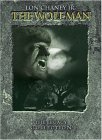
Wolf Man - The Legacy Collection, The
Horror movie fans won't be bothered by the fact that Universal has repackaged groupings of its classic monster movies to help promote its new summer film Van Helsing, as the new Legacy Collection sets are great bargains. Frankenstein, Dracula and The Wolf Man each come in fancy book-like cases with the original David J. Skal docus and Tom Weaver commentaries, and three more features each. As the first Universal DVDs of these films (mostly OOP) were a pricey purchase even when arranged as double features, this will please fans who missed them because of sticker shock.
 | The Wolf Man Universal 1941 / B&W / 1:37 flat full frame / 70 min. / Street Date April 27, 2004 / 26.98 Starring Claude Rains, Warren William, Ralph Bellamy, Patric Knowles, Bela Lugosi, Maria Ouspenskaya, Evelyn Ankers Cinematography Joseph A. Valentine Art Direction Jack Otterson Film Editor Ted Kent Makeup Jack P. Pierce Special Effects John P. Fulton Original Music Charles Previn, Hans J. Salter, Frank Skinner Written by Curt Siodmak Produced by Jack J. Gross, George Waggner Directed by George Waggner |
You know, it gives a person paws ..."
Sung to the tune of Camelot.
The Wolf Man character was Universal's first big horror success with a monster almost completely invented in-house. Inventive writer Curt Siodmak spun his own ersatz mythology around the generic shape-shifting werewolf lore complete with demonic origin, talismans that foretell the future and strict rules as to the lupine monster's weaknesses. Just as the 40s sequels to The Mummy trimmed Egyptology and ancient curses down to one priest with a Fistful of Tana Leaves, Siodmak engineered his werewolf to be easily understood by every popcorn-eating kid in 1941 America.
WereWolf of London (included in this set) is the better movie in every respect, with a truly strange story and an odd semi-human monster in Henry Hull. By contrast, The Wolf Man is every bit a 40s Universal chiller - it's short, cleanly shot and delivers a monster that lives up to the picture on the poster. It's Lon Chaney Jr's finest monster role; he's not a natural but he's likeable and sympathetic as an ordinary Joe with a curse on his head. Evelyn Ankers is an attractive love interest and the gypsy babble-talk has a great saleswoman in Maria Ouspenskaya, easily the best thing in the picture. The movie sticks with the lycanthropy plot and soft-peddles all the other content, including the jealous gamekeeper Patric Knowles (who returned rather confusingly as a mad doctor in Frankenstein Meets the Wolf Man) and local gossip against Larry and Gwen.
Claude Rains is relaxed in the role of Larry's father; although Larry's been gone fifteen years over a family dispute there's not a hint of rancor between them. So there's not much chance of interpreting Larry's hairy condition beyond black magic and cruel fate. Siodmak's original script wanted to imply that Larry's feral dilemma might be all in his mind; Universal was having none of that psychobabble and insisted on a monster without a complicated origin.
Perhaps to work with Rains, to complete contractual obligations, or (who knows?) to be first in what might be a rebirth of the horror craze, well-known faces Warren William and Ralph Bellamy take sheriff and doctor roles of little or no interest. The effect is to bolster Lon Jr. somewhat and lend the show a class not seen in the previous year's The Mummy's Hand. Universal was seemingly trying to position him as a successor to Lugosi and Karloff.
I've never been a real fan of the Wolf Man's makeup (he looks more like an exotic breed of lapdog) but he moves well and his snarling attacks are pretty exciting, especially for 1941. The lap-dissolve transformations are no longer particularly impressive; Henry Hull's metamorphosis was much more challenging. Larry's legs start sprouting hair while he's wearing a sleeveless tee shirt, leaving us to picture him putting his nice black shirt on after the transformation: The snarling monster buttoning all the buttons with his clawed hands.
The Wolf Man's foggy grove of trees and the uncredited music of the stalwart Universal composers set a mood that would carry Universal for the next five years. Joe Valentine's photography gets the most from the meagre resources of hand-me-down sets and backlot storefronts, and gives us some great angles on Larry as he prowls and attacks. Uni's charismatic monster inspired a handful of sequels and joined the classic pantheon to sell a million Aurora plastic models. His success inspired the creation of Val Lewton's competing horror B unit over at RKO, a challenge Lewton accepted by introducing new kinds of horror under titles even more salacious than Universal's: The Cat People, I Walked with a Zombie.
Universal's deluxe DVD box The Wolf Man: The Legacy Collection packs a lot of value onto two discs. One good thing about this set is that the quality of the shows has not visibly diminished; putting four relatively short features on two discs doesn't mean a low bit rate.
The first disc has The Wolf Man, its sequel Frankenstein Meets the Wolf Man and a commercially-oriented short subject by New Wave. It's hosted by "horror expert" Stephen Sommers and betrays the whole reason for the deluxe treatment of Uni's horror canon - to promote the expensive Van Helsing movie. A superficial piece about werewolves soon segues into a promo emphasizing the shapeshifting monster in the new movie; there are similar pieces on the other Legacy collections for Dracula and the Frankenstein Monster. Van Helsing looks like another awful pastiche with heroines in leather bustier-corsets and a werewolf like a Marvel superhero. The actor involved talks about his getting into the character, and then we're mostly shown a CGI animated werewolf. Savant's lack of interest is the unmistakeable sign that Van Helsing will be a bigger hit than Uni's Mummy series.
Disc two is a flipper with She Wolf on London on side one and Werewolf of London on side two. As I've already reviewed these features, I'll just direct you to their original notices:
She-Wolf of London & WereWolf of London.
The best thing about the 1999 Uni monster releases were the astute and exhaustive docus compiled by film author David J. Skal; you have to go to the back of the set to find it, but Monster by Moonlight is there, hosted by John Landis and featuring input from Curt Siodmak and makeup whiz Rick Baker. Although I've been told some viewers have experienced problems, my copy played all the way through without a hitch. 1
Back on disc one is a great commentary track from film biographer Tom Weaver. It's an academic track filled with facts. Weaver has a engagingly friendly delivery and is a pleasure to listen to. The clever box art creates a really handsome Wolf Man portrait on the cover, with a sleeve with a partially printed window ... ah, you'll understand when you see it.
I'm not holding my breath, but Universal may release collection-oriented Legacy boxed sets for more of its multitude of horror and Sci fi thrillers, the ones that moved a lot of laserdiscs in the 90s. It would be great to get the three Creature movies all together with Skal's terrific documentary. All I would ask is that two of their best be remastered. They haven't been seen in good versions on VHS or DVD. This Island Earth needs a quality widescreen presentation to show off its original Technicolor, and Universal's best Sci Fi feature The Incredible Shrinking Man deserves a transfer in its full width as well. 2
On a scale of Excellent, Good, Fair, and Poor, The Wolf Man rates:
Movie: Very Good
Video: Excellent
Sound: Excellent
Supplements: Promo, David J. Skal Docu, trailer, Tom Weaver commentary, bonus features Frankenstein meets the Wolf Man, She-Wolf of London, WereWolf of London.
Packaging: Keep case
Reviewed: May 2, 2004
Footnote:
1. Mr. Skal reportedly had done interviews for other Universal monster pix when the studio pulled the plug back in 1999. They could do a lot, lot worse than bring him and Tom Weaver back to continue their good work - the fans watch these great docus as much as they do the movies.
Return
2. When I saw Shrinking Man at the LA County Museum of Art in 1972, my memory is that it was in SuperScope, with the logo added to the credits.
Return
| |
|



| Popular Reviews |
| Sponsored Links |
|
|
| Sponsored Links |
|
|
| Release List | Reviews | Shop | Newsletter | Forum | DVD Giveaways | Blu-Ray | Advertise |
|
Copyright 2024 DVDTalk.com All Rights Reserved. Legal Info, Privacy Policy, Terms of Use,
Manage Preferences,
Your Privacy Choices 
| |||||||