
| Reviews & Columns |
|
Reviews DVD TV on DVD Blu-ray 4K UHD International DVDs In Theaters Reviews by Studio Video Games Features Collector Series DVDs Easter Egg Database Interviews DVD Talk Radio Feature Articles Columns Anime Talk DVD Savant Horror DVDs The M.O.D. Squad Art House HD Talk Silent DVD
|
 DVD Talk Forum |
|
|
| Resources |
|
DVD Price Search Customer Service #'s RCE Info Links |
|
Columns
  


 
|
|
|
Walt Disney Treasures - Tomorrowland: Disney in Space and Beyond
This is Savant's most awaited disc of the year, a collection of Disney's Tomorrowland-themed television shows that contains something I've wanted to see for forty years, Disney's 1950s "space" trilogy of entertainment/educational shows that charted out the course for the next decade's space program. When I saw them in 1959 at age seven, I had no idea they'd first been aired in 1955. Although that initial broadcast was in B&W, Disney shot them in expensive color - which has to be the height of faith in his own work.
Man in Space, Man and the Moon and Mars and Beyond are on Disc One of this two disc set. Leonard Maltin again provides necessary context and exposition to enable 2004 viewers to appreciate the effort and genius that went into these shows, made the very same year that Disney was just a little preoccupied opening his Disneyland theme park. Disney writer and animation director Ward Kimball directs and hosts the programs, which feature a full multi-media mix of interviews, graphics, full animation, special effects photography and even a live-action space sequence the equal or better than similar work in George Pal's Conquest of Space made the same year. 1
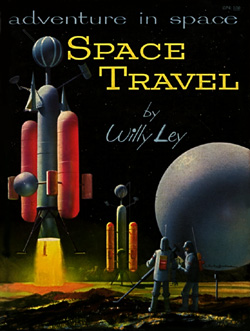
The trio of shows take on the big task of educating the public about space travel, almost as if they were paid to do so by the fledgling NASA (which I don't think existed yet in 1955). Coffee table books with Chesley Bonestell art were popular earlier in the 50s, but I credit this landmark TV trilogy with taking the concept of space travel away from Buck Rogers and convincing America that it was really going to happen. The only obvious objection was money - the hardware and rockets proposed in the show would easily cost more than what the country was worth. Just the same, when Kennedy launched a Moon program five years later the country was primed for the adventure. Disney's seal of approval had a lot to do with it.
Director Kimball uses the "infotainment" formula that worked so well in Victory Through Air Power. Each show starts with a light comedic section providing background information. Breezy, clever and funny episodes explain man's ancient curiosity for the stars and our popular romantic notions regarding the moon. The last show has fun with our 20th century fascination with pulp fantasy visions of Mars and space. Clever animation shows the explosion of space fantasy comix and a hilarious segment about "the typical space monster story" wraps up the entire movie genre with the wit and accuracy of a Mad magazine layout.
Animation fans will be intrigued by the variety of styles used here. The look of the cartoons change with every new subject, showing Disney artists to be masters of their graphic craft. The writing, visual invention and communication skill here are at the highest level of sophistication.
After the comedy section Man in Space its the remaining half hour or so to teach the basics of space travel required to get a man into orbit. The concepts of escape velocity, multi- staged rockets and orbiting are presented in the clearest terms using animated lecture boards and beautiful conceptual drawings. Just as shown in The Right Stuff, America's brain trust for the space race are all Germans. It's amusing to see and hear Deutschland's best, Werner von Braun, Willy Ley etc., explaining theories and manipulating models for us just as they must have done for the Nazi command fifteen years earlier. 2 But the U.S. Army didn't transplant them to New Mexico for nothing - these guys know their stuff. Their accents and origin go unmentioned, even when a clip from Fritz Lang's 1929 The Woman in the Moon demonstrates that they have been popularizing their space dreams for decades.
Disney's space launch is a doozie, shown with beautiful conceptual animation. The design of the giant-finned rockets (immortalized in a line of styrene model kits that were the new hobby rage in 1955) is daring and creative, and most of the details of the launch and orbiting mission are a good match for what we saw later with the Apollo program. The engineering of a space station is quite different from how we're doing it now, but even when covered by stills, the visuals of worker-bee space suits buzzing around assembling the orbiting wheel are beautiful. The launching of nuclear reactors into space is taken as a routine idea. It hasn't happened yet in real life because there's too great a risk of poisoning the entire planet. Tsk, tsk, details.
After a whimsical look at mankind's love affair with the moon with examples from Baron Munchausen to kid's nursery rhymes, Man and the Moon settles in for the main course, the construction in orbit of a rocket for a lunar journey. Here the show switches to live-action sets, actors and special effects. The crew are young, white and forgettably bland looking, with a commander who looks like Sergeant Rock (Frank Gerstle, from D.O.A., Between Heaven and Hell and The Atomic Brain) clearly chosen to affirm that any bold quest needs a military man in command.
The spaceship set and spacesuits are exceptionally good, and other effects are much better than those in the George Pal movie. Exterior shots appear to use automated animation identical to the "invention" of motion control twenty years later, but probably not with electronic control or synchronized selsun motors moving the ships. Unlike Conquest of Space there are no travelling mattes and there aren't convenient "clear strips" through the starfield for the ship to pass without the stars showing through. It's really good effects work, and in brilliant color as well. 3
Passing over the dark side of the moon, the show reaches its climax with a dramatic use of flares to see the landscape below, each brief flash accompanied by a blast of music. The final flash reveals an obvious alien base of some kind, as postulated in fantasies like The Mysterians. It's an odd dash of fantastic provocation that goes unexplained, teasing the audience with the adventurous idea that the ultimate dream of all this hardware obsession is the search for life in space.
Mars and Beyond moves from the fantastic dreams of the past to wild speculations of life elsewhere in our solar system. A date isn't specified, but now we have atomic spaceships that look like colossal parasols. A string of six of them heads off to Mars, cueing the deep-think boys to come up with wonderful visualizations of abstract scientific concepts.
The episode starts with a starfield backed by a "heavenly" score reminiscent of the opening of Invaders from Mars of two years before. The humorous entertainment section already showed us dozens of whimsical nonsense aliens, but now we're given possible ways living things could have adapted to the hostile conditions on other planets. Using every animation trick in the book, various theories are compounded until Mars seems to be populated with monstrous vegetation more frightening than anything in Sci Fi pictures. When the text postulates crystal creatures based on silicon instead of carbon, we see visuals identical to those of The Andromeda Strain of 16 years later.
Best of all is the idea (also taken up two shows before in a 'space medicine' section) that man might reach his mental and physical limits, and be overwhelmed by the disorienting void of vastness. How does one cope with conceptual vertigo when every direction is "down" into a black nothingness that goes on into infinity? Disney was a brave pioneer in entertainment back then, transferring to the screen stories like 20,000 Leagues Under the Sea while leaving intact themes like 'justified' terrorism and colonial oppression. Here his organization and Ward Kimball take us into a challenging and cold scientific future that promises the eventual unlocking of all the mysteries of the cosmos - and there's not one mention of God or religion. Pretty risky stuff.
What's interesting about the show is that it was made before anybody had really defined what the Science Fiction craze was all about. The year 1955 is fairly early in the cultural Sci Fi fad, and Disney's people manage to encapsulize the real meaning of most of its components - sense of wonder, pulp monster fun, fascination with techology. Then they transcend it with visions of man's place in the universe.
Disney In Space is never discussed in critical examinations of the Science Fiction film genre, but it appears to be one of its most important milestones. When space travel became the property of nonfiction news shows and newspaper headlines, the majority of Sci Fi movies retreated back into juvenile fantasies.
Disc Two of the Tomorrowland Tin is less ground-shaking but has its good points. The three television specials show the gradual change in tenor in Disney docus. Also made for TV, Eyes in Outer Space andOur Friend the Atom show more of a condescending attitude sneaking in. Atomic power didn't turn out to be an endless supply of clean energy to usher the world into a new era of peace and security, but that's not Disney's fault. There's nothing malign about touting the promise of the atom in 1955. However, the Genie out of the Bottle imagery swiped from The Thief of Bagdad makes it seem as though Disney has decided to teach everyone with examples designed to reach kindergartners.
Between then and roughly 1966, when we see Walt just before he died showing his Epcot plans, something went wrong with Disney's Tomorrowland ideas. The proposed city of Epcot might be the joy of utopian designers, but it seems as unliveable as the porcelain towers of the 1936 Things to Come. People movers and monorails are fine (if you're not handicapped), but the regimentation of our lives into an orderly anthill of proscribed motions isn't any more attractive than the model's antiseptic-looking residential areas. The basic living structure is a single family mansion and there aren't very many of them. Will we all be a wealthy, educated and birth-controlled happy hive of obedient citizens? Or is Disney proposing that those "apartment" structures closer to the center of town (away from the green-belt gardens) are the living quarters for a working underclass? One look at the Epcot dreams and my father reiterated the old saw that Kubla Khan made the perfect city but forgot to create the perfect people to live in them. Nobody's yet conceived of a societal structure that didn't have an underclass forced to labor mainly for survival. Our cities are an organized chaos of petty disputes and nagging inequities, but at least they're an adventure in their own right. We don't wake up in the morning to be moved about like Hostess Twinkies on a Koyanniskatsi conveyor belt.
The guest interview sections help bear this out. Futurist/author Ray Bradbury has high praise for Walt but has tempered his optimism for endless futures of improvement. It's a far cry from his speech to my High School in 1968 when he said that world peace would come when consumer realities conquered Red China and Chairman Mao couldn't find a parking space in Peking. Chief Imagineer Marty Sklar has fascinating insights into the social engineering ideas that began with Disneyland's amazing design. But what sneaks into the stew is the necessity for and the domination by a little thing called "corporate sponsorship." The real culprit seems to be the 1964 World's Fair (or '66?) where Disney designed some key installations for corporate sponsors. The attractions later relocated to the Anaheim park, where the vapid "It's a Small World" ride still draws crowds.
In the Space shows and other earlier docu-essays Disney's storytelling had always used cartoons and humor to secure audience attention for the serious content. The empty style of "It's a Small World" has no serious content and no message beyond Hallmark card drivel. The world is a bloody slaughterhouse of political, racial and religious terror? Give them dancing dolls of peace singing a dippy song.
The old docus sometimes simplified concepts like atomic power, but the "Carousel of Progress" exhibit briefly shown in Sklar's scrupulously avoided explaining anything, as if it were a waste of time. The show insinuated that the future and our way of life had all been preplanned for us by benevolent corporations. The Carousel explained the world thusly: 1) your grandparents had a quaint life where all the household appliances were cute and funny. They must have laughed all the time! Look at the funny dog! 2) Yes, all of our present power sources and utilities are a vast and complicated and far too big for us, the corporate masters, to explain to you right now. Just keep paying your bills and stop asking questions. 3) The future is all rosy and you'll be warm and snug in your beds. Just don't put any restraint on our schemes to control the world and every facet of your insignificant lives. We'll make sure that you get plenty of sports, fast food and wholesome Disney entertainment.
I learned nothing from the insultingly patronizing Carousel except that a paternalistic corporation wanted me to be passive and admit that everything about reality was far too troublesome for me to concern myself with, and much better left to "those who knew better." 4
That's the real drama played out in the second half of the Tomorrowland Tin - the dreams of a fantastic future souring into corporate feudalism. Medical cures, public safety and who eats and who starves are now determined by national interests as defined by and for big corporations. All we're left with is nostalgia for the days of silvery rocketships and bold exploration into space. Disney's pioneering vision was watered down to satisfy the aims and public images of its corporate sponsors. Tomorrowland is now just a futuristic adjunct to Fantasyland.
Disney's Walt Disney Treaures: Tomorrowland - Disney in Space and Beyond set is a thing of beauty. All the contents are in tip-top shape. Only the title and credit sequences of the three space shows are in B&W; the rest of the material is in perfectly preserved color that flatters the wide range of animation and graphic styles on display. The dynamic music tracks come through nicely as well.
There is also a limited selection of behind the scenes stills, art conceptualizations, storyboards, etc. The uneven nature of this set doesn't end things on the strongest of notes - Disc one is fabulous and Disc 2 not as dazzling - but Disney in Space is already something I can't wait to re-view.
The new simplified menu system is a blessing. I was sick of navigating through galleries, endless curtains and jukeboxes to figure out how to access basic content, and the new pared-down arrangement ends the frustration.
On a scale of Excellent, Good, Fair, and Poor, Walt Disney Treasures: Tomorrowland - Disney in Space and Beyond rates:
Movie: Excellent
Video: Excellent
Sound: Excellent
Supplements: it's all a supplement, see above
Packaging: Double keep case in collectable tin that won't stop a bullet if you wear it over your heart.
Reviewed: May 13, 2004
Footnotes:
1. Conquest of Space was Pal's second go at a 'documentary' space film after his great success with Destination Moon. Studio meddling ruined the picture, but it hardly mattered; after this Disney program "real" outer space adventures were taken over by the US military/civilian space program, and most of movie science fiction beat a hasty retreat to infantile stories like Queen of Outer Space.
Return
2. The funniest and most acidic comeback line I ever heard on television came from Dick Cavett, when a guest mentioned Werner von Braun and his popular autobiograpy. Cavett added a subtitle to the book: I AIM AT THE STARS - But I Keep Hitting London! While watching the show, Gary Teetzel pointed out that it sounded as if Willy Ley's voice was completely dubbed by Paul Frees, with a convincing German accent.
Return
3. The "adventures" en route to the moon are almost identical to those encountered in Destination Moon. The repair of the meteorite hit with a convenient plug is pretty amusing; it's rather simple compared to the brilliant crisis management and techno-panic of Apollo 13.
Return
4. I think the perceived malice in things like It's a Small World and The Carousel of Progress aligned pretty well with the fact that my graduating class faced being drafted and sent to Vietnam. We still were still kids who wanted to believe in Walt Disney but the park responded to the crazy world with silly singing dolls and patronizing messages from big companies. After the inspired satire of The President's Analyst, the Disney way of communication with a smile now seemed an insult, a tool to get us to conform.
Return
| |
|



| Popular Reviews |
| Sponsored Links |
|
|
| Sponsored Links |
|
|
| Release List | Reviews | Shop | Newsletter | Forum | DVD Giveaways | Blu-Ray | Advertise |
|
Copyright 2024 DVDTalk.com All Rights Reserved. Legal Info, Privacy Policy, Terms of Use,
Manage Preferences,
Your Privacy Choices 
| |||||||