
| Reviews & Columns |
|
Reviews DVD TV on DVD Blu-ray 4K UHD International DVDs In Theaters Reviews by Studio Video Games Features Collector Series DVDs Easter Egg Database Interviews DVD Talk Radio Feature Articles Columns Anime Talk DVD Savant Horror DVDs The M.O.D. Squad Art House HD Talk Silent DVD
|
 DVD Talk Forum |
|
|
| Resources |
|
DVD Price Search Customer Service #'s RCE Info Links |
|
Columns


|
|
|
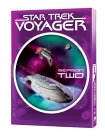
Star Trek Voyager: Complete Second Season
Star Trek: Voyager got off to an acceptably entertaining start in Season 1, introducing the characters and presenting the fundamental premise of the show: the adventures of a mixed Federation/Maqui crew stranded in the far-distant Delta Quadrant, struggling to find a way home while dealing with the strange, often hostile alien races around them. Season 2 might be reasonably expected to take the series a bit farther, but instead it looks like Voyager has already settled into a fairly predictable pattern of both content and quality.
Voyager is clearly modeling itself more after the original Star Trek and Next Generation rather than Deep Space Nine, opting for a heavily episodic style with minimal attention to overall story arcs. The basic premise of "trying to get home" is really the only overall theme, and even that is frequently passed up in favor of exploratory adventures of the week; for a shipful of lonely, stranded people, the Voyager crew are remarkably complaisant about the time they're taking to get home. The one concession to continuity is in the recurring alien races, most notably the Kazon tribes (clearly echoing the role of Klingons in the original series) and on a more minor note, the Ocampa. In episodes like "Maneuvers," we do see a recurrence of a character and plot from Season 1, but even with a "hook" thrown in at the end to suggest further development of that plot thread is planned, it doesn't feel like a coherent part of an overall story arc. (It doesn't help matters much that the "hook" is hopelessly cheesy and soap-opera-ish.) Similarly, "Alliances," in which Captain Janeway reluctantly decides to accommodate non-Federation tactics to help Voyager survive, is rather bland, and certainly not as interesting as it ought to have been.
If Voyager is to pass up the chance to develop an ongoing storyline (and it's a big missed opportunity), then it must stand or fall on the merits of its individual episodes. Unfortunately, in Season 2 the writing continues to be rather weak. Stories often get off to a reasonable start, but then fizzle partway through, like "Twisted," which creates an interesting premise (the ship is undergoing strange spatial distortions) but then drags through the middle to the end of the episode without developing the plot any further. Others are bland from start to finish, like "Parturition," which is nothing more than a threadbare plot to accompany the "character development" of Neelix, and the dreadfully boring "Tattoo."
One of the problems with Voyager is its love affair with technobabble. Admittedly, technobabble has always been a feature of Star Trek, but in earlier shows, it was under control. Scotty, Geordi, or O'Brien might come up with some nifty seat-of-the pants tweaking of something-or-other, but the actual mumbo-jumbo was kept to a tolerable level, and the basic vocabulary of gadgets was actually reasonably consistent: shields, deflectors, the warp core, Jeffries tubes, phasers and photon torpedoes, and of course a few different kinds of radiation (tachyons always being a favorite, it seems). But Voyager goes over the top. It seems that in every episode, there's a new gadget, a new kind of radiation, or both, being invented. It starts moving beyond the silly, into the realm of the absurd, as in "Cold Fire," when we learn about a "sporocystian life form" (uh, ok) that gives off "sporocystian radiation" (uh-huh). What's more, we're subjected to Torres describing in agonizing detail exactly what kind of whatchamacallit she's rigging up. Um, hello, Voyager writers? This stuff is all made up, and we know it. We know it's all pulled out of nowhere, even by Star Trek standards. We really, really don't find it interesting to hear about how recalibrating the gazingus drive by fifty microwidgets and irradiating the ship with chrono-tachy-boolean radiation will do the trick... OK?
Why do we get so much technobabble? That's the real question, and I suspect that the answer is that the episodes lack sufficient dramatic tension of their own. When the story works, it doesn't need a lot of tech-talk to jazz it up. Take, for instance, one of the better episodes of the season, "Non Sequitur." Here, Harry Kim is thrown into an alternate version of reality in which he stayed on Earth instead of shipping out with Voyager. A bit of technobabble is needed to provide the reason for these events, but it's kept simple and to a minimum; the natural focus of the story is on Kim dealing with the situation, and it works quite well.
Where Voyager does better is in the development of its characters, something that has been a strong point in all the Star Trek series. Even without strong stories to build on, the ensemble of characters are, for the most part, interesting and believable; these are people we're interested in seeing more of. While Neelix remains an annoyingly grating character, and Captain Janeway still feels bland, the characters of Harry Kim, B'Elanna Torres, Tom Paris, and Chakotay are engaging and fun to watch. And my favorite character is, without a doubt, the Doctor: the "Emergency Medical Hologram" is by far the most creatively drawn and amusing character in the bunch, and he does get his fair share of attention, such as in "Projections" in which he becomes unsure whether he's a hologram or a real person.
Voyager: Season 2 contains all 26 episodes from the show's second season, originally airing from 1995-1996.
The DVD
Voyager: Season 2 comes in the same style of packaging as Season 1, which is with the seven DVDs held in a book of hard plastic pages (this time in neon purple), and a two-part slip cover going over top and bottom. The purple "book" that holds the DVDs is fine, but now that I've had more time dealing with putting the slip covers back on and off, I can officially declare that they're a royal pain in the neck. If they're not overlapped exactly right, they don't fit properly... and any case designer at Paramount who thinks otherwise must not have spent any time with the final product. Well, at least the episode titles are usefully printed on the back of the slip cover.
Video
Voyager looks fabulous here, with bright, vibrant colors accompanied by rich, deep blacks producing a lovely visual appearance. Contrast is handled very well in these episodes, with minimal grain. The picture is sharp and both live-action and special effects shots look natural. The show appears in its original 1.33:1 aspect ratio.
Audio
Voyager continues to sound excellent, with both a Dolby 5.1 track and a Dolby 2.0 soundtrack offered. The audio is clean and sharp, with clear dialogue and nicely done special effects, making for an enjoyable listening experience overall.
Extras
A reasonable assortment of interesting special features appears on the final disc of the set. The producers of Voyager offer an overview of the challenges of making the series' second season in "Braving the Unknown: Season 2" (16 minutes). Next up is a 14-minute interview with Tim Russ (Tuvok); filmed in 2003, it offers Russ the opportunity to reflect back on his experiences with Voyager. The interview with Martha Hackett (Seska) in "Saboteur Extraordinaire" (6 minutes) also dates from 2003. The 7-minute "A Day in the Life of Ethan Phillips" is self-explanatory, following the actor as he gets made up as Neelix and so on. "Red Alert: Visual Effects Season 2" (13 minutes) narrated by visual effects producer Dan Curry, offers an interesting look at some of the special effects for the second season, while the 12-minute "Real Science with Andre Bormanis" talks about the way that science is worked into the show.
For other special features, we get a text "trivia commentary" for the episode "The 37s," and a photo gallery. There are also three short "lost transmissions" with mini-featurettes, one on each of the first three special features menu screens. These are fairly easy to find, but it's still irritating; why not just make them into proper features with labels?
Final thoughts
Season 2 of Voyager sticks to the path that was trodden in Season 1, leaning heavily on stand-alone episodes rather than making much use of continuity. The result is a season that feels bland; it's watchable, but there's no sense of anticipation for the next episode. The writing is weak, with few episodes able to boast well tuned plots; fundamentally what keeps Voyager reasonably watchable is its ensemble of likable characters. Fans of Voyager, and devoted Star Trek fans in general, will probably enjoy watching these episodes, but the set is really not solid enough to merit recommending it as a purchase. I'll suggest it as a rental, with the added comment that those who do choose to buy the set can be assured that the transfer quality is excellent.
|



| Popular Reviews |
| Sponsored Links |
|
|
| Sponsored Links |
|
|
| Release List | Reviews | Shop | Newsletter | Forum | DVD Giveaways | Blu-Ray | Advertise |
|
Copyright 2024 DVDTalk.com All Rights Reserved. Legal Info, Privacy Policy, Terms of Use,
Manage Preferences,
Your Privacy Choices 
| |||||||