
| Reviews & Columns |
|
Reviews DVD TV on DVD Blu-ray 4K UHD International DVDs In Theaters Reviews by Studio Video Games Features Collector Series DVDs Easter Egg Database Interviews DVD Talk Radio Feature Articles Columns Anime Talk DVD Savant Horror DVDs The M.O.D. Squad Art House HD Talk Silent DVD
|
 DVD Talk Forum |
|
|
| Resources |
|
DVD Price Search Customer Service #'s RCE Info Links |
|
Columns
  



|
|
|
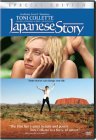
Japanese Story
The Movie
Toni Collette provides one of those magnificently radiant performances in Japanese Story , the type that expands beyond your home theater and threatens to engulf every house on your cul-de-sac. And she's only one of numerous positives in director Sue Brooks' and writer Alison Tilson's powerfully touching film, which has (sadly) gone overlooked in North America but deserves greater recognition with its release on DVD.
Set in Australia, Collette plays geologist Sandy Edwards, an ambitious and strong-willed geologist who finds herself more than slightly flustered at the prospect of having to figuratively baby-sit Tachibana Hiromitsu (Gotaro Tsunashima, also delivering a moving and bravura performance), a Japanese businessman representing a potential investor in her company. Ordered by her bosses to cater to his curiosities while in Australia, she reluctantly drags him around town: to the beach, a karaoke club (where he proceeds to butcher Danny Boy) and to various company mines and holdings. Her frustration with her new role as ad hoc tour guide grows exponentially with each trip, especially when he insists on her taking him out to see the Pilbara desert in the remote outback. Their truck winds up getting stuck in the soft earth of the desert, and the two strangers are forced to spend the night together with the very real and fatal possibility that they might be stranded.
And all this is just the set-up. To reveal any more would be to reveal too much, but over the course of the film Sandy and Hiromitsu begin to discover more about each other, crossing the cultural and emotional divide to establish a deep connection between themselves. When the third act begins, the film takes a sharp left turn into dramatically rich territory, in which their relationship takes a sudden and heart wrenching turn. It is here when Collette proves herself to be one of the sharpest and most convincing actors of our times. She overlays her character with so much depth and realism that, long after the film is over, the ferocity of her raw performance will continue to linger.
Credit must also be given to Alison Tilson, whose script smartly veers far away from more predictable and mundane narrative devices. This film is not just about two mismatched people who learn to look past their differences after being stranded alone together. We've seen this type of film hundreds if not thousands of times before, and she has instead constructed a rich and poignant character piece that eschews conventional definitions of love and pathways of understanding. Sue Brooks' direction is honest and thoroughly unflinching, but she bathes the story and its characters with beauty and emotional honesty.
Winner of eight Australian Film Institute Awards, including Best Film, Best Actress (Toni Collette), Best Director (Sue Brooks) and Best Cinematography (Ian Baker), Japanese Story is a great film. Don't miss it.
The DVD
Video:
Japanese Story is presented in its theatrical aspect ratio of 2.35:1, and has been anamorphically enhanced for your widescreen-viewing happiness. Ian Baker's cinematography is one of the many reasons why this film is so impressive, and the video quality of this DVD doesn't disappoint. Colors are strong, rich, and vibrant, while sharpness levels are pleasing and solid. A couple of scenes looked a tad soft, but the overall level of detail is smart. I did notice a smidgeon of edge-enhancement at times, especially in some of the bright outback scenes, but the video quality is generally quite pleasing.
Audio:
The audio is presented in Dolby Digital 5.1, with optional English subtitles. No complaints here. You won't find a raucous, aggressive, and engaging six-channel dynamic soundstage with sharp directionality and impressive discrete imaging, but what you will find is a natural sounding and warm delivery of the soundtrack. Dialog levels are bright and clear, with minimal but effective use of the surrounds and some broad if not overly expansive imaging.
Extras:
Director Sue Brooks and screenwriter Alison Tilson provide a feature-length audio commentary. The pair talk affably and at-length about their film, providing a host of anecdotal material about the cast and production as well as screen-specific comments, and the track remains rather low-key but enjoyable throughout its running time. Also included are five deleted scenes with optional audio commentary by director Sue Brooks, which collectively run almost thirteen minutes in length. The Talent Files section contains filmographies for Toni Collette, Gotaro Tsunashima, Lynette Curran, Matthew Dyktunski, Sue Brooks, Sue Maslin, and Alison Tilson. Photo Gallery contains eight color stills from the production. Finally, there are trailers for the film as well as for My Life Without Me, The Secret Lives of Dentists, The Statement, and The Code.
Final Thoughts
I can't stress enough my positive reaction to Japanese Story. The film is beautiful, haunting, and utterly real; there is not a false note in the entire production. One can watch the latest big-budget, empty-headed and emotionally-bankrupt production from the major studios and fool themselves into thinking that they've somehow seen a "good" movie, but after watching something as moving and extraordinarily rich as Japanese Story one begins to understand the truly transcendent power that great cinema can achieve. With that in mind, this DVD indeed comes very highly recommended.
|



| Popular Reviews |
| Sponsored Links |
|
|
| Sponsored Links |
|
|
| Release List | Reviews | Shop | Newsletter | Forum | DVD Giveaways | Blu-Ray | Advertise |
|
Copyright 2024 DVDTalk.com All Rights Reserved. Legal Info, Privacy Policy, Terms of Use,
Manage Preferences,
Your Privacy Choices 
| |||||||