
| Reviews & Columns |
|
Reviews DVD TV on DVD Blu-ray 4K UHD International DVDs In Theaters Reviews by Studio Video Games Features Collector Series DVDs Easter Egg Database Interviews DVD Talk Radio Feature Articles Columns Anime Talk DVD Savant Horror DVDs The M.O.D. Squad Art House HD Talk Silent DVD
|
 DVD Talk Forum |
|
|
| Resources |
|
DVD Price Search Customer Service #'s RCE Info Links |
|
Columns
  


 
|
|
|
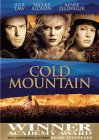
Cold Mountain: Collector's Edition
Is it better to have had something wonderful for a short time and then lose it, than to never have had it at all? That's the question at the heart of Cold Mountain, which is, among other things, an extended meditation on the way the human heart and spirit keep going in adversity.
Told in alternating scenes of "present time" and flashbacks which gradually move together in time, Cold Mountain thrusts us immediately into the horror of the U.S. Civil War, as the Confederate stronghold of Petersburg is attacked by Yankee forces. In the ensuing firefight and gruesome hand-to-hand combat, the film sticks with one of the Confederate soldiers, a North Carolina man whose name we later learn is Inman (Jude Law). The one thing that keeps him going is the thought of returning home to Cold Mountain and his beloved Ada (Nicole Kidman), whose battered photograph serves almost as a talisman to him. Meanwhile, Ada faces the lonely reality of waiting for a man who may never return to her, without the means to even know if he is still alive.
Cold Mountain is one of those uncommon films that actually merits its lengthy running time (two hours and thirty-four minutes). From the very first scene to the last, the story is always moving along, always developing in an interesting way, with new elements being woven in at various points along the way. The cast of characters is extremely well handled: apart from Inman and Ada, there are a considerable number of well-drawn and memorable secondary characters. Cold Mountain's origins in a novel (by Charles Frazier) are evident in the story's depth and richness; we get the sense that these are characters with lives beyond what we see here, and that their stories are just some of many in a richly textured world. The only note that doesn't ring quite true in the film is a minor one: the uneven accents. Jude Law manages to not sound British, but he certainly doesn't sound like a North Carolinian; Nicole Kidman does a bit better, though her accent doesn't hold a candle to the fully authentic one of Renée Zellweger.
Cold Mountain pulls no punches when it comes to depicting the struggle for survival in the war-torn South. The ravages of war extended far beyond the battlefields, as law and order broke down in towns virtually emptied by the enlistment of all but the oldest and youngest men. With a shattered economy and the constant threat of either harassment by "Home Guard" or invasion by the Yankees, the daily life of the women trying to keep things going at home ranged from difficult to brutal. Cold Mountain's dual threads of narrative, with one thread following Inman and the other following Ada, depict these hardships through two different perspectives. In Ada's half of the tale, we see how the townspeople we've come to know in the flashbacks try to help each other to survive. Ada, raised as a "young lady" and versed in accomplishments such as reading Latin and playing the piano, finds an unlikely ally and friend in rough-spoken but practical Ruby Thewes (Renée Zellweger, who won an Academy Award as Best Supporting Actress for her performance here). Meanwhile, Inman's story is more picaresque, as his travels take him across the path of various other characters, all of whom are trying to survive in one way or another.
As a historical film, then, Cold Mountain does a remarkable job of evoking the chaos and social breakdown of the South in the Civil War, but that's really just the wrapping around the central story of the film, which is the relationship between Inman and Ada. We learn early on that the two barely know each other, and have exchanged only a handful of words before Inman left to join the fighting; what the film asks us to ponder is "How much is enough?" As time goes by, each character becomes more and more of an abstract idea to the other: the idea that there will be a life after the war, the idea that there's something worth waiting and struggling for. If the thought of love keeps each of them going, does it matter whether it's real? Will that thought be enough to sustain both of them, and will it last the contact with reality?
In this way, Cold Mountain's love story works far better than the more typical one of "true love separated by adversity" because we can see that their relationship is founded on their need for something to believe in. What we're interested in seeing, as the film develops, is how that imagined relationship stands up... both to adversity, and to the possibility of actually becoming reality. Cold Mountain asks us whether it's worthwhile to have something beautiful for only a moment – namely, the brief time that Inman and Ada know each other – even if you can never have it again. And while I won't reveal the ending to the film, I'll simply comment that the conclusion is very well handled, and leaves some of those questions for the viewer to continue thinking about.
The DVD
Cold Mountain is a two-DVD set, nicely packaged in a slim single-wide keepcase. The film appears on the first disc, and the bulk of the bonus materials are on the second disc.
Video
Visually, Cold Mountain is stunning on DVD, with one of the nicest transfers I've had the pleasure to see in quite a while. The film is presented in its original 2.35:1 widescreen aspect ratio, and is anamorphically enhanced. The level of detail is impressive, and overall the image looks sharp and finely textured, with edge enhancement invisible to all but the most searching eye. Colors are presented very well, with a level of subtlety that allows for slight shifts in tone to capture the mood of particular scenes, from the golden, sunshine-filled flashback scenes on Cold Mountain to the bleak grays and blues of winter in the mountains. The print is in pristine condition, with no flaws or noise appearing anywhere in the image.
Audio
The DTS 5.1 soundtrack is a delight to the ear, though the Dolby 5.1 option is no slouch either. The sound is rich and full, with all the elements of the track (music, dialogue, sound effects) nicely balanced. Surround sound is put to extremely good use here, with a continual sense of immersion in the world of the film; the battle sequences are particularly impressive as well. Could this track sound any better? I don't think so.
Extras
Miramax didn't stint with the special features for this Collector's Edition; the bonus content here certainly merits the two-disc treatment. On Disc 1, fans of the film will be pleased to find a full-length audio commentary track from director Anthony Minghella and film editor Walter Murch.
Disc 2 contains the rest of the bonus materials, and they're quite substantial. Taking center stage is a 73-minute documentary on the making of the film, called "Climbing Cold Mountain." It's a substantial and interesting piece, touching on all aspects of the making of the film, from creating the screenplay and doing location scouting, to production design, to shooting and publicity. Various members of the crew as well as the cast are interviewed at various points throughout the documentary, making for a very informative piece overall. Another "making-of" documentary is also included, called "A Journey to Cold Mountain"), but this 29-minute piece is simply a promotional-style piece, and not even remotely as interesting as "Climbing Cold Mountain."
Eleven deleted scenes are included, running about twenty minutes in all; they're in fairly rough format, indicating they were most likely cut early in the process. A play all feature is conveniently included here. Film buffs will likely also be interested in the storyboard comparisons for three scenes, which total about eleven minutes. "Sacred Harp History" is a four-minute piece giving some background information on the 19th century songbook that served as a source for the music of Cold Mountain.
One last special feature is somewhat unusual. "The Words and Music of Cold Mountain" is the recording of a kind of celebration of Cold Mountain, performed live at Royce Hall. The performance runs a bit over 90 minutes, and includes a lengthy and interesting interview with director Anthony Minghella. Following this are readings from the original novel and live performances of some of the songs in the film.
Final thoughts
With Cold Mountain: Collector's Edition, Miramax has graced a lovely, thoughtful, and rich film with an outstanding transfer and a hefty load of special features. In a film that makes such extensive use of landscape and visual imagery as Cold Mountain, it's especially nice to see a spotless transfer like this; while it's not often that I give five stars to anything, I really can't see how Cold Mountain could look or sound much better than it does. As one of the best films and certainly one of the best DVDs I've had pass through my hands this year, Cold Mountain earns a DVDTalk Collector's Series rating.
|



| Popular Reviews |
| Sponsored Links |
|
|
| Sponsored Links |
|
|
| Release List | Reviews | Shop | Newsletter | Forum | DVD Giveaways | Blu-Ray | Advertise |
|
Copyright 2024 DVDTalk.com All Rights Reserved. Legal Info, Privacy Policy, Terms of Use,
Manage Preferences,
Your Privacy Choices 
| |||||||