
| Reviews & Columns |
|
Reviews DVD TV on DVD Blu-ray 4K UHD International DVDs In Theaters Reviews by Studio Video Games Features Collector Series DVDs Easter Egg Database Interviews DVD Talk Radio Feature Articles Columns Anime Talk DVD Savant Horror DVDs The M.O.D. Squad Art House HD Talk Silent DVD
|
 DVD Talk Forum |
|
|
| Resources |
|
DVD Price Search Customer Service #'s RCE Info Links |
|
Columns
  



 
|
|
|
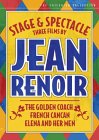
Stage and Spectacle - Three Films by Jean Renoir
Jean Renoir is one of cinema's finest directors. Son of the impressionist painter Pierre-Auguste Renoir, Jean served as a pilot in WWI, and after the war turned, eventually, to film. He was at the helm of several excellent pictures, including the classics The Grand Illusion, and Rules of the Game, both of which are available on DVD from Criterion. For their latest release, Criterion has again turned to Renoir, but this time they have put out a trio of films from later in the director's life. Under the title Stage and Spectacle, this boxed set contains The Golden Coach, French Cancan and Elena and Her Men, three of Renoir lighter movies.
When talking about his films, Renoir once said, "I tried to establish a kind of confusion between acting on a theatrical stage and acting in life." He did that successfully with these three films.
The Golden Coach (1953):
A troupe of actors arrives in a small town in 18th Century Central America. Soon after they arrive, the lead actress of the company, Camilla (Anna Magnani,) is set upon by a trio of suitors including the local Viceroy Ferdinand (Duncan Lamont). The three try to woo her by offering what they think she would like the most. The Spanish officer wants to settle among the Indians with her. The torero offers his glory, but the Viceroy gives her his magnificent golden coach, much to the irritation of his mistress.
This is a very colorful, amusing, and interesting movie. Each of Camilla's three suitors sees a different aspect of her, and thinks that she is the perfect woman for them. But none of them see her as she sees herself.
The music by Vivaldi is excellent, and fits in well with the scenes. Renoir wrote the script while listening to the famous composers works and thought of him as a partner in the writing. He once commented "It is wonderful to have someone who has been dead for several hundred years as your associate, because he never objects."
Anna Magnani gives an outstanding performance as the attractive Camilla. She seems so at ease with the role, you wonder if that sort of thing didn't happen to her all the time. While the rest of the cast is competent, they all pale in comparison to Magnani's stellar acting. This light and breezy comedy is the best film in the set.
French Cancan (1955):
This film is Renoir's tribute to the Moulin Rouge. Henri Danglard (Jean Gabin) is a promoter teetering on the brink of bankruptcy. He stumbles upon the idea of bringing back the Cancan and launching a club with a washerwoman, Nini (Françoise Arnoul) who is also a talented dancer. A pair of love triangles involving Nini and Henri and their old lovers complicates matters, but Henri is determined to open up his new club, the Moulin Rouge.
This is a really charming movie, with some wonderful music and great production numbers. Jean Gabin, one of my favorite French actors, does an excellent job as the down on his luck promoter, and Arnoul is wonderful as the girl who has to decide what she wants out of life.
Renoir's attention to detail is superb. The sets are decorated with period items and everything is colorful. The dancers and stage personnel running about make you feel that you are back in Paris of by gone days.
The closing number is a grand spectacle, something that I wouldn't have thought Renoir would have ever filmed, bases on his early work. Renoir makes it work wonderfully though. The lines of girls dancing are exciting and colorful without being over the top and gaudy. This ten-minute scene is a great climax to the film.
While this movie has more drama that his previous film, it is still light in tone for the most part. Renoir does a good job of keeping the action moving with a lot of drama and some humor. This is a wonderfully made film.
Elena and Her Men (1956):
The Polish princess Elena Sokorowska (Ingrid Bergman) juggles several men in pre-WWI Paris. She is engaged to a shoe magnate, but still interested in ambitious men. She gets introduced to General Roland who falls in love with her. Some people want Roland to seize power, and they enlist Elena in their cause.
This film is loosely based on French politics of the 1880's when the French government was very weak. General Georges Boulanger was being touted as someone who might be able to seize power, and several factions were hoping that he would. In reality his chance came, and he let it pass. He fled to Belgium where he lived in exile for the rest of his life. In this film Boulanger's name has been changed to Roland, but the situation is very similar, except that Renoir attempts to turn the movie into a farce.
This is not my favorite Renoir movie. Bergman is absolutely beautiful in the film, but that isn't enough to save it. Renoir tries to turn this into a mapcap comedy in parts, but I think it fails to a large extent. The scene where Elena tries to hide from the General at the engagement party felt flat to me. There are some good scenes in this film, especially the kiss at the end, and the Bastille Celebration at the beginning. Aside from that it just doesn't work for me. The movie isn't really all that funny, and the plot is too convoluted and a tad confusing.
The DVD:
This set in presented in three individual Amaray cases that come in a colorful slipcase.
Audio:
All three films come with the original mono soundtrack. All three films sound very good for films made almost 50 years ago. The musical accompaniment sound clean and clear, with the high notes coming through strong. The dialog is easy to discern, and there is no noticeable hiss. A good sounding DVD.
Video:
The full frame video is excellent. Criterion has done another wonderful job in presenting these films. The colors are bright and vivid and there is an excellent amount of detail. A couple of the scenes in the movies do lose some detail in the shadows and dark areas, but this is a minor complaint.
The Extras:
There are a good number of extras spread across these three DVDs. There are introductions by Jean Renoir to both The Golden Coach and Elena and Her Men, as well as an introduction to The Golden Coach by Martin Scorsese. Peter Bogdanovich introduces French Cancan. In addition to this, there is the second part of a BBC documentary, Jean Renoir—Hollywood and Beyond. A three-part interview with the director, Jean Renoir Parle de Son Art, conducted by director Jacques Rivette is included also. Lastly there is an interview with the set designer for French Cancan, Max Douy.
Final Thoughts:
While I admit that I prefer Renoir's earlier work to these later efforts, this is a fine set. The first two films are wonderful comedies, and while I didn't particularly care for Elena and Her Men, it did feature the gorgeous Ingrid Bergman. People only familuar with Renoir's earlier work might be taken back by the lighter tone that these movies have, but they are all finely crafted works, that deserve to be in the Criterion Collection. Recommended.
|



| Popular Reviews |
| Sponsored Links |
|
|
| Sponsored Links |
|
|
| Release List | Reviews | Shop | Newsletter | Forum | DVD Giveaways | Blu-Ray | Advertise |
|
Copyright 2024 DVDTalk.com All Rights Reserved. Legal Info, Privacy Policy, Terms of Use,
Manage Preferences,
Your Privacy Choices 
| |||||||