
| Reviews & Columns |
|
Reviews DVD TV on DVD Blu-ray 4K UHD International DVDs In Theaters Reviews by Studio Video Games Features Collector Series DVDs Easter Egg Database Interviews DVD Talk Radio Feature Articles Columns Anime Talk DVD Savant Horror DVDs The M.O.D. Squad Art House HD Talk Silent DVD
|
 DVD Talk Forum |
|
|
| Resources |
|
DVD Price Search Customer Service #'s RCE Info Links |
|
Columns
  


 
|
|
|
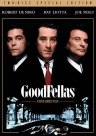
Goodfellas
Gangster movies are fun. Something like Get Shorty can make the antics of hipster wiseguys a real kick, especially when played by slick stars with ultracool dialogue to mumble. Even the crime films of Michael Mann feature designer hoods pulling off brilliant robberies and proving their soulful superiority whether or not they beat the system.
Martin Scorsese's Goodfellas changes our perceptions of hoods forever. This is a true story of a middle-level thug in the 50s, 60s and 70s who had a grand time raking in illicit dough while terrorizing anybody he pleases and laughing at the square nobodies who waste their time holding down real jobs. The main identification figure is a nefarious bad guy who does terrible things. The movie is frightening in a disturbing way; as a crime film it has has yet to be bettered. It's probably Scorsese's best crimer ever.
They're tacky, crude, abusive, arrogant, profane, destructive, mendacious, venal hoodlums, and in Goodfellas we live with them for about 2.5 ultra-tense hours. The talented Ray Liotta has been dogged for the rest of his career by his perfect impersonation of the sharklike Henry Hill; he's so slimy in the movie that his face brings chills of recognition. Robert De Niro gets top billing but has a subdued presence; most of his crimes aren't shown directly so we forget that he's easily the most ruthless murderer of the bunch. And this film made Joe Pesci; he'd soon be playing a loveable comedy crook for Home Alone, but I can't see him in anything without being reminded of Tommy DeVito, a horrible loose cannon compensating for his damaged ego with ever-escalating brutality.
Liotta's Henry Hill character narrates in an unapologetic "this is what happened and so what?" tone indicating that his only regret is that he couldn't keep doing his crimes and reaping his loot forever. Also narrating from time to time is his opportunistic wife Karen, an excellent choice that lets us in on what it's like to be seduced into criminal irresponsibility by a charming wolf with lots of money to spend. These people go through money faster than they can steal it, squandering money on ostentatious displays and grandiose tips. Utterly worthless people, they seem to crave the validation of being treated like princes.
These people show no restraint whatsoever. For all but the most serious crimes, their mafia organization makes them untouchable - the police and the judges are all fixed. Their streetwise cadres can enforce their will on anybody and anything that gets in their way. We get chilling examples of their clout when they terrorize a U.S. mailman, and steal half a million dollars through inside connections at the airport. The old boys, the "made men" have things sewn up so well that they can run their feifdoms by verbal messages alone.
Our three young Turks fall victim to different character flaws that overturn any notions we had about honor among thieves. De Niro's Jimmy Conway goes paranoid after a big heist and starts "whacking" his many confederates, one by one. Not only does it keep them from talking to the law, it also plays into his guilt-free desire to keep all of the money. It doesn't matter if a victim is a drinking buddy for the past 20 years, he gets it just the same. Joe Pesci's Tommy is a budding psycho who expresses his rage through unplanned bursts of violence. Half of what he does is a sick joke, and he himself doesn't seem to know the difference between verbally abusing somebody, and killing them. Soon enough we're choking on the "humor" of Tommy blasting down an innoffensive errand boy. Tommy DeVito is so horrible that audiences forget to be relieved when he gets his ironic just desserts - Evil that pernicious can't be gotten rid of so easily.
Henry Hill doesn't want to kill anybody and is therefore a more identifiable creep. His avaricious consumer meltdown has a familiar ring - he gets to do what lots of us think about in our morbid daydreams. Endless consumer goods, clothing, vehicles, all sourced through drug money. But Henry self-destructs the same way many of us moght, through snorting his own goods and losing control of his operation. At the height of his coke-induced paranoia (brilliantly expressed through the nervous editing of Thelma Schoonmaker and James Y. Kwei) he's allowing his mistress (Debi Mazar) to run a drug processing apartment with paraphernalia lying about covered in cocaine dust. He's trying to make his crime deliveries while running an overheated personal family schedule, and while flying so high he can't think straight. He's finally done in by a sloppy associate, but it could have been any of 50 ways. He so zonked on coke he can't tell real surveillance helicopters from imagined ones.
We watchers of standard crime films have come to expect scenes of remorse and grief, and attempts at atonement garnished with an occasional self-sacrifice to make things right. The end of Henry Hill and Co. has no such sentiments. Caught dead to rights by Federal cops, Hill and his upset wife still act inconvenienced and make incensed demands of their captors as if they still had cards to play. They still expect to get exceptional treatment, as if they were the ones owed something. They're like hit and run drivers who when caught by the cops and the insurance company, come back demanding that their victims pay damages.
For those of us who still run their lives with ethical standards (say what?) in mind, watching Goodfellas generates an overwhelming despair. Is this really how the world works? That response probably militates against Scorsese's films finding larger audiences. As the original Daily Variety reviewer said of Raging Bull, "Martin Scorsese makes films about people you don't want to know." I sweated through my first viewing of Goodfellas in 1990 and knew it was a masterpiece, yet I've never been tempted to watch it again until now. It's as good as ever.
Martin Scorsese's filmmaking skill here is so finely honed that breaking down the show into its component graces is a tough order. Music is used extremely well, especially one rock'n roll number (Layla) that counterpoints a series of horrible murders. The mix of narration and nervously jumping time frames also works exceptionally. It's difficult to take one's eyes off the screen.
Warners' DVD of Goodfellas more than atones for the early flat flipper disc that's been around now for seven years. The new enhanced transfer is on one disc with two engrossing commentaries. The filmmakers' track is chock-full of information and insights, but the second Cop and Crook track is a valuable cultural artifact. It features both the real Henry Hill and the real agent who set up his witness protection plan. Theirs is obviously a unique point of view, and the track is fascinating.
Disc two has a fistful of interesting docus starting with new and old making-of featurettes. The Pesci, DeNiro and Scorsese interviews are all vintage. The only predictable piece has contemporary directors talk about how they were influenced by Goodfellas. Considering the quality of most of their work, we wish they'd use the time making better movies. Scorsese may be oversold as the cinema conscience of the country, but he's the real deal, a superb moviemaker.
The set's two discs are packed into a normal-sized case, an arrangement preferable to the fancy card-plastic containers that are hard to keep straight, and difficult to protect from damage.
On a scale of Excellent, Good, Fair, and Poor, Goodfellas rates:
Movie: Excellent
Video: Excellent
Sound: Excellent
Supplements: Two commentaries — the Cast and Crew with Scorsese, Pileggi, Liotta, Bracco, Vincent, Sorvino, producers Irwin Winkler and Barbara De Fina, cameraman Michael Ballhaus and editor Thelma Schoomaker; Cop and Crook commentary with Henry Hill and lawman Edward McDonald; featurette Getting Made with Bracco, Pileggi, and Liotta (new), De Niro, Scorsese, and Pesci (old); featurettes The Workaday Gangster, Made Men: The Goodfellas Legacy and Paper is Cheaper Than Film.
Packaging: 2 discs in Keep case
Reviewed: August 15, 2004
| |
|



| Popular Reviews |
| Sponsored Links |
|
|
| Sponsored Links |
|
|
| Release List | Reviews | Shop | Newsletter | Forum | DVD Giveaways | Blu-Ray | Advertise |
|
Copyright 2024 DVDTalk.com All Rights Reserved. Legal Info, Privacy Policy, Terms of Use,
Manage Preferences,
Your Privacy Choices 
| |||||||