
| Reviews & Columns |
|
Reviews DVD TV on DVD Blu-ray 4K UHD International DVDs In Theaters Reviews by Studio Video Games Features Collector Series DVDs Easter Egg Database Interviews DVD Talk Radio Feature Articles Columns Anime Talk DVD Savant Horror DVDs The M.O.D. Squad Art House HD Talk Silent DVD
|
 DVD Talk Forum |
|
|
| Resources |
|
DVD Price Search Customer Service #'s RCE Info Links |
|
Columns
  


 
|
|
|
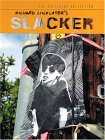
Slacker: Criterion Collection
The Movie
Slacker, Richard Linklater's landmark 1991 independent film, is ostensibly a celebration of Austin's self-proclaimed "slacker" culture, a loose-knit hodge-podge of eccentrics, oddballs, loners, artists, intellectuals, anarchists, pseudo-intellectuals, conspiracy theorists, superfreaks, what-have-you. The film, as it were, presents no driving narrative, no real plot to speak of, and nary a whisper of a storyline. Linklater's film starts with a single character - a young man stepping off of a bus (played by Linklater himself) - who has evidently spent hours mentally tumbling with Schrodinger's feline. Stepping into a taxi, he wildly relates his flexible theories vis-à-vis the space/time continuum to a completely unresponsive and uninterested driver. Exiting the taxicab, he witnesses a hit-and-run accident in which an elderly lady is left seemingly dead in the road. As he runs to a payphone to contact authorities and the woman's relatives, the camera pans back down the suburban street, into a driveway as a car quickly pulls in - the same car that hit the elderly lady. As it turns out, the driver of the car was the woman's own son, and the camera follows him into the house. He receives a phone call from the witness up the street, informing him of the accident. He nonchalantly plays it off, and turns to some rather bizarre activities: clipping pictures out of a high school yearbook and burning them, and playing home movies featuring a mother and son on a continuous loop The cops arrive and arrest him, an event witnessed by a local musician. This musician ends up writing and performing an impromptu song about the arrest, which is overheard by a young lady heading to a coffee shop. And this young lady...
This chain of events continues throughout the course of 100-minute film. Rather than existing as an intricate demonstration of causality and collectivity of consciousness and responsibilty, a la Phil Hay's and Matt Manfredi's masterful Bug of 2002, Slacker simply acts as a wandering eye, passing from character to character, peering at various events, conversations, insights, and whispers. The viewer's appreciation of Linklater's film rests solely upon their tolerance for such a conceit. The phrases "tone poem", "contemplative meditation", "cinematic exercise free from the constraints of traditional narrative" are inevitably thrown around when discussing Slacker. The truth of the matter is that the film showcases a searing and often joyous blast of independent cinema, eschewing conventional prefabricating storytelling and narrative drive and presenting various "slices of life" that permeate slacker culture. Perhaps there is a thread of commonality weaving through this series of continuous vignettes, a universality of human condition that Linklater is trying to expose or put on display or condemn or condone. Then again, maybe Linklater simply wants to bend his ear and listen to the rhythm of the late 80s/early 90s bohemian subculture. If there isn't a singular point or plot, there's certainly a vibe and a sense of movement throughout the film.
If I noticed anything that seemed to present something of a theme in Slacker, it was that the people presented in the film were either (a) vainly looking for something that they did not possess, (b) seemingly bursting with something, anything, to share with the world, but were either unable or unwilling to properly open up or express themselves accordingly, or (c) obliquely and/or blissfully trapped within the confines of their own consciousness/self/pscyhe. It's easy to chortle at the conspiracy theorist ghag follows people home and annoys them past the point of polite tolerance, or the crazy lady at the lunch counter who drones endlessly about sexual exploitation and her imaginary medical degree. Easily the most compelling vignette deals with an old Anarchist (played by Louis Mackey), who encounters an armed robber in his home. He takes the robbery in stride, and soon afterwards escorts the robber on a walking tour of Austin, cheerfully and amiably sharing his theories on the destructive and selfish nature of humanity. It's so well played, so beautifully delivered, and so haunting that it somehow (in my view) emerges as the film's spiritual pulse.
I don't think Slacker is a perfect movie. It goes on a bit too long, and many of the scenes try the patience of the most hardened of avid independent-cinema fans. But just when the film seems to meander a bit too much, it tilts again and presents some remarkably compelling material. The film ends abruptly with a group of revellers, forcing the viewer to reflect upon the seeming randomness of the preceding 100 minutes. Was there a point to be made, or did Linklater simply meander without reason or rhyme? Or was the deepest, most esoteric secrets of life hidden somewhere within Madonna's pap smear and Coke-stealing peeping toms? If there's anything to be glamed from Slacker, it's all in the grinding of the tale and wandering eye of the cinema. Thirteen years later, even surrounded by a host of mediocre imitations, Slacker still maintains its urgent potency.
The DVD
Video:
Slacker is presented in its original, full-frame aspect ratio of 1.33:1, sporting a brand-newest digital restoration supervised by Richard Linklater and DP Lee Daniel. The resulting video probably looks as magical as Criterion could allow. I say probably because, objectively, the film was originally shot on 16mm on a budget that cost less than your car, and the inherent limitations of the utilized film stock will pretty much guarantee that Slacker will never look like Finding Nemo. On the plus side, the transfer is pretty clean throughout, free from distracting dirt, debris, scratches, compression noise and blocking. Colors are stable and richly rendered, with smart contrasts and a remarkably stable picture. Image detail varies, with sharpness levels ranging from very soft to acceptable. The 16mm grain structure is notably evident throughout the transfer, retaining the original film-like appearance. Some might view the grain levels as excessive; others will view it as a natural and acceptable by-product of the film's original delivery. Your mileage may vary. The transfer falters a little in its shadow delineation, in which a few scenes seem a little lifeless during moments of flat darkness. Other than that, there's very little for which once can really complain about this transfer. The flaws in the transfer are generally relatable to the original source material, and keeping that in mind Slacker looks very impressive.
Audio:
The audio is presented in a mostly monaural Dolby Digital 2.0 soundtrack, and has also been restored by Criterion. The mix is remarkably clean; this movie is driven by its quirky dialog, and it is presented without hiss, noise, or distortion. Dialog volume is remarkably crisp. The subtlest of lines, whispered dialog, and throwaway observations are reproduced with brightness and clarity, without requiring the viewer to dive for their remote to catch what's going on. Background noise and music are kept mostly in the frontstage, save for a bit of score and music over the final credits in which some noticeable surround activity is evident. Overall, this is a clean and pleasing transfer that doesn't need multi-channeled aggression or immersion to create a satisfying audio experience.
Extras:
Buckle up.
Disc One
The supplements on Disc One start with not one, not two, but three audio commentary tracks. The first track features director Richard Linklater. Recorded in March 2004, Linklater talks animatedly and engagingly throughout the entire commentary. Linklater considered his film to be a "kitchen sink" film, an organic and collaborative work that grew out of his desire to create something that culled multiple experiences, local/urban legends, and varying points-of-view. He provides a host of screen-specific remarks that detail individual vignettes, information about the cast and crew, and a wealth of production anecdotes. A fine commentary track, this is essential listening for fans of the film.
The second commentary track features various members of the cast (Rudy Basquez, Jerry Delony, Scott Marcus, Gina Lalli, Louis Black, Sarah Harman, John Slate, Kathy McCarty, Kalman Spelletich, Scott Rhodes, R. Malice, and Wammo), recorded in 2001 and 2004, who obviously provide commentary during the scenes in which their characters appear. From actor/edit Scott Rhodes we immediately learn where the term "slacker" originated, as well as how it applies to this film; we then seigue into Rudy Basquez's commentary, he who played the taxi driver who picked up Richard Linklater's character off of the bus, and so forth and so on. Each participant provides insightful information towards the production and their characters. While not as compelling as Linklater's commentary, it still makes for an interesting and moderately engaging track.
The third commentary features a conversation with the crew, this time consisting of director Richard Linklater, director of photography Lee Daniel, and co-producer Clark Walker. These three members of the legendary "Slacker Seven" talk about their close-knit friendship that revolved around the Austin Film Society, and provide a feature-length, more technically-oriented discussion about the production. While moderately enjoyable, it's easily the least compelling and most technical commentary on the disc. Still, it is more than worth a listen.
The Supplements A-Go-Go section (a snarky nod, if there ever was one) is broken down into five sub-sections:
No Longer: Not Yet contains text pages from the original script for No Longer: Not Yet, the original title for Slacker. The film is broken down into forty-five separate sequences, many of which ended up in the final film.
Showing Life is dedicated to the unique cast of the film, most of which had little or no acting experience and many having been literally pulled "off the street" to participate in the film. It contains a text intro by casting director Anne Walker-McBay and fourteen minutes of cast interviews.
Taco-And-A-Half After 10 contains twelve minutes of home-movie footage shot on the set of Slacker. It's not the most memorable of footage, but it nonetheless provides for a moderately interesting "behind-the-scenes" look.
Les Amis is a ten-minute trailer (!) for Nancy Higgins's film Viva Les Amis, a film dedicated to the legendary Austin restaurant that was home to slackers, artists, intellectuals, and various eclectics throughout the Austin community. A victim of corporate uniformity, the restaurant was closed when, due to the technology boom of the nineties, it could no longer afford its skyrocketing rent and now houses something called "Starbucks" (never heard of 'em). The trailer looks at various other local landmarks that were closed and replaced with national chains and franchises, and showcases some of the local talent, artists, musicians, and employees that made a home out of Les Amis. For a trailer, this was one hell of a short feature. I would love to see the finished product.
Shooting From The Hip contains dozens of behind-the-scenes and publicity photographs of various members of the cast and crew. There is also an Easter Egg containing the entirety of a text essay entitled Austin and the Fine Tradition of Slack by R. U. Steinberg (I am not.) To find it, go to the Supplements A-Go-Go section, highlight "Shooting From the Hip", press the left arrow on your remote, and press "Enter."
Now on to Disc Two...
The primary extra on the second disc is It's Impossible To Lean To Plow By Reading Books , Richard Linklater's 1988 film and his first full-length feature, presented in its entirety. The 85-minute film is presented for the first time on home video in this collection, and is displayed in its original full-frame aspect ratio and monaural Dolby Digital 1.0 sound. The quality of the transfer is shaky, grainy, soft, and of somewhat limited resolution. It was shot on Super-8, so exactly what else would someone expect?
Linklater delivers a feature length audio commentary in which he discusses the influence of movies on his own personal development, and how he wanted to depict his current life through the cinematic medium. The film itself is described as an "oblique narrative" and "visual experience", and a meditation on alienation, although to many that might translate to "pretentious and meandering self-indulgence." So be it. I somewhat enjoyed the film, with its long takes, quiet observations, and its stark presentation of quiet isolation. Could it have been trimmed and judiciously edited? Sure. But as a debut feature, it displayed a lot of promise upon which Linklater definitely delivered with his later work.
Our look into Linklater's cinematic past continues with Woodshock , a 16mm short film shot by Linklater and Lee Daniel, chronicling the 1985 Woodshock music festival. Linklater and Daniel attempted to pay homage to sixties cinematic psychedelia with this seven-minute short. And if you took one look at Woodshock, you'd be hard-pressed to convince anyone that this was filmed at any time later than 1968. In that regard, the short is a rousing success. It also demonstrates an amateurish but promising cinematic eye that would come into fruition with later films.
The Austin Film Society section details information about the AFS, which was co-founded in 1985 by Linklater. This section contains an article by Denise Montgomery, an essay by Lee Daniel, and reproductions of several flyers produced during the first ten years of the society's existence. A quick perusal shows that the AFS hosted screenings of various independent, foreign, classic, and experimental films, featuring works by Bunuel, Anger, Fassbinder, Minnelli, Dreyer, Bresson, Pasolini, Kubrick, Renoir, Brakhage, Ozu, Fuller, Cassavetes, Bergman, and many others. You know... would it have killed these guys to have packed up their stuff and moved to Miami in the mid-1980s? We had nothing like this here. Grrr....
Moving right along... Aint No Film In That Shit contains some further bonus material. The Roadmap contains the entire text working script of the film, broken down into 55 separate sequences and highlighted by fourteen deleted scenes and alternate takes. You can view the scenes with or without viewing the working script by utilizing the "Play All" function.
Rounding out the supplements are the film's three-minute original theatrical trailer, a text reproduction of Linklater's 1991 essay on "Slacker Culture", and a twenty minutes of video footage shot during the 2001 tenth anniversary screening of the film.
Final Thoughts
Boasting a wonderfully restored digital transfer and several hours worth of high-quality bonus materials, Criterion's release of Slacker on DVD makes for one of the most exhaustive and comprehensive DVD collections ever, even judged by their own inimitably high standards. Fans of the film will be absolutely elated, both with the presentation of the material and the absolutely copious amount of extras: three commentary tracks, the original and final shooting script, on-set video footage, trailers, interviews, deleted scenes, alternate takes, photographs, and more. Yet this two-disc set is not just a comprehensive examination of Slacker, as it also celebrates the early career of Richard Linklater, and the inclusion of his first feature-length film (with commentary), a short film, essays, involvement with the Austin Film Society, and more add up to a two-disc collection with nearly ten hours of bonus material... and that's aside from a fine presentation of a celebrated independent film. On that basis alone, I must award this two-disc set the highly coveted DVD Talk Collector's Edition rating. Do not let this set pass you by.
|



| Popular Reviews |
| Sponsored Links |
|
|
| Sponsored Links |
|
|
| Release List | Reviews | Shop | Newsletter | Forum | DVD Giveaways | Blu-Ray | Advertise |
|
Copyright 2024 DVDTalk.com All Rights Reserved. Legal Info, Privacy Policy, Terms of Use,
Manage Preferences,
Your Privacy Choices 
| |||||||