
| Reviews & Columns |
|
Reviews DVD TV on DVD Blu-ray 4K UHD International DVDs In Theaters Reviews by Studio Video Games Features Collector Series DVDs Easter Egg Database Interviews DVD Talk Radio Feature Articles Columns Anime Talk DVD Savant Horror DVDs The M.O.D. Squad Art House HD Talk Silent DVD
|
 DVD Talk Forum |
|
|
| Resources |
|
DVD Price Search Customer Service #'s RCE Info Links |
|
Columns
  



 
|
|
|
Tess (Ws Spec Sub Dol)
Roman Polanski's major literary adaptation is a departure from his previous filmography, but not a radical one. Tess of the d'Urbervilles is endearingly true to both her 19th century origins and Polanski's overriding themes of innocence destroyed and universal oppression. Curiously, the previous Polanski movie Tess most resembles is The Fearless Vampire Killers, another tale of woeful idealists lost in a hopelessly cruel world. Tess's richly colored English countryside is a place where the wealthy prey upon the poor as if it were the natural order of things. Our virtuous heroine learns to her woe that honesty and a true heart count for almost nothing.
Tess Durbeyfield is cursed by the discovery of her family's noble past. It's the last thing her ne'er-do-well father needed to know, as his newly-found pride is a convenient excuse to stop being even minimally responsible for his family. Tess is expected to wheedle the cost of a new horse out of distant relatives. They turn out to actually be named Stokes, having bought the d'Urberville title years ago. Old Mrs. d'Urberville is a blind, dotty nut who likes to pet her chickens, and her son Alec leverages every advantage of his wealth and security to possess girls like Tess. She's totally unprepared and easy prey for the dishonest cad. Pregnant and betrayed by her family and the church, she's one of Polanski's tragically isolated heroines.
Tess builds upon themes from Polanski's short films Mammals and The Fat and the Lean: People will always exploit other people if they can get away with it, and most of the exploited will accept the injustice. As in The Fearless Vampire Killers, the "bad" element that wants to despoil the world for its own selfish ends is just doing what comes naturally, sucking blood or demanding rent. Tess lives in a civilized, beautiful country where a woman outside the narrow bounds of social acceptability is at great risk. The rich ride in coaches while ordinary milkmaids must deal with muddy roads blocking the way to church. Not going to church is unacceptable. Arriving at church in a muddy dress is unacceptable. Allowing a young man to carry you over the mud is doubly unacceptable. The rules of goodness are just another source of oppression.
Tess Durbeyfield eventually goes down to defeat, cursed by her father's pride and her own beauty. She's also victimized by gullibililty, bad luck and the need for honesty and truth in her life. She divulges her past to Angel, who she mistakenly thinks is worthy of her. Bad timing ruins her second hope for happiness, and again Tess states that she wishes that she could die, or that she had never been born.
Tess is an intimate epic that creates a 19th century world where progressive threshing machines are transforming an ancient landscape. The beautiful cinematography doesn't resort to pretty pictures for its effects, and Philippe Sarde's romantic music almost seems to be mocking Tess' pain and suffering. Polanski uses uncommon restraint when it comes to scenes of a baby's death and a murder. The latter is represented only by a bloodstain on a ceiling.
The acting is uniformly excellent, with Nastassia Kinski's heroine an alarmingly wonderful find. Peter Firth is appropriately dreamy as the young idealist, and Leigh Lawson memorably domineering. The rest of the accomplished cast play an assortment of typically isolated and confused Polanski characters. Suzanna Hamilton has a special moment as another milkmaid who loves Angel from afar.
Columbia's Special Edition DVD of Tess features a fine enhanced 2:35 transfer, richly colored and marked only by an errant scratch or two. The added extra is a lengthy (70 minute) Laurent Bouzereau documentary broken down into three parts. Numerous crewpeople and actors are interviewed and both author Thomas Hardy and the mostly French production are covered in fascinating detail. Ms. Kinski was only 17 at the time, and the director describes the process of getting clearance from his French producers to let a German girl play a classic English heroine. Writer John Brownjohn tells us his dialogue rewrite uses the correct local dialect - he lived only a few feet away from the real English pub described in Hardy's novel.
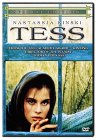
The packaging is a plain keepcase bearing images of Nastassja Kinski that don't do justice to her beauty. Columbia's liner notes give away practically every detail of the story, and misspell Ms. Kinski's name in the bargain.
On a scale of Excellent, Good, Fair, and Poor, Tess rates:
Movie: Excellent
Video: Excellent
Sound: Excellent
Supplements: Three documentary short subjects by Laurent Bouzereau
Packaging: Keep case
Reviewed: September 20, 2004
| |
|



| Popular Reviews |
| Sponsored Links |
|
|
| Sponsored Links |
|
|
| Release List | Reviews | Shop | Newsletter | Forum | DVD Giveaways | Blu-Ray | Advertise |
|
Copyright 2024 DVDTalk.com All Rights Reserved. Legal Info, Privacy Policy, Terms of Use,
Manage Preferences,
Your Privacy Choices 
| |||||||