
| Reviews & Columns |
|
Reviews DVD TV on DVD Blu-ray 4K UHD International DVDs In Theaters Reviews by Studio Video Games Features Collector Series DVDs Easter Egg Database Interviews DVD Talk Radio Feature Articles Columns Anime Talk DVD Savant Horror DVDs The M.O.D. Squad Art House HD Talk Silent DVD
|
 DVD Talk Forum |
|
|
| Resources |
|
DVD Price Search Customer Service #'s RCE Info Links |
|
Columns
  


 
|
|
|
500 Nations
When I was in college I took several history courses as electives. After a series of high school 'social studies' teachers had managed to make even the most intriguing and interesting areas of history come across as dry and dull, an introductory class in college sparked an interest in learning about our past. While browsing through the course catalog trying to arrange my classes for the following semester one year, I realized that there were classes on the place of African-Americans and women in America, but no classes were offered on Native Americans. This caused me to think back on my earlier education, and I realized that the only time Indians were discussed in school, for the most part, was when the first Thanksgiving was described in elementary school. Sure, I knew that the US pushed them off their traditional lands and onto reservations, but I found it quite strange to have gone through 12 years of public education and barely touched on the people who inhabited the land before Europeans arrived.
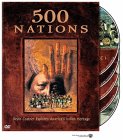
To cover this gap in knowledge that many Americans seem to have, Kevin Costner produced and hosted the1995 miniseries 500 Nations. This painstakingly researched and very thorough documentary relates the history of Native Americans both before European settlers arrived, and after. The series has recently been released on DVD in a very nice boxed set including all eight episodes in the series, a new introduction and concluding remarks by Kevin Costner, and a CD-ROM filled with images and other archival material.
The show starts where the story ends, at Wounded Knee where hundreds of Indians, men, women and children, who had given up their weapons were massacred by the US army. The narrative then travels into the past, to the earliest known inhabitants of Central and North America to describe their culture and place in history. From then on the program takes a more or less chronological examination of Indian tribes and some of their most important leaders and events that shaped their destiny.
The show examines many aspects of Native American life, not just where they lived and when. Indians lived in just about every ecosystem from the jungles of Central America to the dry and arid desert and even the bitterly cold north. The program discusses how tribes managed to exist and even thrive in such harsh enviroments, and how the tribes interacted. Trade patterns among the different tribes are discussed as is the way that commercial hunting changed trade patterns and the effects that it had on some tribes.
But this isn't just a compilations of Indian tribes being examined, a very important aspect of the show is what happened when Europeans settled. This series also depicts the often brutal and unpleasant results of interaction with foreigners. It covers the Conquistadors arrival in Mexico, how many Indians were enslaved by settlers in the New World, and it discusses such pivotal events as the Indian Removal Act of 1830.
Even though the stories often end sadly, there are some incredible stories told. I particularly liked the chapter on the Aztecs and story of the great Indian warrior Tecumseh, and his brother the prophet Tenskwatawa. The treatment of the Indians is often not pleasant, and there is a section in the prologue where they describe an Army surgeon who was in the Civil War blanches at the wounded women and children from Wounded Knee. Some of the images and discussions might be a little too strong for younger children.
Told through photographs, contemporary accounts, paintings, CGI recreations and interviews with historians, 500 Nations is filmed on location were the events it describes actually takes place. The photography is wonderful and simply breathtaking at times. The music used, often Indian songs, fits very well with the subject and enhances the contemporary location footage.
Many of the Indian cities and encampments no longer exist, even as ruins, so the show recreates what these locations must have looked like with computer graphic imaging (CGI). The CGI was good even though it was done in 1995, an eternity when it comes to computer technology. The 'camera' would track down a main avenue and go into a typical dwelling, giving the viewer a better understanding of what day to day life must have been like for these native peoples.
The content of the program was very interesting and it was incredibly informative. Every episode reveled a lot of facts, even for topics that I thought I was fairly well versed in such as the Aztecs. The pace did slow down in parts, but it would soon pick up again, and I can't think of any episode that wasn't engrossing for the most part.
The series does have one fault, and that is that there isn't a single thread running through all of the shows for the viewer to follow. When you think of the best documentaries, Ken Burns' Civil War for example, when one episode or section ends, you immediately want to continue to the next part to see what happens next. I never got that feeling with this show, since there wasn't straight narrative throughout. Each section jumped to another tribe or area of the country, so when one episode ended, the next would be discussing another topic. This gave the show a bit of an academic feel, and made it a little hard to watch more than a couple of shows at one time. This shouldn't be a problem for most people who can take their time and watch the show at their own pace. Something poor beleaguered reviewers such as myself often don't have the luxury of doing.
The DVD:
This series is presented on four DVDs that come packed in a fold-out case with two DVDs per page. (One on top of the other.) I would have preferred to have only a single DVD on each page, but this is a minor quibble. There is also a bonus CD-ROM and a booklet which includes an introduction written by Kevin Costner and the episode list with chapter stops. All of this comes encased in a nice looking slipcase.
Audio:
The stereo soundtrack sounds like a standard television audio track. There isn't a huge amount of dynamic range, but the voices and dialog are reproduced faithfully. The background music sound clean, as do the sound effects. The audio is very clear, with no noticeable hiss or audio defects. While English is the only language track available, there are optional subtitles in English, Spanish and French.
Video:
The video quality was pretty good overall. Presented in the shows original aspect ratio of 1.33:1, the image was a little on the soft side, but only a little. The lines were not as tight as they could have been, but this wasn't a large defect. The colors looked very good, with the earth tones that make up much of the video being reproduced accurately, and the bright green fields of grass and snow capped mountains also being striking. There were some digital defects that crept into the transfer, with a good amount of aliasing and moire effects present, and fine lines had the tendency to jiggle. The show didn't look bad because of this, but it was noticeable. Still a good looking show.
Extras:
The DVDs themselves are a little lacking in the extra department. The only thing included is an eight minute talk with the director about the use of CGI models in the show which is presented on the fourth DVD. The biggest bonus item is the CD-ROM. It has a lot of content and is fairly easy to navigate. The packaging states that there are over 2000 images on this disc, and I have no doubt that is an accurate figure, but I wish they had been presented differently. Most of the pages on the disc have several pictures photoshopped together, and I would have much preferred being able to look at each one individually. As it is, there is an image gallery that only has about a dozen or so pictures. The nice thing about these is that there is a button to click if you'd like to set that image as your desktop wallpaper. Other than that, the bonus disc comes across as a typical interactive CD-ROM with audio clips, some animation, maps and time lines.
Final Thoughts:
500 Nations is a very good series covering a part of American history that is often portrayed inaccurately, when it is discussed at all. The most thorough and accurate look at Native Americans I've ever seen, this set can be recommended for that achievement alone. It does have its faults though, being a little slow in places and fairly dense in the amount of information that is contained in each episode. These two aspects combine to make it a little hard to watch more than one or two shows at a time. Still a very important series for fans of history and documentaries to check out. It gets a high Recommendation.
|



| Popular Reviews |
| Sponsored Links |
|
|
| Sponsored Links |
|
|
| Release List | Reviews | Shop | Newsletter | Forum | DVD Giveaways | Blu-Ray | Advertise |
|
Copyright 2024 DVDTalk.com All Rights Reserved. Legal Info, Privacy Policy, Terms of Use,
Manage Preferences,
Your Privacy Choices 
| |||||||