
| Reviews & Columns |
|
Reviews DVD TV on DVD Blu-ray 4K UHD International DVDs In Theaters Reviews by Studio Video Games Features Collector Series DVDs Easter Egg Database Interviews DVD Talk Radio Feature Articles Columns Anime Talk DVD Savant Horror DVDs The M.O.D. Squad Art House HD Talk Silent DVD
|
 DVD Talk Forum |
|
|
| Resources |
|
DVD Price Search Customer Service #'s RCE Info Links |
|
Columns
  


 
|
|
|
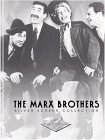
Marx Brothers Silver Screen Collection
Harpo, Chico, Zeppo (sometimes) and Grocho. Although they only made a little more than a dozen movies together, the last one released over fifty years ago, you just need to see the first names to know who I'm talking about: The Marx Brothers. The kings of wacky comedy, their films are considered classics today. To celebrate the 75th anniversary of this great team's first film, Universal has released their first five movies in the Marx Brothers Silver Screen Collection. This set has some of their absolute best movies and includes: The Cocoanuts (1929,) Animal Crackers (1930,) Monkey Business (1931,) Horse Feathers (1932,) and Duck Soup (1933.) This is a good companion to the Warner Brothers release of The Marx Brothers Collection that came out earlier this year.
Contrary to a rumor circulating around the internet, these films have not been edited. (See further down for more details.)
The Marx Brothers, and they really were brothers, had been preforming in vaudeville, both together and separately, for decades before they stepped in from of a movie camera. They started at the bottom, playing small venues in rural cities, and worked their way up the ladder culminating with a tour of England. When they returned from their British tour, the brothers had a falling out with one of the most influential men in vaudville, E. F. Albee, and they ended up being blacklisted on the major circuits. Though the other brothers were for either breaking up the act or starting at the bottom on the smaller circuits again, but Chico convinced them that they were too good for vaudeville, and that they should put a show on Broadway. Their first show, I'll Say She Is opened on Broadway in 1924 to good reviews. That show was followed by Cocoanuts in 1925 which played 275 shows on Broadway and then toured for two years. Their next play was Animal Crackers in 1928 which was also successful.
In 1927 something happened that would dramatically effect the Marx Brothers lives: The Jazz Singer. With the coming of sound, the Marx Brothers chaotic mixture of slapstick and fast paced banter could finally be translated to the silver screen. And the time was ripe for their type of verbal humor too. Slapstick was out of fashion in Hollywood; films could talk, so comedians should too. Being the star of two popular Broadway comedies, the brothers were able to make a deal with Paramount. For their first project, they settled on their play Cocoanuts.
The Movies:
Hammer : Now here is a little peninsula and here is a viaduct leading over to the mainland.
Chico : Why a duck?
Like all of the Marx Brother's movies in this set, the plot in Cocoanuts is little more than window dressing; a backdrop for their zany humor. Hammer (Groucho) is running a failing hotel in Florida. His real goal however is to strike it rich either marrying a rich widow (Margaret Dumont) or by fleecing some speculators by selling them some swamp land. Enter Harpo and Chico (they aren't given names in the film) who arrive at the hotel basically to cause trouble. Add a plot about a stolen necklace, and two young lovers who are forbidden to marry, and you have a classic Marx Brothers Movie.
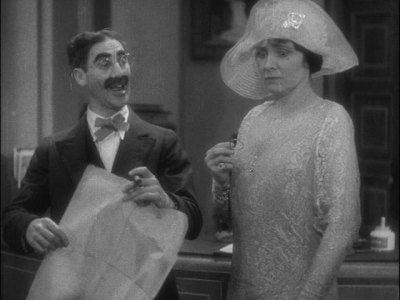
This is a funny film, and there really wasn't anything like it previously filmed. It is maniacal and crazy. The plot takes a back seat to the antics of the brothers running around leaving chaos in their path. The movie has the famous "Why a duck?" bit, as well as some other great routines, including a riotous land auction, make for great fun. One of my favorites is when Chico tells Harpo how desperately he needs some cash:
Chico : Right now I'd do anything for money! I'd kill somebody for money. I'd kill you for money.
[Harpo has a dead pan expression.]
Chico : Ha ha ha. Ah, no. You're my friend. I'd kill you for nothing.
[Harpo smiles.]
And later talking to Hammer about his plot to sell real estate:
Hammer : All along the river, those are all levees.
Chico : That's the Jewish neighborhood?
Hammer : Well, we'll pass over that.
The brothers filmed this movie in New York while they were still preforming Animal Crackers. They would film early in the morning so that the sounds of the city wouldn't leak into their sound stage, and then go on stage at night. Being an early sound picture, no one was comfortable working with microphones and they took some rather odd precations. Notice that the map Groucho shows Chico in the film is dripping wet. They soaked the prop in water so that the rustling of the paper wouldn't be picked up by the microphone.
While this is a very good start, they haven't hit their stride yet. The movie still has that Broadway adaptation feel to it, and the songs and dance numbers bring the action to a grinding halt. It would take the brothers a few films to figure out a way around this.
Chorus: Hooray for Captain Spaulding, the African explorer!
Animal Crackers is about, if it's really about anything, the famous explorer Captain Spaulding (Groucho.) He returns from Africa to attend a party thrown by (read "sponge off of") Mrs. Rittenhouse, the rich widow. While he's there, a valuable painting gets stolen and Spaulding along with two musicians, Signor Emanuel Ravelli (Chico) and his friend the Professor (Harpo,) help Mrs. Rittenhouse reclaim her expensive art.
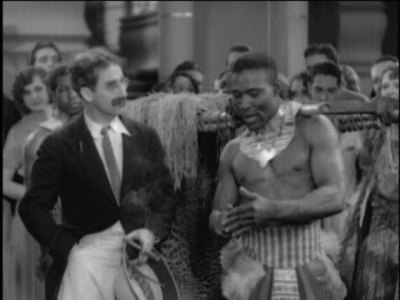
This movie, also based on a play, is still a little bit 'stagey' but flows better than Cocoanuts. While there are still musical interludes that interrupt the movie, these are generally more entertaining, with Groucho insulting Chico while he plays the piano. The ending seems to drag just a tad, but the beginning of the film is classic. The scene where Captain Spaulding enters and tells of his exploits in Africa is wonderfully funny:
Africa is God's country, and He can have it. Well, sir, we left New York drunk and early on the morning of February 2nd. After fifteen days on the water and six on the boat, we finally arrived on the shores of Africa. We at once proceeded three hundred miles into the heart of the jungle, where I shot a polar bear. This bear was six foot seven in his stocking feet and had shoes on.And the famous:
One morning, I shot an elephant in my pyjamas. How he got in my pyjamas I don't know. Then we tried to remove the tusks...but they were embedded in so firmly that we couldn't budge them. Of course, in Alabama, the Tusk-a-loosa. But, uh, that's entirely irrelephant to what I was talking about. We took some pictures of the native girls, but they weren't developed, but we're going back again in a couple of weeks.I'm surprised that the last line made it past the Hayes office.
Groucho fits so many jokes into his rapid paced monologes that it's hard to catch them all on the first viewing. Harpo shines in this film too. He's a little more chaotic and off-the-wall. The scene where Chico asks him for a flash (light) is great with Harpo pulling everything out of his coat but the one thing he needs. ("No, that's a fish....no, that's a flute...etc. etc.) A good and funny movie, but the best is yet to come.
Zeppo : Everybody seems to be having nearly as much fun as I am.
This aptly titled third film is just plain anarchy. It features the four brothers as stowaways on a ship headed for America. Also on the ship are a pair of rival gangsters who each manage to hire two of the brothers. The brothers spend most of their time on the ship causing trouble and running from the crew before they dock and get involved in a kidnaping.
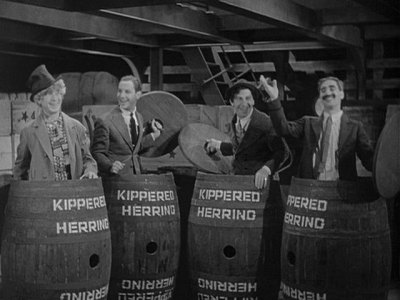
This is my second favorite Marx Brother movie. It seems to be the one that packs the most jokes in; the witty lines just start flying and they never seem to stop. There is a nice balance between the four brothers, with Zeppo (still a straight man) getting more screen time than he previously had. Of course, Groucho still has some of the best lines:
Groucho: Oh, I know it's a penny here and a penny there, but look at me. I worked myself up from nothing to a state of extreme poverty.
Groucho (to an American Indian): If you don't like it here, why don't you go back where you came from!
Higlights include the boys trying to pass themselves off as Maurice Chevalier by singing one of his songs, and Groucho impersonating a reporter and interviewing a member of society:
Groucho: Is it true you're getting a divorce as soon as your husband recovers his eyesight? Is it true you wash your hair in clam broth? Is is true you used to dance in a flea circus?
Madame Pucchi: This is outrageous! I don't like this innuendo.
Groucho: That's what I always say. Love flies out the door when money comes innuendo.
A wacky comedy full of laughs. You can't go wrong with this movie.
Professor Quincy Adams Wagstaff : Have we got a college? Have we got a football team?....Well we can't afford both. Tomorrow we start tearing down the college.
Professor Quincy Adams Wagstaff (Groucho) is the new president of Huxley college. His son, Frank (Zeppo) is attending the school. The big football game against the rival school, Darwin, is coming up, and Frank convinces his father to recruit two ringers who hang out in the local speak easy. Wagstaff tries, but as luck would have it, he approaches the wrong guys. He ends up getting Baravelli (Chico) and Pinky (Harpo) while Darwin gets the real players. In order to make up for this blunder, Baravelli and Pinky try to kidnap the players that Darwin recruited with predictably disasters results. This all is capped off with the most hilarious football game since Harold Lloyd's The Freshman.
This film is another laugh riot, almost as good as Monkey Business. Just the thought of Groucho teaching college is enough to make most people smile. The highlight of this film is easily Groucho and Chico's exchange when Wagstaff is trying to get into the speakeasy. Grouch's speech to the faculty and students where he sings "I'm Against It!" is classic absurdist comedy, and the biology class that Groucho teaches is also a riot. (Particularly the ending with Groucho, Harpo and Chico getting into a three way pea shooter fight.)
The brothers had clearly hit their stride in Monkey Business, and they continue with the format that had served them so well in the past. There were still some serious songs included in the movie, and a stab at romance. At the time these elements were thought to give the movies a little class and dignity, today they seem like filler. This is the biggest role Zeppo would ever play in a movie. They expanded his usually small part in an effort to stop him from leaving the act. The ploy was only partially successful. Their next movie, Duck Soup, would be his last.
As with all there films, there are some great lines:
Wagstaff: Why don't you go home to your wife. I'll tell you what: I'll go home to your wife, and outside of the improvement she'll never know the difference.
Baravelli: Hey, what's-a matter, you no understand English? You can't come in here unless you say, "Swordfish." Now I'll give you one more guess.
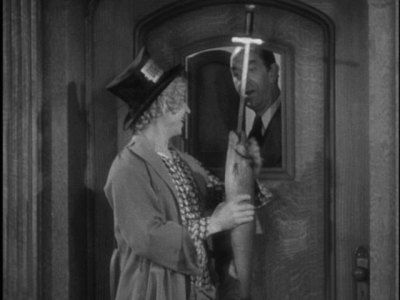
Harpo: *honk*
Rufus T. Firefly : We're fighting for this woman's honor, which is more than she ever did.
This was the last film that the Marx Brothers would make for Paramount. Not only is it the best Marx Brother film, but it is also one of the best comedies ever made. (The best for my money.)
The small country of Freedonia is in a financial crisis. Nearly bankrupt, the wealthy widow Mrs. Teasdale (Margaret Dumont) agrees to bail the country out on the condition that Rufus T. Firefly (Groucho) is appointed President. Meanwhile two spies from the neighboring country of Sylvania, Chicolini (Chico) and Pinky (Harpo) arrive in an attempt to steal secret information. When tensions rise, war erupts with Sylvaina. Unfortunately, Freedonia's forces are lead into battle by Firefly!
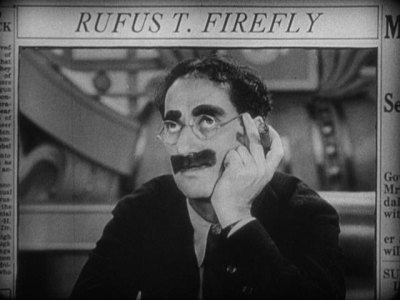
This set is filled with wonderfully funny films, and this one is the crowning jewel. Duck Soup works on so many levels; as an anti-war film, and as a comment on the role of money in our political system, but mainly it works as a very, very funny film. In this movie the brothers stripped away just about all of the serious songs and romantic subplots that would get in the way of the comedy and decided to just run wild. This movie showcases what the Marx Brothers do best.
This frantic and anarchic film is filled with great gags and outrageous jokes that will keep you laughing for the entire film. It has the brilliant mirror sketch, and the peanut stand/lemonade seller 'war' which always leaves me in stitches. I loved Harpo's shtick when he answered the phone and had a conversation: without talking of course. Then there is Groucho's banter with Chico, and his prevalent one-liners:
Rufus T. Firefly (trying to seduce Margaret Dumont) : I can see you in the kitchen bending over a hot stove... I just can't see the stove.
Rufus T. Firefly : Maybe you can suggest something. As a matter of fact, you do suggest something. To me you suggest a baboon.
Ambassador Trentino : What?
Rufus T. Firefly : I, uh, I'm sorry I said that; it isn't fair to the rest of the baboons.
Rufus T. Firefly : You're a brave man. Go and break through the lines. And remember, while you're out there risking you're life and limb through shot and shell, we'll be in be in here thinking what a sucker you are.

This film was way ahead of its time. When it was released, it was a horrible flop and received scathing reviews. Today it is acknowledged as one of the greatest comedies ever filmed, and placed fifth on the American Film Institutes list of the 100 greatest American comedies of all time. If that's not vindication, I don't know what is.
The movies in this set are simply fantastic. This set contains more laughs than any other comedy boxed set that I can think of, and presents the Marx Brothers at the height of their careers. After Duck Soup's dismal preformance at the box office, Paramount dropped the act. They then moved to MGM where they made a very good film, A Night at the Opera, and a pretty good one, A Day at the Races. Things went down hill after that, and the brothers never made another film as outrageously hysterical as the ones in this set. To be able to have all of these classics available in one set it a great treat.
In a word: no. There was a rumor going around on the internet that one of these movies was edited, but it is false. It started when gossip columnist Marilyn Beck stated in an interview that the "We're Going to War" production number in Duck Soup had the been censored to remove objectionable material. I don't know where she got the idea that this scene was censored, (and I can't think of anything objectionable in the scene) or why she would report that it was, but she's wrong. I can definitely state that there is no difference between the Image DVD of Duck Soup and the new Universal release when it comes to the"We're Going to War" production number. I synched up the new disc and the old on my DVD player and laptop respectively. I watched the scene with both running at the same time, an they are exactly the same.
"But" you say, "what if Marilyn Beck just mentioned the wrong scene? After all, she talked about the recently released Marx brothers two disc set, and we all know that the boxed set had seven movies on five discs."
Good question. To see if a cut may have been made elsewhere, I compared running times. If you time it from the first image to the last (Universal has a 21 second logo graphic before each movie starts) you'll find that they have the same run times, with each movie clocking in at 1:08:20. So, unless Universal actually altered the image and I didn't catch it (and I think I would,) or the Image version has been edited an NO ONE has noticed it for the last several years, this movie is uncut.
I checked a couple of the other movies, and they all matched to length of the Image releases within two seconds. I didn't notice anything missing from these films, and I've seen all of them several times. Based on this I can confidently say that they have not been edited for this release.
The DVD:
This set comes in a nice looking 'book.' The book opens to a pair of fold out leaves that contain the DVDs. In the middle is a short book that is bound to the spine. This book has a short biography of the brothers, notes on each film, production photos and chapter stops. Unfortunately this book isn't removable, which makes it a little hard to flip through it.
Audio:
The two channel mono was about what you'd expect for these movies that were made in the early days of sound. The sound on all of the discs were flat, and the levels were too low on some scenes. This was surely inherent in the original negatives though. There was a good amount of distortion in all the films, especially in the louder parts. Hiss was evident in most of the quiet parts, and there was a fair amount of hum. Even with these defects it was fairly easy to hear the dialog and catch all of the quips. These sounded very similar to the Image discs, but if anything there was a slight improvement. There were English, Spanish and French subtitles.
Video:
Unfortunately these film are not restored. These early Marx Brothers films deserve to be preserved, and it is a shame that Universal, who released this set, didn't take the opportunity to do so. Most of the prints used were pieced together from several different sources, some of them fairly poor. Overall, the image wasn't that bad, especially for films of this age, but they weren't spectacular either. All of the films had a low to moderate about of print damage; spots, dirt, scratches and the occasional hole or tear. The contrast was okay, but not anything fantastic. All the films have at least a little grain, and details on black areas like dark suits tended to disappear or blend in with the background. The blacks were not as deep as I would have liked them but they weren't too bad. The image tends to be on the soft side too.
I have all of the original releases of these films that Image released, and I did do some spot checks on the image quality between the two versions. In all cases I thought the new Universal set looked a little better. There was a bit more contrast and the image wasn't as dark. There also seemed to be less frequent examples of print damage. There was a little differance in the way the images were cropped on some of the movies, but it wasn't very significant. I was going to include a series of screen captures from each film, but I didn't think that the difference was large enough to be able to discern it in the small image sizes I would have to use. In any case, here are two captures from both version of Cocoanuts to give you an idea of the differance:
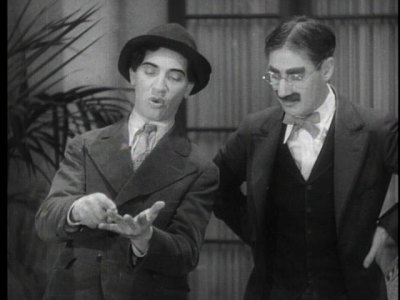 | 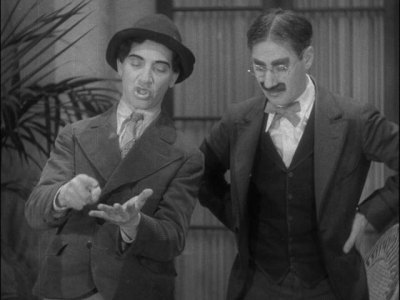 |
| | |
In conclusion, the picture quality on these isn't fantastic, but it's not so bad that people shouldn't buy this set. A little better than average for a film of this age. These do look a little better than the Image releases, but not by very much.
Extras:
All of the extras are on the sixth disc in the set, and it consists of three interviews that were conducted on the Today show. Harpo from 1961 (7 minutes,) Groucho from 1963 (5 minutes,) andHarpo's son, William Marx, from 1985 (4 ½ minutes.)
The Harpo's bit was the best. It was a lot of fun to see his goofing around on TV and he plays around with a gag harp. Everything except the first section had a set up feel to it, and the anchors just seemed to be laughing politely, rather than really enjoying his antics. The beginning of the bit is missing, which was too bad.
Groucho talks about meeting Marilyn Monroe for the movie Love Happy, and demonstrates his walk for the audience. He's about to launch into a story about Harpo, when they have to stop for a commercial. Hugh Downs tells Groucho he'll have to wait until they come back from the break, but that's the end of the clip. I was pretty disappointed they didn't have the rest. (I assume there was some more by the way the segment ended.)
The William Marx interview had a several seconds home movies where you can see Harpo and Groucho without their make-up for a change, and his son talks briefly about living with his famous father.
After the lavish extras on the WB boxed set of Marx brothers films, I was expecting a lot more. These video clips, just little more the 15 minutes worth, could have easily fit on any one to the other DVDs. When they include a disc of extras, it should have more than this.
So, should I upgrade?
If you have the original Image releases of these films, you might be thinking of upgrading them with this set. I wouldn't. The image quality is only marginally better than the Image discs, and the sound is about the same. The extras are very skimpy, and I don't think they'd be worth the money an upgrade would entail. I've often upgraded for better sound or image quality, but I don't think there is much of an improvement here.
Final Thoughts:
I love the Marx Brothers, and these are their best movies. Even the worst in this lot is uproariously funny, and the best movies are some of the greatest comedies ever filmed. I really wish that Universal had gone to the trouble to remaster the audio and video on this set. As it is these look and sound a little better than your average 1930's movie, and are a pleasure to watch. The extras are pretty anemic, but you don't need a lot of bells and whistles when you have movies of this quality. Highly Recommended.
|



| Popular Reviews |
| Sponsored Links |
|
|
| Sponsored Links |
|
|
| Release List | Reviews | Shop | Newsletter | Forum | DVD Giveaways | Blu-Ray | Advertise |
|
Copyright 2024 DVDTalk.com All Rights Reserved. Legal Info, Privacy Policy, Terms of Use,
Manage Preferences,
Your Privacy Choices 
| |||||||