
| Reviews & Columns |
|
Reviews DVD TV on DVD Blu-ray 4K UHD International DVDs In Theaters Reviews by Studio Video Games Features Collector Series DVDs Easter Egg Database Interviews DVD Talk Radio Feature Articles Columns Anime Talk DVD Savant Horror DVDs The M.O.D. Squad Art House HD Talk Silent DVD
|
 DVD Talk Forum |
|
|
| Resources |
|
DVD Price Search Customer Service #'s RCE Info Links |
|
Columns
  


 
|
|
|
Different From the Others
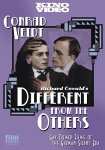
Another film in Kino's series of "Gay-themed Films of the Silent Era," Different from the Others is the earliest entry. In fact, it is the first film to depict homosexual activity in a positive light, and it discusses the issue in a very frank and straight forward fashion. The movie is a rally against Paragraph 175 of the German Penal Code which made homosexuality between men against the law.
This film has an interesting history behind it. Paragraph 175 had been a source of contention for a number of years. Dr. Magnus Hirschfeld, a German sexologist and scholar, thought that homosexuals were actually a "third sex," and they were just acting on their nature. During WWI, Hirschfeld teamed up with director Richard Oswald to produce a series of films on sexual education. They filmed stories on prostitution, VD and the like. After the war the censor restrictions were lifted in German and Hirschfeld saw his chance. He and Oswald made Different from the Others, part educational and part political, their film was very controversial when it was released. It was banned in 1920, and all copies were burned by Nazi's. Today the film only exists in an incomplete form discovered in a film archive in Russia.
The film stars Conrad Veidt (Cesare from The Cabinet of Dr. Caligari) as a virtuoso violinist, Paul Körner. He takes on a handsome young student, Kurt (Fritz Schulz,) and the two soon fall in love. Unfortunately, Paul is being blackmailed by Franz Bollek (Reinhold Schünzel) a shifty crook who has found out that Paul is a homosexual. He's bleeding Paul for all he's worth, and though Körner could have Franz arrested for blackmail, he would be arrested too for violating Paragraph 175. Why, the film asks, should someone, an artist no less, be condemned for just loving someone?
The main problem with this film isn't the subject matter or the way it is handled, it's the fact that it is incomplete. The film runs less than 50 minutes, and roughly half of that is actual video. The rest of the movie was recreated from production still incorporated into the film and long intertitles that explain the sections that are missing. Unlike Metropolis however, which handles missing segments in a similar fashion, there is a large percentage of Different from the Others that is missing. Whole subplot involving Paul's family are missing, as well as much of the film dealing with Kurt's relatives. The film has no rhythm to it because of the frequent intertitles, and the synopses of the missing scenes are no replacement for the scenes themselves. It is really hard to judge the quality of this movie because so much of it is missing.
One highlight of the film was Conrad Veidt's performance. He did a wonderful job, and he is always a joy to watch. His climactic scene was my favorite part of the movie.
The DVD:
Audio:
This DVD has the best accompaniment of any of the films in this series. The piano score actually matches the action on the screen, with fast intense music during the fight scene and slower music during the somber sections. A nicely matched score.
The intertitles to the film, as well as the letters and other text information are in English and contemporary creations. There are no subtitles.
Video:
Taking into account that there is only one copy of this film left, the image isn't too bad. The image is dark in places, and the details are lost in darker areas, but there is a good amount of detail. The contrast isn't great, and there is a good amount of print damage, but the DVD is very watchable.
Extras:
Unfortunately, there are no extras with this disc.
Final Thoughts:
Unfortunately, the complete version of this film is lost to us, and this pieced together reconstruction, while better than nothing, only hints at what the complete movie would have been like. While Conrad Veidt does a good job, there were just too many missing sections of film to really evaluate the quality of the script or direction. A very interesting look at homosexuality in German between the wars, this DVD is would make a good rental.
|



| Popular Reviews |
| Sponsored Links |
|
|
| Sponsored Links |
|
|
| Release List | Reviews | Shop | Newsletter | Forum | DVD Giveaways | Blu-Ray | Advertise |
|
Copyright 2024 DVDTalk.com All Rights Reserved. Legal Info, Privacy Policy, Terms of Use,
Manage Preferences,
Your Privacy Choices 
| |||||||