
| Reviews & Columns |
|
Reviews DVD TV on DVD Blu-ray 4K UHD International DVDs In Theaters Reviews by Studio Video Games Features Collector Series DVDs Easter Egg Database Interviews DVD Talk Radio Feature Articles Columns Anime Talk DVD Savant Horror DVDs The M.O.D. Squad Art House HD Talk Silent DVD
|
 DVD Talk Forum |
|
|
| Resources |
|
DVD Price Search Customer Service #'s RCE Info Links |
|
Columns
  


 
|
|
|
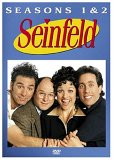
Seinfeld - Seasons 1 & 2
What's the #1 title on your "Most Wanted" list? Was it Star Wars? The Godfather trilogy? The Matrix? All those releases came and went, and sure, I was glad to see them, but they were just somewhere in the top 10 of my personal Most Wanted list. Firmly lodged in the #1 slot for years has been one show that's the epitome of great comedy – of great television, in fact – a show about... nothing. In a word: Seinfeld.
So it was with greedy delight that I tore off the shrink-wrap on the first volume of my personal Holy Grail of DVD. (It was in my house for a whole five minutes or so before the first disc went into the DVD player.) And there I was, feet propped up on the coffee table, laughing my head off at the most brilliant comedy ever to make its way to television. It doesn't matter that I've seen these episodes half a dozen times already, and can anticipate all the jokes; they're still just as flat-out hilarious as the very first time I saw them. Maybe they're even funnier, since my viewing experience is balanced between delighted enjoyment of the episode and delightful anticipation of what's to come.
Is there anyone reading this review who doesn't know what Seinfeld is about? Well, there were a few people who hadn't seen Star Wars before it came to DVD, so maybe there are a few deprived souls who've never seen Seinfeld. (You're in for a treat.) In a nutshell, Seinfeld is about the lives of a handful of rather neurotic characters: Jerry Seinfeld (playing himself), George Costanza (Jason Alexander), Elaine Benes (Julia Louis-Dreyfus), and Kramer (Michael Richards). But these characters don't have "adventures" in the typical television way. Instead, they run into all sorts of difficulties just trying to manage their romantic relationships, friendships, and just life in general.
Part of the genius of Seinfeld is that it pokes fun at the bizarre nature of daily life: all the little contradictions and absurdities that we put up with, all the uncertainty and potential for disaster that lurks beneath even the simplest human relationship (doubly so for romantic relationships). The fact that two of the characters (Jerry and George) are tremendously insecure only broadens the range of potential targets for the show's humor, as they bring into focus all the little things that we better-adjusted (we hope) folks secretly obsess about or bluff our way through. Whether it's interpreting a vague phone call from a potential girlfriend ("Good News, Bad News"), disentangling oneself from an unwanted friendship ("Male Unbonding"), offending an elderly relative ("The Pony Remark"), or dealing with a fashion faux pas ("The Jacket"), Seinfeld gives us permission to laugh our heads off at the utter absurdity that's lurking below the surface in everyday life.
But another element of Seinfeld's brilliance is its writing, which is spot-on. Having the main character be a comedian certainly opens the door to a lot of wisecracks and witty remarks in the episodes, but it wouldn't work unless those remarks were genuinely funny. And they are. Combine the great humor in the dialogue with the brilliantly absurd plots, and voila! Seinfeld is born.
The first two seasons of Seinfeld contain a surprising number of great episodes. Why surprising? Because it's just amazing that a show that ended up being the greatest comedy series of all time (in this reviewer's not-so-humble opinion) got it right from the beginning... and then got even better in later seasons.
Seinfeld starts out on a solid note with the first few episodes, including the pilot. While Seinfeld fans will amuse themselves by noticing the elements that are inconsistent with the later episodes (Jerry's apartment looks different, and Kramer is described as the guy who never leaves the apartment building), the overall feel of the show is spot-on. In fact, all four of the Season 1 episodes are excellent. What's not to like about an episode like "The Stakeout," in which (among other things) we are witness to the invention of George's alter ego, Art Vandelay (and his import/export business)?
Season 2 is also fairly short, with only 13 episodes, but they're very good indeed. "The Pony Remark" is perhaps the best of this season, with Jerry accidentally offending an elderly guest at a dinner party (with interesting consequences). George lives up to his reputation as incompetent in dealing with women in "The Phone Message," and Elaine starts to experience some job problems in "The Statue." Speaking of employment troubles, "The Revenge" is the start of many great episodes focusing on George's troubles with finding (and keeping) a job; here, he's in a tizzy because he's been demoted to using the regular bathroom at work. "The Apartment" is a prime example of how an episode can be about "nothing" and yet be extremely funny. What happens here? Kramer experiments with using mousse in his hair, George tries to meet women, Jerry considers what it would be like to have Elaine take an apartment in his building. You wouldn't think that's prime material for a comedy show, would you? But it's not what the episodes are about (nothing!) but how they're told that counts. About the only episode that doesn't really live up to its promise is "The Chinese Restaurant," although this one seems to be a fan favorite; personally, I think its static nature makes it feel a bit forced.
Seinfeld certainly hit the ground running, but that's not to say that the series feels exactly the same in these early seasons as in the later seasons. Logically enough, in Seasons 1 and 2 Seinfeld is still developing: fleshing out the main characters and developing secondary characters who would add so much to the series later on. The writers also haven't quite fully realized the potential for more complex plots in each episode: these earlier episodes tend to focus on one story thread in each episode. One result is that we get more, and longer, segments of Jerry's stand-up comedy, sometimes intercut into the middle of the episode as well as at the beginning. Of course, considering how funny his material is, that's not much of a drawback... we can enjoy the lighter structure of these episodes while looking forward to the more tightly constructed later episodes that draw all of their humor from within the story world.
I'll go ahead and list the episodes that are included in this set: the names may jog a few more memories and remind you why this set is worth buying. All the episodes are the full-length, original episodes, not the slightly shorter syndicated versions. Note that the episodes are presented in production order, not by air date. This means that "The Stranded," which was produced in the second season but not aired until the third season, appears here in the second season. Episodes with commentary tracks are listed in bold.
Season 1 (1990)
- Pilot (1989)
- Male Unbonding
- The Stakeout (Jerry Seinfeld and Larry David)
- The Robbery
- The Stock Tip
Season 2 (1991)
- The Ex-Girlfriend
- The Pony Remark
- The Busboy (Julia Louis-Dreyfus, Jason Alexander, and Michael Richards)
- The Baby Shower (writer Larry Charles)
- The Jacket
- The Chinese Restaurant
- The Phone Message
- The Apartment
- The Stranded
- The Statue
- The Heart Attack (writer Larry Charles)
- The Revenge (Julia Louis-Dreyfus, Jason Alexander, and Michael Richards)
- The Deal (Jerry Seinfeld and Larry David)
The DVD
I quite like the packaging for Seinfeld. The set's four DVDs each have a super-slim plastic keepcase, and these four cases fit into a glossy paperboard slipcase, with another paper slipcover fitting over the whole thing. It looks stylish, it doesn't take up too much space, and it's easy to access the discs.
I'm not so thrilled about the menus. Cleverly designed, sure... user-friendly, not entirely. Spoiler clips play on the main menu screen, and the menus themselves are decidedly slow to navigate. On the bright side, though, all the features are clearly labeled and logically arranged. I also appreciated the liberal use of the "play all" feature, for the special features as well as the episodes.
Video
Seinfeld appears in its original aspect ratio of 1.33:1. Considering that these episodes are about 14 years old (how time flies...) at this point, the transfer looks respectable, though not as good as I'd have hoped for it to look. The image is bright and generally free of flaws, though a few speckles make their way onto the picture; the level of detail is satisfactory, and contrast is handled well. Colors are very bright and vibrant, with primary colors sometimes even verging on the too-vivid end of the scale. Depending on the scene, a moderate amount of edge enhancement is apparent; some grain also appears. All in all, it's a satisfactory transfer.
Audio
The Dolby 2.0 soundtrack presents the show in a pleasingly clean, crisp manner. For a show with such an emphasis on verbal wit and byplay, clear dialogue is essential, and the soundtrack handles it very well. The Seinfeld theme music is nicely balanced with the main part of the track, and the laugh track is not too obtrusive.
Extras
A substantial amount of bonus material is included in this set, spread across all four discs. Here's a breakdown of what we get:
Disc 1
Two of the episodes on this disc have different play options. The pilot can be played in its original version, with the "old" theme music (this is the default) or in the revised-for-syndication version, which replaces the music with the same theme that's used in the later episodes. "The Stakeout" has the option to view it with a short introductory clip from Julia Louis-Dreyfus and Jerry Seinfeld.
When it comes to actual bonus content, we start out with a commentary track for "The Stakeout," with Jerry Seinfeld and co-creator Larry David. Seinfeld and David provide a reasonable level of commentary for the episode, though it's clear that it's a little difficult for them to provide a lot of details for a 14-year-old episode. Speaking of commentaries, the "Notes about Nothing" feature toggles on a text commentary track that provides various bits of trivia about the episodes in the form of subtitles. The Notes about Nothing are available for all the episodes, and provide a few interesting snippets of information. They can be selected from the episode menus, the special features menu, or on the fly by using the subtitles button.
Probably of most interest on this disc is the set of "Inside Looks": short segments that use interviews with cast and crew to look behind the scenes for a particular episode. These can be selected individually, or viewed with a "play all" feature from the special features menu. Running about 14 minutes in total, we get segments on the pilot, "Male Unbonding,""The Stakeout," and "The Robbery."
Disc 2
Commentary tracks for "The Busboy" (Louis-Dreyfus, Alexander, Richards) and "The Baby Shower" (writer Larry Charles) appear on this disc. While Charles' commentary is reasonably interesting, the cast commentary is rather disappointing. The actors don't seem to have much to say, and there are long periods of silence. In general, while they try to stir up some banter, it tends to fall flat, and their commentary is neither particularly informative nor funny.
Moving on to more satisfying special features, we get a seven-minute segment of exclusive stand-up comedy from Jerry Seinfeld ("Master of His Domain"), and the "Inside Looks" section offers 12 minutes of interesting behind-the-scene information on "The Pony Remark," "The Busboy," "The Baby Shower," and "The Jacket."
Two deleted scenes are included here as well (6 minutes), along with the "Notes about Nothing" feature.
Disc 3
On this disc, viewers have the option to play "The Stranded" with a very short introductory clip from Jerry Seinfeld, which was originally created to explain the out-of-continuity nature of this second-season episode when it was broadcast as part of the third season.
The "Inside Looks" section continues to be of interest, with a total of 12 minutes of material on "The Chinese Restaurant," "The Phone Message," "The Apartment," and "The Statue." A 13-minute bloopers section has the merit of being reasonably funny, and viewers will be interested in the deleted scene from "The Chinese Restaurant" (1 minute). Once again, we also get "Notes about Nothing" options for all episodes.
Disc 4
The best special feature of the set appears here: a very interesting 64-minute making-of documentary called "How It Began." This three-part program (which has a "play all" feature) features interviews with a number of different people involved in the creation of Seinfeld, starting back when Seinfeld was a young stand-up comedian with no television aspirations.
Three commentary tracks appear here as well. "The Heart Attack" with writer Larry Charles is not bad, but once again the commentary by Louis-Dreyfus, Alexander, and Richards for "The Revenge" is rather bland and uninteresting. Fortunately, the commentary on "The Deal" by Seinfeld and David is a lot more lively and information-rich.
For more behind-the-scenes insights, we get 11 minutes of "Inside Looks" for "The Revenge" and "The Deal." A 5-minute deleted scene for "The Heart Attack" is also included. "Notes about Nothing" are available for all the episodes as well.
This disc also features both the original and syndicated versions of "The Revenge," with the difference being that in the original version, Larry David supplies the telephone voice of Newman, while in the syndicated version it's replaced by Wayne Knight's voice to correspond with the rest of the series.
For miscellaneous special features, we get a 19-minute compilation of "The Tonight Show" appearances: a 1981 and 1990 appearance by Seinfeld, and a 1989 appearance by Michael Richards. There's a four-minute segment of NBC promos for the series, a Spiderman 2 trailer (yeah, that's relevant), and a photo gallery.
Final thoughts
So now we've got the first two seasons of Seinfeld available... what are you waiting for? This is a classic comedy series, and one that has proved to be amazingly long-lasting and re-watchable. Could you catch some episodes of Seinfeld as re-runs on TV instead of buying the DVDs? Sure... but there's nothing that compares to being able to watch the episodes when you want to, as many times as you want to, in the right order, without commercials or edits for syndication. The sound quality is great, and the image looks quite respectable as well (if not quite as clean as I'd have liked). The bonus material is nothing to sneeze at, either: Seinfeld fans will be delighted by the behind-the-scenes and never-before-seen material that's assembled here. Seinfeld: Seasons 1 & 2 gets a very robust "highly recommended."
|



| Popular Reviews |
| Sponsored Links |
|
|
| Sponsored Links |
|
|
| Release List | Reviews | Shop | Newsletter | Forum | DVD Giveaways | Blu-Ray | Advertise |
|
Copyright 2024 DVDTalk.com All Rights Reserved. Legal Info, Privacy Policy, Terms of Use,
Manage Preferences,
Your Privacy Choices 
| |||||||