
| Reviews & Columns |
|
Reviews DVD TV on DVD Blu-ray 4K UHD International DVDs In Theaters Reviews by Studio Video Games Features Collector Series DVDs Easter Egg Database Interviews DVD Talk Radio Feature Articles Columns Anime Talk DVD Savant Horror DVDs The M.O.D. Squad Art House HD Talk Silent DVD
|
 DVD Talk Forum |
|
|
| Resources |
|
DVD Price Search Customer Service #'s RCE Info Links |
|
Columns
  


|
|
|
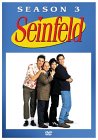
Seinfeld - Season 3
Seasons 1 and 2 of Seinfeld show how this fantastic comedy hit the ground running, but it's in Season 3 that the show underwent a creative explosion. In this season, what had been a very funny show that relied to a certain extent on comic set-pieces jump-started its evolution into the wildly inventive series that would develop some of the most hilarious ongoing storylines ever to grace the television screen. How did they manage to get it so right, so quickly?
While the episodes in Seasons 1 and 2 each focused on a single storyline, which might involve Jerry Seinfeld's friends to a greater or lesser degree, Season 3's episodes hit upon the strategy of giving each character his or her own storyline (sometimes larger, sometimes smaller) and cleverly interweaving them so that they intersected in some unexpected way. It's a clear case of the whole being greater than the sum of its parts, as the comic potential of the series skyrocketed. This kind of interwoven story isn't brand-new any more, as we've seen many other shows that were heavily influenced by Seinfeld, like Friends or the British show Coupling. But Seinfeld is still the reigning King of Comedy... nobody has managed to top the wacky brilliance that Seinfeld's writers and cast brought to this comedy series.
Picking out classic Seinfeld moments to mention is enough to put anybody into "choice paralysis," particularly now that the episodes start to pack more cleverness into the same length of episode. Season 3 is the first really full season, with 22 episodes, and viewers are sure to spot many favorites among the lineup. Once again, we're privy to the hilarious results of Jerry, George, Elaine, and Kramer just trying to negotiate the hazards of modern life. Whether it's Jerry letting his tax records fall into the hands of George's ex-girlfriend ("The Truth"), Elaine helping George cheat on an IQ test ("The Café"), or Kramer experiencing a moment of glory in a Woody Allen film ("The Alternate Side"), the results are sure to be hilarious. Let's not forget brilliant episodes like "The Red Dot," one of the best of the whole series, in which George's choice of a gift for Elaine turns out to be a flop, at the same time that the saga of his struggles to find (and keep) a job continues.
The really funny thing is that it's remarkably hard to explain what's so hilarious about these episodes... Plot synopses are almost useless, as material that might have been inane or oddly pointless in different hands turns out to be absolutely brilliant when the Seinfeld crew get their hands on it.
It's clear that in Season 3 Seinfeld was starting from some solid comic territory... but instead of settling down and getting into a routine within that material, the series took the brilliant move of striking out even further. For one thing, the main characters get fleshed out more, but we also get to see a lot more of the recurring secondary characters. Jerry's parents get a spot in the limelight in "The Pen," when Jerry and Elaine pay a (disastrous) visit to their home in Florida; Kramer's buddy Newman makes an appearance in "The Suicide" and "The Boyfriend"; and the unfortunate Babu makes his first of several appearances in "The Café."
We also get some absolutely brilliant surreal moments, like when Jerry's penis and brain square off in a game of chess to decide whether he should continue to date a sexy but dumb woman ("The Nose Job"). In addition to a brilliant rendition of a library policeman, "The Library" even plays around with time, using some flashbacks to George and Jerry in high school as part of the storyline. The use of voiceovers to share the characters' thoughts is another great way in which Seinfeld breaks down the conventions of a television comedy to great effect, as in episodes like "The Café" or "The Subway." Season 3 also rewards viewers with a double-length episode, "The Boyfriend," which played in two parts on television but is reassembled into one 46-minute episode for the DVD. "The Parking Garage," another classic Seinfeld episode, takes the same functional premise as Season 2's "The Chinese Restaurant" – the characters spend the whole episode in the same place – but handles it much better, resulting in an episode that's both memorable and funny.
What's more, re-watching Seinfeld (for the second or the umpteenth time) makes it abundantly clear that these episodes just get better with time. Probably the closest parallel in film is The Big Lebowski, a bizarre, inventive, and hilarious film that even stands up to being re-watched immediately after the first viewing. Even if you know the stories inside-out, Seinfeld is so well done that it's impossible not to laugh at the brilliant comedic performances of the cast and the improbably tangled plots. I can't think of any other television show, comedy or drama, that has the replay value of Seinfeld.
All the episodes in Season 3 are the full-length, original network versions (not the shorter syndicated versions). The episodes appear in production order, not air date order; "The Stranded," which was originally broadcast as part of the third season, has been returned to its original production order and appears in Season 2. Here's a list of all the episodes; those with commentary tracks are listed in bold.
Season 3 (1991-1992)
- The Note
- The Truth
- The Dog
- The Library (writer Larry Charles)
- The Pen (Jerry Seinfeld and Larry David)
- The Parking Garage (director/producer Tom Cherones and production designer Tom Azzari)
- The Café
- The Tape
- The Nose Job
- The Alternate Side
- The Red Dot
- The Suicide
- The Subway (Julia Louis-Dreyfus, Jason Alexander, and Michael Richards)
- The Pez Dispenser (Jerry Seinfeld and Larry David)
- The Boyfriend (Julia Louis-Dreyfus, Jason Alexander, and Michael Richards)
- The Fix-Up
- The Limo (writer Larry Charles)
- The Good Samaritan
- The Letter
- The Parking Space (director/producer Tom Cherones and production designer Tom Azzari)
- The Keys
The DVD
Seinfeld: Season 3 is packaged in the same attractive and user-friendly style as Seasons 1 & 2. The four DVDs each have an ultra-slim keepcase that fits inside a glossy paperboard case, with a slipcover fitting over the whole thing.
Video
The image quality for Season 3 is a shade better than for Seasons 1 and 2. Colors are just as bright and vibrant, but they're also a shade more natural-looking; contrast continues to be handled well. The prints look to be in excellent condition as well. The image looks its best in the close-up shots, which are very nicely sharp and detailed. In the middle-distance shots, a moderate amount of grain and some edge enhancement does show up, making the transfer less than perfect but, overall, very respectable. All the episodes appear in their original, correct aspect ratio of 1.33:1.
Audio
The soundtrack, a Dolby 2.0 track, provides a very pleasant listening experience. The sound is crisp and clean, with all the dialogue sounding natural and distinct. The theme music and laugh track are also handled well. French and Spanish dubbed tracks are also provided, along with subtitles in French, Portuguese, and Spanish, and English closed captions.
Extras
Once again there's a lot to like in the special features on this set. Let's take a look at what's on each disc.
Disc 1
First off, we get the "Inside Looks" for three episodes ("The Note," "The Library," and "The Pen"), totaling about 13 minutes. These are interesting and informative looks at the making of each episode, and the fact that you can play them all at once from the Extras menu or choose to watch them separately from the Episodes menu makes them quite user-friendly as well.
Two commentary tracks appear on this disc. "The Library" has a nice commentary from writer Larry Charles, who jumps right in with comments that are both interesting and informative. The commentary from Jerry Seinfeld and Larry David on "The Pen" is surprisingly lame, however, as it mostly consists of the two of them laughing at the on-screen action and making inane comments about what's going on.
Two deleted scenes (3 minutes in total) are provided for "The Note" and "The Dog," and we also get the option to have text "Notes about Nothing" for all the episodes. These notes, which take the form of subtitles on-screen, are sometimes a bit odd but more often supply interesting behind-the-scenes information, such as insights about alternate versions of the script for that episode.
Disc 2
Three episodes get "Inside Looks" on this disc: "The Parking Garage," "The Café," and "The Nose Job," for a total of 14 minutes of interesting material on the making of these episodes. Just one commentary track is supplied here: director/producer Tom Cherones and production designer Tom Azzari share the honors here, and it's easily the best commentary track in the set so far, as the two men supply a constant stream of informative and insightful material about the production and design challenges of the episode.
Three minutes of deleted scenes are presented here, for "The Parking Garage," "The Nose Job," and "The Alternate Side," and "Notes about Nothing" are an option for all the episodes.
Disc 3
Every episode on this disc gets an "Inside Look," for a fat total of 22 minutes of neat insights into the making of the show. Three episodes also get commentary tracks. "The Subway" and "The Boyfriend" feature Julia Louis-Dreyfus, Jason Alexander, and Michael Richards. The trio are still not particularly exciting commentators, but they at least seem to have warmed up a little bit from the last set. "The Pez Dispenser" has a reasonable track from Jerry Seinfeld and Larry David.
Two minutes of deleted scenes appear here (for "The Red Dot" and "The Boyfriend") along with "Notes about Nothing."
Disc 4
This disc has some nice goodies for fans of the show. First off is a 22-minute featurette on the character of Kramer... but "Kramer vs. Kramer: Kenny to Cosmo" is more than your routine set of interviews with the actor, as we get to hear about the genesis and evolution of the character not only from Michael Richards and various other people involved with the show, but also from Kenny Kramer, the real-life inspiration for the character of Cosmo Kramer.
The "Inside Looks" section isn't neglected: all the episodes on this disc are featured, for a total of 17 minutes of material. Eight minutes of deleted scenes also appear, for "The Fix-Up," "The Good Samaritan," and "The Letter." A 15-minute set of bloopers for the third season has some laughs in store, and on top of that we get 10 minutes of exclusive stand-up material from Jerry Seinfeld in "Master of His Domain." Notes about Nothing are available for all the episodes as well.
The two commentaries presented here are both very solid. Writer Larry Charles delivers his usual interesting commentary on "The Limo," while director/producer Tom Cherones and production designer Tom Azzari return for "The Parking Space." As with their earlier commentary, this is a very insightful and worthwhile track.
For miscellaneous features, we get a set of NBC promotional spots for the show, a Spider-Man 2 trailer (again!), and a photo gallery.
Final thoughts
If you read my review of Seasons 1 & 2, you know that I think Seinfeld is the single greatest comedy television show, ever. You want to see what I mean? Watch Season 3. Rather than resting on its already excellent laurels, in its first really full season Seinfeld takes another giant step forward (you might call it a Superman-sized step) in terms of the creativity and humor to be found in these episodes. Not only that, these episodes have triumphed in the rewatchability department, remaining every bit as funny (or funnier!) on the umpteenth viewing, years after their original air date. Package that up with an excellent transfer and a very solid set of special features, and you get a well deserved DVDTalk Collector Series rating.
|



| Popular Reviews |
| Sponsored Links |
|
|
| Sponsored Links |
|
|
| Release List | Reviews | Shop | Newsletter | Forum | DVD Giveaways | Blu-Ray | Advertise |
|
Copyright 2024 DVDTalk.com All Rights Reserved. Legal Info, Privacy Policy, Terms of Use,
Manage Preferences,
Your Privacy Choices 
| |||||||