
| Reviews & Columns |
|
Reviews DVD TV on DVD Blu-ray 4K UHD International DVDs In Theaters Reviews by Studio Video Games Features Collector Series DVDs Easter Egg Database Interviews DVD Talk Radio Feature Articles Columns Anime Talk DVD Savant Horror DVDs The M.O.D. Squad Art House HD Talk Silent DVD
|
 DVD Talk Forum |
|
|
| Resources |
|
DVD Price Search Customer Service #'s RCE Info Links |
|
Columns
  


 
|
|
|
Lord of the Rings: The Return of the King - Extended Edition, The
So here we are: in the last chapter of The Lord of the Rings. While The Fellowship of the Ring was about beginnings, The Return of the King is about endings: the story threads that were so intriguingly introduced in the first film and drawn out in the second film must now find a resolution. Director Peter Jackson has had different challenges in each phase of what's been essentially one long project, but The Return of the King basically puts all the cards on the table. Does the film trilogy finish strong, making a coherent whole?
The answer is a resounding yes. Jackson's handling of The Return of the King is fantastic, and the film rises far above the weaker middle segment, The Two Towers, to tell a compelling, exciting, and emotionally moving story in which all the elements that have been put into motion in the previous two films finally come together into a thrilling conclusion.
As with each film in the trilogy, The Return of the King continues the overall storyline of The Lord of the Rings, while subtly shifting the emphasis of the story. The Fellowship of the Ring was a very personal tale, in which the hobbits (and Frodo in particular) gathered the courage to embark on a dangerous journey whose end they could not foresee. The Two Towers shifts more into the epic mode, dealing with the threat of Saruman and the corruption at the royal court of Rohan, and showing Aragorn finally starting to come into his own. Now, in The Return of the King, these two types of story – the personal and the epic – fuse together. One portion of the film follows the heroic thread of the story, as Minas Tirith prepares for the final attack by the forces of Sauron, while the other main story being unfolded is the very personal struggle of Frodo and Sam to bring the One Ring to the fires of Mount Doom.
Here Sean Astin should get a lot of credit for an exceptional performance in a pivotal role, because the character of Sam is now one of the most important in the entire film. This story thread starts to take on the mythic overtones of the hero's descent into the underworld, which could have had the effect of distancing us from the characters involved. But cleverly Tolkien – and Jackson – uses the utterly down-to-earth and fully three-dimensional character of Sam to anchor this thread of the story. Frodo may be on a hero's journey, but Sam worries about food, shelter, getting a good night's sleep, and – most importantly – about his friend's state of mind. And while Frodo (and Aragorn) basically get all the credit for being heroes, it's Sam who has the determination and strength on a personal level to actually get Frodo to Mount Doom.
The fact that Jackson is able to make this fusion of the distant epic and the close-up personal story actually work, and work well, is a testament that he understood very well the difficulties inherent in adapting The Return of the King for the screen, and that he found successful ways to overcome those difficulties.
There are many reasons why Tolkien's massive novel is difficult to bring to the screen, but perhaps the most overlooked one is that the internal structure, pacing, and development of The Lord of the Rings often have more in common with medieval sagas than the modern construction we call a "novel." In a saga, characters are two-dimensional, conflicts are drawn in bold strokes, motivation is rarely developed, if it's even considered, and plot is incidental at best. In contrast, the novel's focus on characters, and its more modern pacing and attention to plot development, make the latter form more amenable to adaptation for film.
This is to a great extent why The Fellowship of the Ring translates best into film of any of the three parts of the story. Fellowship is fundamentally the hobbits' story, and the hobbits are the most psychologically modern characters in the story; the portions of the story that focus on them are the most novelistic in terms of plot and characterization. Then, in The Two Towers and The Return of the King, the story starts to shift from this focused, character-based, novelistic type of storytelling to a more epic, saga-based type of storytelling, before eventually returning to a novelistic style at the very end. This presented Peter Jackson with a difficult challenge in bringing the last two parts of the story to the screen: balancing the epic and the personal levels of the story to make a satisfying film.
While I don't think Jackson got the balance right in his adaptation of The Two Towers, he strikes just the right notes in The Return of the King. Here, the storyline certainly takes on epic proportions, as we can see in the new importance of the kingdoms of Rohan and Gondor to the story, and in the shift from Sauron's menace as a personal threat to Frodo and the Fellowship, to a large-scale menace that threatens entire civilizations. Yet in this film the epic always remains rooted in the personal, so we genuinely care about what happens, and are struck with awe and terror by the events on-screen.
One reason The Return of the King's epic scenes work so well is that we are more invested in them: the characters we know and love are caught up in the events on-screen, and what's even more important, they are changed by these events. For instance, Merry and Pippin were basically just along for the ride in The Two Towers, and they start out The Return of the King as exactly the same happy-go-lucky characters that they were before any of the story began. In The Return of the King, though, they finally are faced with tough decisions and the very real possibility of loss and pain. The involvement of the two hobbits with the fighting forces of Rohan and Gondor not only develops their characters, it also gives us a personal connection to the conflict.
When it comes to the journey to Mount Doom, Jackson was able to stick closely to the story as written, simply choosing to emphasize some aspects more than others. Gollum is a remarkable character in The Return of the King, with the film effectively fleshing out his interior conflict into full-blown schizophrenia between his "Gollum" and "Smeagol" personalities. This split is certainly present in the original book, but the additional development that Jackson gives it makes Gollum into an even more captivating and effective character.
Not all of Jackson's adaptations work perfectly. One of his changes was to highlight some of the female characters, who are generally on the sidelines or completely off-stage in the original book. In the case of Eowyn (Miranda Otto), the warrior princess from Rohan, Jackson gets it exactly right in this film: she's given just the right amount of screen time, especially now that the Extended Edition pays more attention to her, and she's a very appealing and sympathetic character. Arwen, on the other hand, could have been written out of the script entirely and the film would have been the better for it. For one thing, she's essentially irrelevant to the plot, unlike Eowyn. For another thing, as Liv Tyler gets more screen time, it's more evident that there's very little substance to her performance. Tyler may periodically allow a tear to trickle down her cheek, but her range of emotion here seems to be limited to "vaguely melancholy or mediative."
There's also the question of Jackson's handling of the conclusion of The Return of the King... a very interesting question.
Where does the story of The Return of the King fundamentally resolve? With Frodo and Sam on the slopes of Mount Doom, the Ring destroyed, Sauron defeated, and Mordor shaking itself to pieces around them. The Fellowship's mission has been accomplished, Middle Earth is safe, and the bond between Frodo and Sam has survived every challenge.
I think the film could have ended here, and it would have been a daring and possibly quite effective choice, but it would not be in line with Tolkien's own vision. Fundamental to Tolkien's conception of The Lord of the Rings was what he called the "eucatastrophe": the sudden "turn" in which the darkest moment in the story turns to joy. For Tolkien, this moment is the scene in which Frodo wakes up in Gondor. And, in fact, it does work quite well in the film to continue past the climax at Mount Doom: the tension has come to a peak, and it has been released. As viewers, we can share the joy of the moment in which Frodo, incredulous, finds himself safe and surrounded by his friends. The remainder of the film is basically just tying up the last loose ends.
In the theatrical cut of The Return of the King, I felt that the film from this point to the end was very badly handled: it felt far too long, and the drag in the pacing really diminished the impact of the ending overall. Considering that the Extended Edition has exactly the same conclusion as the theatrical cut, I expected to have the same reaction... but I didn't.
I do still think that the ending could have been made a little tighter, but it works significantly better in the Extended Edition than in the theatrical cut. One reason for that is simply context: the 20 minutes of final material is a smaller percentage of the overall film in the four-hour cut than it was in the three-hour cut, so it doesn't feel too long in proportion to the whole film. Another reason is that the pacing of the ending material is slower than that of the theatrical cut, but it's consistent with that of the Extended Edition, so it fits better here. Most importantly, though, I think the ending works better because the Extended Edition gives us more depth for the characters and more reason to care about them. When Frodo says goodbye to Merry and Pippin, he's saying goodbye to genuine friends and companions in adventure, since we've seen much more how the two young hobbits were involved in the story. And the closing shot of Sam with his family has a lot more emotional power now that we've come to appreciate just how important Sam was to Frodo and to the Fellowship as a whole.
I've been mostly talking about character and story here, but the review wouldn't be complete without a nod at just how fantastic The Return of the King looks: not just in terms of image quality on the DVD (we'll get to that later) but in terms of how realistic and convincing the fantasy world of the film is. If we're to fully engage with the film, it's important that we believe in it while we're watching, and The Return of the King excels in this department. Obviously, the amazing CGI has a lot to do with this: the fact that it's possible to genuinely forget that Gollum is not real is simply astounding. But I suspect that the overall realistic feel of The Return of the King has a lot to do with Jackson not relying too heavily on CGI. There's a lot of model and miniature work in this film, and I think we can see the benefits in the convincing texture and sense of solidity of the places, people, and things here.
The Extended Edition
When 50 extra minutes of material are added to a film that's already more than three hours long, you have to ask: what effect is this going to have? Sometimes adding material to a long film just bloats it even more, but oddly enough, sometimes the extra running time makes the whole film pull together better overall.
In the case of The Return of the King, the extra material is undeniably a success, making an already good film significantly better. I liked the theatrical cut of The Return of the King, but it didn't bowl me over; in contrast, the Extended Edition completely impressed me.
There are two kinds of new material here: extensions of existing scenes, and several totally new scenes.
Twenty-two separate scenes have added material, over the course of the entire film. For the most part, these additions give us a more personal glimpse of the characters and their reactions to the events going on around them. One story thread that benefits greatly from the extended material involves Denethor, the Steward of Gondor. Here it's clearer that he has fallen into madness in his grief and despair at Boromir's death and the invasion of Gondor, and his final scene in the Tomb of the Stewards takes on a Shakespearean quality that's quite effective. Aragorn's journey through the Paths of the Dead also benefits from some additional material, with the Haunted Mountain sequence becoming even more chilling.
Fourteen completely new scenes are added as well. These range from substantial additions that add depth to the plot, to shorter segments that serve mainly to adjust the pacing of the film, providing a pause to take a breath between two highly-charged scenes. One of the best new scenes takes place early in the film, and shows us a confrontation between Gandalf and Saruman. It's a compelling scene in its own right, and also provides a touch of dread for what's to come later as Sauron attacks in force. A parallel scene late in the film, with Gandalf and the Witch King, is another great addition. The final action in Mordor is also enhanced by several new scenes: one with the "Mouth of Sauron" confronting Aragorn's forces, and another with Frodo and Sam trying to cross the orc-filled plains of Mordor.
All in all, The Extended Edition of The Return of the King wins out over the theatrical cut: it's a significantly better film in its longer cut, and it's saying a lot for me to feel that way. I was afraid before I saw the Extended Edition that it would be too much of a good thing, but the longer cut really won me over. This is the superior version of the film.
The DVD
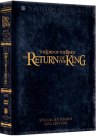
The Return of the King: Extended Edition is packaged in the same style as the two earlier Extended Edition releases. It's a four-DVD set, with the movie split between the first two discs and the special features on the remaining two discs. The DVDs are held in a fold-out cardboard holder which fits snugly into the sturdy cardboard case. This set is in blue, with the same attractive design and art on cases and discs as the other releases. A small insert booklet is also included, with chapter titles (conveniently indicating scenes that are new or expanded for the Extended Edition) and an overview of the special features content.
The menus are attractively designed, simple to use, and faster to navigate through than those in the theatrical cut.
Video
The video transfer of The Return of the King is reference-quality. I scrutinized the image throughout the whole movie, and it holds up impeccably in all circumstances: there is nothing whatsoever wrong with this transfer, and let me tell you, there's a whole lot that's right with it.
Let's start with the print: it's clean as a whistle. No noise, no specks, no scratches, no hint that this is anything but a window into Middle Earth (and one that was recently washed, no less). I could not find a single instance of edge enhancement in the film, even in the most challenging shots, so the level of natural-looking detail is incredible. Even the layer changes are secreted into just the right moments, so I never noticed them.
The transfer does a phenomenal job of capturing all the subtle variations in color and shading throughout the film. Colors always look clean, richly textured, and natural, whether they're the subdued grays and browns of Mordor, the dazzling white of Minas Tirith, or the vibrant primary colors of the Shire. Many of the scenes throughout the film present significant challenges in terms of contrast, with images that have both brightly-lit and very dark areas in the same frame, but the transfer always handles these situations perfectly. Black levels are nicely deep and dark, but even in dark areas of the scene there's always just the right amount of detail and shading.
The Return of the King appears in its correct widescreen aspect ratio of 2.35:1 and is anamorphically enhanced. As far as I can tell from comparing scenes from the two versions, it's the same transfer as the theatrical edition.
Audio
If you don't have DTS capability in your home theater, The Return of the King: Extended Edition is a perfect argument for upgrading. The DTS 6.1 track is absolutely phenomenal. First of all, there's the rich and vibrant quality of the sound overall. It's powerful while never being overbearing, and always sounds natural, whether we're listening to the dialogue, the music, or the environmental effects. Then there's the incredible immersive nature of the audio environment that this track creates: we're really transported into the middle of the action, with full use of all the sound channels. Think that's it? No, we also get fantastic use of localization and movement of the sound through the different channels. On many different occasions, the sound design creates the convincing illusion of events taking place to the viewer's left or right, or behind, or moving around... it's amazingly effective.
A Dolby 5.1 track is the next best choice, offering an exceptional sound experience in its own right, though once you've treated yourself to the DTS you'll see that it's not quite as rich or immersive as the DTS track. The Dolby 2.0 is obviously the weakest track: it's competently presented, but for a movie like The Return of the King, you really need surround sound to fully appreciate it.
Extras
The Return of the King: Extended Edition follows in the path of the two other Extended Editions in terms of the quantity of bonus materials. For overall quality, The Return of the King still gets a very high rating, but not quite so high as the earlier DVD sets.
The special features offer a comprehensive look at the making of The Return of the King, with a lot of behind-the-scenes footage, interviews with many different members of the filmmaking team as well as the Weta Workshop people. Pretty much every aspect of the film gets analyzed in exhaustive detail, from the adaptation of the source material to the day-to-day filmmaking to the special effects. The only problem is that for many of these subject areas, there's not a lot that's changed from doing The Fellowship of the Ring and The Two Towers to this film. After presenting reams of detailed information on the making of the costumes, makeup, props, miniatures, location shooting, artwork, and special effects in the earlier DVDs, the coverage of these topics in The Return of the King is often just more of the same.
That's not to say that there aren't some very interesting featurettes here; it's just that by now, the glimpses of movie-making-magic in the earlier DVDs have become, to a certain extent, information overload here. So with that caveat in mind, let's take an in-depth look at what's on offer here.
Discs 1 and 2
The first two discs have the audio commentaries, of which there are four: Peter Jackson and the writers; the design team; the production and post-production team; and the cast. Given the vast quantity of separate special features on the remaining two discs, I'll bet that only the most dedicated fans will have the time or inclination to check out all four of these commentaries (that's a total of over sixteen hours of commentary!) but for those who are interested, they do seem reasonably solid. The participants seem to have a pretty good idea of how to do a commentary, especially in the "crew" commentaries, and provide interesting behind-the-scenes information that's focused on the scene at hand. The cast commentary isn't quite as insightful as the others, but it's not bad.
Disc 3
Disc 3 is where the bulk of the special features start. All the material, incidentally, is presented in anamorphic widescreen, which is a nice touch. A "play all" feature conveniently knits together all the featurettes into a single documentary running three hours and 24 minutes, broken down into five main sections. An "index" feature also allows you to look up specific sub-topics and jump directly to them.
After a very short video introduction from Peter Jackson (not included in the "play all"), the first featurette on tap is one of the most interesting in the set: "JRR Tolkien: The Legacy of Middle-Earth." Running 30 minutes, this piece focuses on the inspirations and background material for Tolkien's immense novel. Various Tolkien experts from academia provide interesting insights into the linguistic and historical roots of The Lord of the Rings; I recognized some of them from when I was researching Tolkien for my dissertation, so we're looking at quite credible sources here.
Next is a section called "From Book to Script," which opens with a 25-minute featurette called "Forging the Final Chapter," on the difficulties of adapting The Lord of the Rings in general and The Return of the King in particular to the screen. There's particular emphasis on how Jackson handled Tolkien's technique of interleaving the two main strands of the story, and how he re-arranged some material from The Two Towers and The Return of the King. This is a reasonably interesting piece. Also in this section is a storyboard for an abandoned concept of Aragorn battling Sauron; this isn't included in the "play all" feature, but can be selected separately from the special features menu.
Moving on to "Designing and Building Middle Earth," we get several hefty featurettes under this heading. First off is "Designing Middle Earth," (40 minutes), followed by "Big-atures" (20 minutes), "Weta Workshop" (47 minutes), and "Costume Design" (12 minutes). Despite the substantial amount of time devoted to these features, I felt that they're relatively weak, considered in the context of all the Extended Edition bonus material. The general topics are pretty much a rehash of material that's been discussed in great detail in the earlier Extended Editions, except that this time it's specific to the sets, costumes, monsters, and props of The Return of the King. Truly die-hard fans will undoubtedly enjoy this section, but I found it less than compelling by now.
Also in this section (but not included in the "play all" feature) is a set of "Design Galleries." These are slideshows of sketches and preparatory material, in the categories of "Peoples of Middle Earth," "Realms of Middle Earth," and "Miniatures." There's a fairly large amount of menu-navigating here, as each category breaks down into multiple slideshows (for instance, one for each major character) and there's no "play all" for this section. Within the slideshows, selected images have short audio commentary clips from the artist.
The next feature, "Home of the Horse Lords," is my favorite of the set. This 30-minute piece focuses on the use of horses in the making of the movie, with the horse trainers, riding doubles, and actors discussing the challenges and unique "tricks" involved in getting the animals to do their part in an atmosphere that was, for a horse, very unnatural. This featurette is particularly interesting as it explores a topic that's completely fresh and at the same time fascinating.
The "Middle Earth Atlas" is not included in the "play all" feature, which might serve as a good reminder that you might as well skip it. Here you can view a map of Middle Earth and trace the path of four different character groups from the Fellowship. At various points on the journey, you can click to see a clip from the film at that point. Perhaps I'm missing something, but this feature seems like a colossal waste of time.
The last feature on this disc is "New Zealand as Middle Earth," which is broken down into six segments (with its own "play all" feature) running a total of 16 minutes. Here, you can select one of the locations featured in the story and see a short featurette discussing the location and its use in the film.
Disc 4
Disc 4 also opens with a short introductory clip, this time by Billy Boyd and Elijah Wood. There's a "play all" feature and an index as well.
The first item under the heading of "Filming The Return of the King" is the massive hour-and-13-minute documentary called "Cameras in Middle Earth." As you might expect from the title, it's an overall look at the filming of the third Lord of the Rings film, with a lot of behind-the-scenes footage; it pretty much goes through the whole film, with each chapter focusing on the making of a specific scene. It's certainly long, but I found it to be not particularly information-dense, especially when compared to the more topic-specific featurettes on Disc 3 and later on this disc. Also in this section is a set of production photos, which are not included in the "play all" but can be selected from the menu.
The "Visual Effects" section starts off with a 42-minute piece on "Weta Digital," which has the general theme of how much better the Weta team has gotten over the course of making the effects for the trilogy. It's not bad, but feels like it's going over material that's already been covered elsewhere. The other, more interesting, piece in this section isn't included in the "play all" but is worth checking out from the special features menu: it's a demonstration of visual effects of a major battle sequence. For the 30-second clip, we see multiple windows each displaying a different aspect of the visual effects creation process. You can select an individual window to display that aspect full-screen, or you can choose to play them all in sequence full-screen.
"Post-Production: Journey's End" contains four featurettes, each running about 20 minutes. "Editorial: Completing the Trilogy" is a reasonably interesting look at the mammoth task of editing together the final film, given the superabundance of both new material from The Return of the King and unused material from The Two Towers. "Music for Middle Earth" and "The Soundscapes of Middle Earth" look at the musical score and the sound effects for the film, and don't really go over much new ground. "The End of All Things" is a bit more interesting, as it covers the scramble to get everything finished and put together into an actual, complete film.
"The Passing of an Age" is a single 25-minute piece that focuses on the promotion of the film, after it was finally complete and released to theaters. It's moderately interesting, as we get to see the cast and crew at the World Premiere in New Zealand and going on a massive world tour as well.
The last section in the special features feels a bit out of place. "Cameron Duncan: The Inspiration for 'Into the West'" is a 32-minute featurette that focuses on a young New Zealand filmmaker who was the inspiration for the song that closes The Return of the King. We learn about him and his struggles with cancer, and get to see clips of his work, but it doesn't really feel particularly relevant or compelling.
All in all, the sheer volume of material on The Return of the King is a bit exhausting as well as exhaustive. It's still a very impressive set of special features with many interesting segments, but there's not quite as much truly fascinating stuff here as in the two earlier DVD sets.
Final thoughts
The Return of the King: Extended Edition is a vastly better film than the theatrical cut, and it's within a hairsbreadth of being as phenomenal as The Fellowship of the Ring: Extended Edition. While there are a few things that don't work quite as well as they might have, like Arwen and the slightly overlong ending, the extra material in this version of The Return of the King really makes it shine. There are few scenes that I can point to specifically as tipping the balance: it's more that the film is now better paced and more fully developed, and now all the pieces fit together into an extremely satisfying whole.
I've given it a relatively low replay value simply because it's so long: watching a four-hour film is basically something you have to schedule your day around, rather than something you can just do on an whim. I'd say that the film itself will stand up quite well to viewing multiple times, though, so it's definitely worthwhile to have in your collection, even if it doesn't get watched as often as other films.
On top of being a fantastic movie, The Return of the King boasts a reference-quality video transfer and knockout DTS sound, so really this is a film that amply deserves to be part of the DVDTalk Collector's Series. It's a fabulous way to wrap up the long, exciting journey of The Lord of the Rings.
|



| Popular Reviews |
| Sponsored Links |
|
|
| Sponsored Links |
|
|
| Release List | Reviews | Shop | Newsletter | Forum | DVD Giveaways | Blu-Ray | Advertise |
|
Copyright 2024 DVDTalk.com All Rights Reserved. Legal Info, Privacy Policy, Terms of Use,
Manage Preferences,
Your Privacy Choices 
| |||||||