
| Reviews & Columns |
|
Reviews DVD TV on DVD Blu-ray 4K UHD International DVDs In Theaters Reviews by Studio Video Games Features Collector Series DVDs Easter Egg Database Interviews DVD Talk Radio Feature Articles Columns Anime Talk DVD Savant Horror DVDs The M.O.D. Squad Art House HD Talk Silent DVD
|
 DVD Talk Forum |
|
|
| Resources |
|
DVD Price Search Customer Service #'s RCE Info Links |
|
Columns
  



 
|
|
|
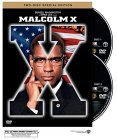
Malcolm X (Two-Disc Special Edition)
NOTE: Read Chris Tribbey's interview with Spike Lee
William Shakespeare couldn't have created a life with more dramatic tension and a more fascinating character arc than the real life (or lives) of Malcolm X. Over the course of thirty-nine years he went from a child who saw the Ku Klux Klan torment his family, murder his father, and start his mother on the path to insanity, to young Boston hustler, drug-dealer, pimp and thief, to Nation of Islam spokesperson and vehement black separatist to, finally, the stunningly progressive social critic and proponent of personal responsibility who sought to take the black struggle in America global. That he was cut down at such a young age, assassinated due to his own outspokenness, only adds to the majestic tragedy of his story. Sadly, his legacy is often boiled down in the history books to a few catchphrases and it seems that the general public knows little more than the image of him holding a rifle and declaring "by any means necessary!"
When Warner Brothers set out to make a biopic based on Malcolm X's legendary autobiography in 1991 (they had released a documentary on the subject two decades earlier; See "extras" below for more info), they initially intended to have Norman Jewison direct. Hot young filmmaker Spike Lee, however, felt that this particular film needed a black director in order for Malcolm's story to be told properly, so he convinced Jewison to step down and started on the production himself. (I always thought that Jewison got a bit of a bad rap out of this. After all, he did direct one of the boldest films of the civil rights era: In the Heat of the Night.) Still, coming off rich, complex films like Jungle Fever and Do the Right Thing, the filmmaker's incendiary statement on modern racial confusion, Lee was ready to tackle the epic story of one of America's most prominent black activists. A turbulent relationship with the studio, an international shoot (including in the holy city of Mecca, a first for a feature film), and a lot of newspaper headlines later Malcolm X emerged as a three-hour and twenty-minute ode to the complexities, contradictions, and transformations of one of the twentieth century's most fascinating men.
Lee's film isn't perfect (it feels rushed at times and a couple of poor casting decisions cost its emotional development dearly) but it shares with the director's best films a sense of passion and overstuffed thematic presence. Spike Lee is a kitchen sink director, flooding his stories with characters who attack the issues from every conceivable angle. Do The Right Thing is notable for the way it presents American race issues as endlessly complex loops of relationships that double back on themselves and repeat. He also isn't interested in offering up tidy, hopeful endings. The most his films hope for is an opening for understanding. His approach to Malcolm X isn't just to relay the specifics of the man's life (which he does quite ably) but to let the film reflect the tone and attitude of his transformations: As Malcolm changes, the film changes. And the way the audience feels changes along with it.
Lee takes a bold approach to structuring the film. The obvious period to cover (and the one that historically has gotten the most press) is Malcolm X's years with the Nation of Islam. But Lee reaches way back, much earlier than that for the first third of his film. Intercutting Malcolm's years in Boston and Harlem as a hustler with his early life and the mental and physical torment forced on his parents, Lee gives up the building blocks of the man's later persona. In a lot of ways, this is the film's strongest cinematic section. Lee is deliriously inspired by the period setting and the fast-talking lifestyle Malcolm (then called "Red") lived. Equally inspired by Vincent Minnelli musicals and James Cagney gangster films, the filmmaker imbues this hour-long sequence with high-energy pacing, eye-popping visuals, and humor.
There's also a sense of danger and sexiness to the world in which Malcolm got his start. Lee's goal here (as it is throughout the film) is to make the audience feel the rush of excitement and desire that made this world attractive to Malcolm. Never mind that Malcolm will eventually shun this path: It's his experience here that builds who he becomes and Lee knows this. A lengthy dance sequence at the Roseland Ballroom finds Malcolm and his friend Shorty (played by the director) hoofing it with a variety of women, including white woman Sophia (Kate Vernon). Malcolm, who knows white people solely as the oppressors of his parents, is unsure of how to act around Sophia, but soon they develop a romance that's dangerous, provocative, and ambiguous. Malcolm can't be sure of what Sophia wants from him and they share a couple of interesting, uncomfortable scenes together.
Malcolm also travels to Harlem where he joins a number running racket run by West Indian Archie (the terrific Delroy Lindo). Here Malcolm hones his skills as a con artist and develops into a player in the Harlem crime game. West Indian Archie provides a sort of father figure for Malcolm, a dynamic he will repeat throughout his life.
The culmination of this period of criminal activity is an eight-year prison sentence. Malcolm, who has no respect for authority, refuses to identify himself by his prison ID number and ends up in isolation. This grueling sequence leads to a near breakdown and acquiescence to the prison guards: Malcolm, voice hoarse, whispers his prison ID. It's a devastating moment considering the bold, proud personality that young Malcolm has at this point. It also emphasizes the importance placed on names throughout the film, from Malcolm Little to Red to the prison number to "X" and finally to Al-Hajj Malik El-Shabaaz, the use of name to define identity is crucial to this story.
Filled with anger and frustration, Malcolm is ripe for influence by Baines (Albert Hall), a fellow prisoner who's also a member of the Nation of Islam. Baines introduces Malcolm to the notion that the white man is the source of all his troubles and preaches that the white man is, in fact, the devil. Not just some white men (like Klansmen and corrupt police officers) but every white person, without fail. Malcolm thinks back over his life, and it adds up.
Unfortunately, this introduces the film's first misstep, and it's a crucial one. While in prison Malcolm has a golden vision that Nation of Islam leader Elijah Muhammed visits his cell to deliver an inspirational message. The controversial (and presumably magnetic) Muhammed is played by Al Freeman Jr., an actor so stilted and bizarre that he nearly wrecks every scene he's in. He affects some sort of bizarre Ghandi-by-way-of-Mississippi accent that comes and goes throughout the film. He stares off at a strange angle and drones his dialog in a distractingly unnatural way. Washington portrays a man transformed beautifully but Freeman gives us no sense of what it was that drew him in. The real Muhammed was a strange man and his accent was a bit peculiar, but nowhere near this weird. This is one case where casting an actor for his resemblance to the real thing (which is uncanny) was not the way to go. A strong actor was required for this role and Freeman cannot deliver.
Still, the tremendous momentum of a man possessed carries the film onward and, as Malcolm is released from prison, he begins to develop a following, preaching the Nation of Islam's words. Lee distills this sequence a little too much (Malcolm becomes powerful before we really have a sense of how) but as Malcolm develops his fiery rhetoric he becomes more potent. He follows Muhammed's lead in placing all the blame for the struggle of black Americans on the white man. He reaches heights of rhetorical fire with lines like "We didn't land on Plymouth rock! Plymouth rock landed on us!" and "The only thing I like integrated is my coffee." There is wit and eloquence mixed in with the anger, but there's no doubt that Malcolm takes his role seriously. One powerful sequence shows him watching civil rights protesters being shot at with firehoses on the news. The grim determination on his face perfectly communicates both his anger and his composure.
Another short, important scene finds Malcolm on his way to give a speech at a university. On his way in he's stopped by a naive but sincere white female student who asks what she and her well-intentioned friends can do to help the cause of black people in America. Malcolm's response to her is shockingly curt and dismissive, especially given how verbose he is when speaking to his own followers. Lee's staging of the scene accentuates how harsh it is: The white viewer who has been identifying with Malcolm as a great film character is immediately reminded of that divide. It has the effect of a fist to the gut. This brief moment, taken from real life, reveals a lot about Malcolm's mindset under the Nation of Islam.
That relationship, however, doesn't last forever. Malcolm grows dispirited with the behavior of Muhammed who, unlike Malcolm, does not walk it like he talks it, and jealousy within the organization of Malcolm's growing fame and the admiration of the public leads to conflict. The Nation gets its chance to muzzle Malcolm when he makes some poorly timed statements criticizing President Kennedy soon after his assassination.
The growing divide between Malcolm and the Nation of Islam causes Malcolm to leave the organization and strike out on his own. Malcolm boldly states in the press that he will be speaking his own words from then on and not parroting the teachings of Elijah Muhammed. This leads into the final stage of Malcolm's development and his greatest personal journey: His pilgrimage to the holy city of Mecca. This powerful sequence finds Malcolm doing something that's difficult for anyone, especially someone so outspoken in their beliefs: He realizes that much of what he was taught is in fact wrong and he does a very public, very honest about-face. Malcolm writes home that he now realizes that the Islam practiced by the NOI is not legitimate Islam and that Muslims actually come in all different colors.
His words "During the past eleven days, I have eaten from the same plate, drunk from the same glass, and slept on the same rug, while praying to the same God, with fellow Muslims, whose eyes were the bluest of blue, whose hair was the blondest of blond, and whose skin was the whitest of white," are some of the most breathtakingly open-minded words he ever spoke. This section of Malcolm's life - and of the film - should leave the viewer stunned. True-life stories are almost never this dynamic; This is the realm of fiction. But the same fire that drove Malcolm X to rise through the criminal underground and race to the forefront of the civil rights movement also drives his emotional rebirth after his pilgrimage. In a life full of twists and turns this one drives it home.
Of course, reversing the Nation of Islam's teachings while still demanding a better life for his own community didn't win Malcolm any new friends in the power structure. Pretty soon Malcolm's household is under attack from the Nation and the film reflects the dour downturn of his mood. Malcolm senses that his time is short and Washington adds a hint of melancholy to his performance. Lee uses one of his favorite tricks (having his actor smoothly dolly down the street) to accentuate the sense of unavoidable fate. By all accounts Malcolm knew that the end was coming. The violent nature of his death is still shocking, however, and the film ends in a flurry of motion and sadness. Still, Lee adds a strange coda that leaves the viewer with a hopeful sense. He's not saying that anything is finished, but rather that struggle remains and that everyone person shares a little bit in that struggle.
The success of Malcolm X as a film hinges on the authenticity and passion of the lead performance. Denzel Washington covers an incredibly wide range of emotions and personalities here. He takes us from Malcolm's rambunctious years through self-destructiveness, anger, and reawakening. In those moments when the film falters in pacing or development, Washington picks up the slack and carries us through on the strength of his personality. As much as is possible, he embodies his character here, really channeling that determination and devotion. Malcolm was, by all accounts, extremely single-minded and devoted to his cause (there are no tales of philandering during his Muslim years, as far as I can tell) and Washington brings across that seriousness and single-mindedness beautifully.
But he also shows us that Malcolm was a complete person. By turns funny and charming, he shows us the dynamic qualities that attracted a following in the first place. It's no surprise that so many stayed with Malcolm after his split with the NOI. If anything, he became far more inclusive in his separation and Washington easily portrays the man whose lead you would follow.
He's surrounded, for the most part, with other fine performers. Albert Hall plays Baines, the fellow inmate who brings Malcolm to Islam and later turns against him. His two-faced seriousness portrays the essence of the Nation of Islam. Lee does a great job playing Malcolm's foil in the early years. His exuberance and energy give Washington something to play off. Their friendship is very believable. And Angela Bassett plays Malcolm's wife Betty in a somewhat underwritten role. Still, her quiet dignity and soulful voice make the most of this role. Her bond with Malcolm, sketched out in relatively few scenes, is strong and real.
The supporting player who got the most praise (deservedly so) was Delroy Lindo as West Indian Archie. He's the slithery numbers runner who really kicks off Malcolm's crime career and his big smile always hides an implied threat. The first scene where the two spar verbally is a real attention-getter. The two actors barely give each other a breath between exchanging lines. Archie sees a soulmate of sorts in young Malcolm and Lindo projects this mentor role with a few short strokes. Like many of the fleeting characters that pass through Malcolm's life, West Indian Archie isn't in the film for too long, but he does make an impact. The one time Malcolm meets him again after his conversion to Islam, we're faced with a sad and resonant scene. The viewer gets the feeling that Malcolm would thank all the people who did him wrong over the course of his life for setting him on the path to eventual enlightenment. Without making it explicit, we know this through the sadness in Washington's eyes when confronted with the remnants of the past.
Film fans will love the parade of recognizable faces that Lee runs in front of his camera. Small roles belong to actors like Debi Mazar, Giancarlo Esposito, Roger Guenveur Smith, Michael Imperioli, Karen Allen, Christopher Plummer, and Peter Boyle (who is saddled with one of the film's few bits of too-obvious dialog), among many others. Even Ernest Thomas (Roger from What's Happening!!) gets a key role and the opportunity to show his acting chops. It's a huge film that works on many levels and is stuffed with excellent performances, storytelling, and cinematic flair.
VIDEO:
The anamorphic widescreen video is very good for such a challenging film. Dickerson's cinematography embodies a wild variety of styles, from the gauzy reminiscence of the early scenes to the harsh grit of prison, to the earthy straight-forward look of the middle section to the bright, colorful, vibrant pilgrimage sequence, with newsreel-like segments thrown in sporadically. The transfer here is quite beautiful, always keeping the look honest and true to the film. The only instance of compression I noticed was on the red velvet wall of a very rich Harlem bar. Other than that the transfer handles this complex, richly visual film superbly.
AUDIO:
The Dolby Digital 5.1 soundtrack is also very well done. The voices are bold and clear, the orchestral score sounds dynamic and vibrant, and the ambient sounds are lively and effective. During speeches voices fill the surrounds and give a sense of place. Subtitles are available in English, Spanish, and French.
EXTRAS:
One thing I should note right off is that the film is split across two discs. The break is rather sudden and not particularly well handled, which is a shame. But with the film running well over three hours, having a break is welcome. I watched the DVD over the course of two nights and found that it worked very well that way. This is event viewing and spreading it out a bit gives it a chance to breathe.
That said, this two-disc set has an outstanding set of extras. (I'll save the best for last.) The film is accompanied by a commentary track from Spike Lee, cinematographer Ernest Dickerson, editor Barry Alexander Brown and costume designer Ruth Carter. While the participants are individually recorded and edited together they all contribute interesting insights into the film and the story.
The first disc also includes a few other fine extras. By Any Means Necessary: The Making of Malcolm X is a very well-made piece on the somewhat unusual story behind the production. It features interviews with many of the key personnel and covers some of the more unusual aspects of the production (the stepping down of Norman Jewison as director, Lee's tapping Michael Jordan, Oprah Winfrey, Bill Cosby, and others for finishing funds) and gives a good sense of the work that went into creating the various periods in the film. Particularly interesting are brief glimpses of costume designer Ruth Carter's beautiful sketches.
Also included is a selection of additional scenes that didn't make the final cut. Each scene is introduced by Lee and the entire section runs about twenty minutes. It shows that some of the tricky, rushed sections of the film were likely more fleshed out originally: One short scene showing the incarcerated Malcolm copying the dictionary by hand helps illustrate how he went from street tough to eloquent speaker. Lee's comments are also pretty good as he discusses what these scenes mean to him and why they were removed. A good feature. (The clips are workprint quality and not quite as polished as the finished film.)
The first disc also includes the trailer, which is a nice example of using a short clip to build excitement. Plus Ossie Davis does the voiceover instead of the typical "In a world..." guy. Nice touch.
The second disc, in addition to the conclusion of the film, includes what may very well be the single best archival extra feature I've ever seen on DVD: The Oscar-nominated 1972 documentary Malcolm X, which is one of the most powerful, emotional viewing experiences I've ever had. Prior to seeing this feature I'd read a great deal about Malcolm X and seen Lee's film several times. But while watching this masterful film I realized that I'd never seen more than a few clips of him speaking in the flesh, and even then rarely anything other than the same soundbites everyone always shows.This 90 minute feature consists almost entirely of Malcolm X's words, either from speeches and interviews, or read from his autobiography (by James Earl Jones, of course), and this insider insight is tremendously valuable. It's usually the case that a feature film representation of a non-fiction character is more poetic, more prescient than their real-life counterpart. If anything here the reverse is true. While Washington's performance is marvelous, there is nothing like hearing the real man speak. It's impossible to imagine a more eloquent, passionate, exciting speaker. Every sentence is a most perfectly formed, poetically beautiful example of grammatical wonder. Even when the ideas expressed are questionable it's a fascinating listening experience.
It's also amazing how funny Malcolm X was. There are moments of charm and humor mixed in with the preaching that are astounding. One laugh-out-loud moment comes at a most surprising moment: When an unruly extemporaneous sentence about being "brainwashed by these blue-eyed white men" gets away from Malcolm he pauses and breaks out a huge smile. After a long pause - perfect comic timing - he deadpans "some of them have brown eyes."
The structure of the documentary is quite interesting. It incorporates a lot of different sources and styles of film, from news footage of kids playing in piles of debris to hideous archival footage from racist films of the past, into a terrific tapestry. These pieces are woven together to create a very moving story, told with little standard exposition. Malcolm's speeches aren't presented in simple chronological order, but in a loose thematic order. The film follows Malcolm's progression as an activist by blending together different speeches and interviews that relate on various topics but that add together to give a better sense of what he was about.
Like Spike Lee's film, the approach here really gives the viewer a sense of the breadth of Malcolm's experiences and how they shaped him as a man, but because the documentary uses the real footage (and because Malcolm is so amazing) the emotional impact is almost greater here. As he changes (and here the changes are truly intuitive, since we interpret them from his speeches and the brilliant ways he delivers them) we grow to respect him more and more. By the end, all the more horrendous for its reality, the film is devastating. The remembrances of some of his admirers, beautifully delivered through heartbreaking tears, are especially powerful.
I often criticize DVDs for not including any deep context that can expand the viewer's understanding of the subject matter but that's not the case here. Including this documentary was a brilliant move (and a no-brainer, since Warner Brothers owns it) that knocks this disc from "Highly recommended" status (earned by Lee's fine film) easily into "Collector's Edition" territory. It's not often that a single extra feature can improve a disc so dramatically, but this one does. Malcolm X, the 1972 documentary, should absolutely be required viewing for all Americans.
All the extra features are anamorphic widescreen.
FINAL THOUGHTS:
Malcolm X is not a perfect film: It rushes through a few sections (even though it's already so long) and the casting of Elijah Muhammed doesn't work. Still, it more than achieves its primary goal of making the central figure vividly real. It's not a stretch to imagine a generation gathering their knowledge of the man, beyond the usual soundbites, from Lee's work here. You could watch Malcolm X and come away with a much greater appreciation of this endlessly complex man. And, thanks to the inclusion of the masterful 1972 documentary on the DVD audiences will actually end up learning a lot. The one-two punch of these two fine films, plus the rest of the worthwhile extras, makes this one tremendous release.
Reviews of other Spike Lee films:
Do the Right Thing
4 Little Girls
25th Hour
|



| Popular Reviews |
| Sponsored Links |
|
|
| Sponsored Links |
|
|
| Release List | Reviews | Shop | Newsletter | Forum | DVD Giveaways | Blu-Ray | Advertise |
|
Copyright 2024 DVDTalk.com All Rights Reserved. Legal Info, Privacy Policy, Terms of Use,
Manage Preferences,
Your Privacy Choices 
| |||||||