
| Reviews & Columns |
|
Reviews DVD TV on DVD Blu-ray 4K UHD International DVDs In Theaters Reviews by Studio Video Games Features Collector Series DVDs Easter Egg Database Interviews DVD Talk Radio Feature Articles Columns Anime Talk DVD Savant Horror DVDs The M.O.D. Squad Art House HD Talk Silent DVD
|
 DVD Talk Forum |
|
|
| Resources |
|
DVD Price Search Customer Service #'s RCE Info Links |
|
Columns
  


 
|
|
|
Letter to Three Wives, A
The Studio Classics series took its time getting to this winner, one of Fox's most entertaining films of the post-war period. Smart & snappy dialogue from Joseph L. Mankiewicz is enlivened by an excellent cast - it's funny, sexy and often right on the mark with its look at the ambitious middle class after the war.
Although a television version was done in 1985, forget about doing a remake of A Letter to Three Wives now - cell phones would make the plot unworkable. The three wives stare at a telephone booth as they sail away with their slum kids, while we realize that in ten years stationary telephones may be entirely passé.
Joseph Mankewicz was an intellectual who wrote and directed a string of classy dramas around the mid-century mark: This movie, All About Eve and People Will Talk. The backstage Broadway film is an acknowledged classic and People Will Talk an interesting oddity, but A Letter to Three Wives is as entertaining as either of them, an intelligent riff on the catty women's picture.
The simple setup posits three wives (there originally might have been four or five) with reasons to worry that their particular husband is the one to have run off with the town siren, described as a perfect cultured lady. Paul Douglas calls her "what a Queen should be." Those kinds of endorsements have given the wives a kind of perpetual marital insecurity.
Working in his familiar flashback mode, Mankiewicz tells a separate episode from the past of each relationship. Jeanne Crain gets an shaky start on post-war life with her classy and monied husband. A farm girl who went directly into the Navy, she feels entirely inadequate to join the social swirl of fancy friends and country club dances. This episode must have won over many females in the audience, the ones intimidated by the standards set for them after the war: To be perfect social companions for upwardly mobile husbands. Interestingly, although two of the three couples are described as middle class, all have large homes and employ at least one servant. Today they would be "lower rich class."
Ann Southern's segment is the least successful. She and Kirk Douglas perform well but Mankiewicz' idea of keen satire is to contrast Douglas' refinement in music and art against the crass commercialism of the kitschy radio dramas his wife writes. It doesn't take much courage to target radio soaps as trash and the episode becomes a little preachy. Mankiewicz does manage a timely dig against the HUAC witchhunts, when Douglas pointedly asks if his higher cultural standards make him un-American. That's a pretty courageous line for 1949.
The final chapter introduced Paul Douglas (The Solid Gold Cadillac) to the screen and is the most entertaining. It deals with Linda Darnell's Lora Mae, a beauty from the wrong side of the tracks, and her use of feminine wiles to maintain her dignity and snare a husband. Lora Mae won't get intimate with her rich boss and drives him nuts until he capitulates and agrees to marry her. There are some good gags with her amusing mother (Connie Gilchrist), a supportive friend (Thelma Ritter in an early role) and Lora Mae's bickering sister (Barbara Lawrence, of the same year's Thieves' Highway). The episode frankly acknowledges the problem of a woman from a lower class position who wants love but must resist becoming a bought item for a wealthy man. Economic inequity forever complicates what could be a perfect romance.
Mankiewicz's slick and clever dialogue is sometimes a bit show-offy, with too many people correcting each other's word usage. Oddly enough, the banter is at its most convincing among the beer-drinking gals at Lora Mae's house. He does manage some sly jokes, such as when an old biddy talking about radio refers to 'penetrating' Ann Southern with a commercial message. There are some good visual jokes as well. Porter has finally broken down and proposed to Lora Mae in her home, one of those shacks adjacent to a railroad that shakes, earthquake style with every passing train. When the two finally embrace, the shaking from the main line tracks turns them into a quivering pair of statues. It's a naughty substitute for the sex Porter so desperately craves.
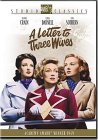
Fox's Studio Classics presentation of A Letter to Three Wives comes in a stunning transfer with a great-sounding audio track. Beyond the expected trailer and newsreel, the main attraction is a Biography episode on the dramatic and tragic life of Linda Darnell. Three experts trade off on a feature commentary, including one of Mankiewicz's sons. They provide too much description of the plot we're all watching unfold on screen, but a lot of interesting information as well.
On a scale of Excellent, Good, Fair, and Poor, A Letter to Three Wives rates:
Movie: Excellent
Video: Excellent
Sound: Excellent
Supplements: Commentary, Biography episode on Linda Darnell, trailer, newsreel
Packaging: Keep case
Reviewed: February 7, 2005
| |
|


| Popular Reviews |
| Sponsored Links |
|
|
| Sponsored Links |
|
|
| Release List | Reviews | Shop | Newsletter | Forum | DVD Giveaways | Blu-Ray | Advertise |
|
Copyright 2024 DVDTalk.com All Rights Reserved. Legal Info, Privacy Policy, Terms of Use,
Manage Preferences,
Your Privacy Choices 
| |||||||