
| Reviews & Columns |
|
Reviews DVD TV on DVD Blu-ray 4K UHD International DVDs In Theaters Reviews by Studio Video Games Features Collector Series DVDs Easter Egg Database Interviews DVD Talk Radio Feature Articles Columns Anime Talk DVD Savant Horror DVDs The M.O.D. Squad Art House HD Talk Silent DVD
|
 DVD Talk Forum |
|
|
| Resources |
|
DVD Price Search Customer Service #'s RCE Info Links |
|
Columns


 
|
|
|
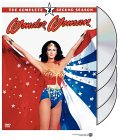
Wonder Woman: Complete Second Season
Seventies nostalgia is pretty much a force unto itself at this point and it's caused the re-emergence of an awful lot of TV shows from that era. A lot of it is quite welcome for an audience weened on the stuff but I dare say that for more than a few people the release of Wonder Woman in spiffy complete season box sets is about the pinnacle of the trend.
Having seen the show as a tot I've always recalled its daring adventures, dastardly villains, and stunning hero. But going back and watching the show now it's incredible how these things have changed - and sometimes how they haven't. The adventures and plots are the epitome of daft goofiness. The villains are (appropriately) exactly the kind of cartoon villains who will hope to rule or destroy the world and intend to reach their goal through some ridiculous means that make absolutely no sense. The action in the show is ludicrously mundane and the pacing is often so slack that there is almost no action on screen at all.
But I'm not insulting the show here: This all feeds into the nostalgia machine. When Roddy McDowell cackles in his underground layer as he plans to turn ordinary mountains into volcanoes, or when an alien race called the Skrill use a silly claw-like device to take over the bodies of humans including the leaden Vincent Van Patten in order to sell their minds on the intergalactic black market, or when Martin Mull playing Hamlin Rule, a prancing rhinestone-encrusted rock-n-roll flutist hypnotizes Eve Plum in order to steal the box office cash from his own shows, the show's innocence and charm are at full throttle. Sure the fights look like they're being fought in a vat of molasses, but all this adds to the charm of the show.
Even the basic premise, inspired by the comic book, of course, is goofy: Diana Prince is a member of a tribe of Amazonian women who live on Paradise Island, located somewhere in the Caribbean (and not in the Amazon) who take their cues from Greek culture. These women prance through the jungle in lingerie like some sort of sorority slumber party. When a plane carrying Steve Trevor, an agent for the Inter-Agency Defense Command (IADC), as well as other United States officials, is hijacked by an agent for rogue South American nation Samara (who?) the Amazonians step in. After rescuing the hapless heroes without their knowing about it, Diana Prince, princess of the Amazonians offers to assume a human identity and take a position in the IADC in order to help out the good people of Earth (i.e., the Americans).Part of the reason that Diana wants to take on this role is that she recognizes Steve Trevor as the son of Steve Trevor Sr., an American she helped fight crime during World War II, the time-period of the first season of Wonder Woman (and you thought the retooling on Alias was convoluted!) Now firmly entrenched in the 1970s, Diana Prince dons some very fetching Diane von Furstenberg-eqsue wrap dresses and assists Trevor in all manner of crime fighting.
A large reason for the show being so watchable is its leading lady, the incredible Lynda Carter. She imbues the show with wit, sweetness, and sincerity. I don't know if it's Diana Prince's confidence knowing that she can turn into Wonder Woman anytime she needs but Carter smiles through nearly every scene, no matter how deep the peril. It's not bad acting, however, but something very winning: She's charming every second she's on screen. Even though as the season progresses her outfits become more dated she's never less than the perfect TV glamazon.
When she assumes the Wonder Woman persona things really kick into high gear. In fact, whenever the plots get too complicated and bizarre, Diana spinds and becomes Wonder Woman - and the hypnotizing effect clears everything up. The celebrated costume is a mix of little kid glitter-and-spangles and BDSM fetish gear. Her corset is so tight (and her figure so exaggerated) that Marilyn Manson undoubtedly has a Wonder Woman poster somewhere in his home. But Carter bears it all with grace, from the high-heeled boots to the lasso of truth (bondage gear, without a doubt) to the bulletproof bracelets that allow her to fend off death and vogue at the same time.
Wonder Woman's second banana, Steve Trevor (played by the inimitable Lyle Waggoner), is a far less impressive agent. He may think he's a smooth 70s daddy but modern audiences will howl at his ineptitude. That's the beauty: He thinks he's Sonny Crockett but he's much closer to Barney Fife. At one point he offers to guard the door while Wonder Woman does something heroic only to be brought in, gun to his back, seconds later. I wish she would put her hands on her hips (as she does so often) and snark "Oh, Steve!"
The adventures themselves are portrayed in hysterical 70s chintziness. The same shots are used in multiple episodes, stock footage is sprinkled in throughout, and the stunts are pretty half-assed. This is not a show that would fly today without some serious pumping-up. But for the tone and the era it's perfect. The evil plots make zero sense (A purple suited villain kidnaps athletes to create his own Olympic team?!?!) but the guest stars are so campy that it doesn't matter. It's even perfect that no one recognizes Diana as Wonder Woman's secret identity - even after she completely ditches her gigantic Clark Kent glasses. There's even a moment when a villain seems to be coming to an epiphany about Wonder Woman's true nature, only to determine that Wonder Woman and Diana Prince must actually be some sort of friends. Good thinking, Einstein!
VIDEO:
The full-frame video is actually surprisingly good. Although it obviously shows its age with some softness and grain, the colors are bright, the image reasonably crisp and the print damage pretty rare. I have to say, there are times when you could almost forget that this is a 70s TV show, not a period known for its beautiful imagery. Whether it was some digital restoration, careful archivism or just dumb luck, Wonder Woman looks damn good.
AUDIO:
The Dolby Digital mono audio is pretty good, starting out kind of rocky (with some very echo-filled locations in the first episode) and improving steadily thereafter. Obviously it's limited in what it can do but the dialog is clear and the crazy music sounds fine. Not a showstopper, but a decent track, to be sure.
EXTRAS:
The only extra is a fine 10 minute piece that looks at the process of adapting the popular comic to the screen that includes interviews with some very enthusiastic fans-cum-Wonder Woman comic book artists as well as Lynda Carter herself. Viewers will appreciate the opportunity to spend a few minutes with the actress who has apparently aged like fine wine.
One note to DVD producers: If you have an eight-sided release and only have an extra feature on the final side, please don't include a "special feature" option on every single menu that only leads to a screen that reads "Check other discs for special features." Us DVD reviewers who receive only the discs and no packaging (and who thus are forced to pop every disc in looking for the elusive features) thank you in advance! (Oh, and in the future, try labeling the discs as well! Thanks!)
FINAL THOUGHTS:
Wonder Woman is a wacky, wacky show. The plots are nuts, the casting is perverse, and the production values are all over the place. Even the theme song is insane. But it's never less than entertaining. Keeping the entire series grounded, however, is Lynda Carter's phenomenal performance. She manages to be sexy, funny, brave, nice, tough and heroic all at once. At twenty-two episodes, it's a lot of show to enjoy and every second of it is bathed in glorious cheese. God bless you, Wonder Woman!
|



| Popular Reviews |
| Sponsored Links |
|
|
| Sponsored Links |
|
|
| Release List | Reviews | Shop | Newsletter | Forum | DVD Giveaways | Blu-Ray | Advertise |
|
Copyright 2024 DVDTalk.com All Rights Reserved. Legal Info, Privacy Policy, Terms of Use,
Manage Preferences,
Your Privacy Choices 
| |||||||