
| Reviews & Columns |
|
Reviews DVD TV on DVD Blu-ray 4K UHD International DVDs In Theaters Reviews by Studio Video Games Features Collector Series DVDs Easter Egg Database Interviews DVD Talk Radio Feature Articles Columns Anime Talk DVD Savant Horror DVDs The M.O.D. Squad Art House HD Talk Silent DVD
|
 DVD Talk Forum |
|
|
| Resources |
|
DVD Price Search Customer Service #'s RCE Info Links |
|
Columns
  


 
|
|
|
Easter Parade
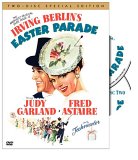
MGM musicals can be split into two categories, at least for this observer: The ones with a concept and the ones that are a collection of agreeable songs. Easter Parade belongs to the second kind, although Fred Astaire and Judy Garland are so watchable that the trite story becomes a small matter. It is simply seventeen musical performances tied together but it hit the button for 1948 audiences, especially the jubilant title song.
Warners' DVD will appeal to the musical fan for more than just a perfect home video experience; the two-disc set also includes the inspiring American Masters docu on Judy Garland.
Easter Parade is a fine picture and it feels more than a little boorish to discuss its shortcomings as compared to other MGM musicals that happen to be one's favorites. The dialogue is fairly clever and the acting expert but Easter Parade is for the most part a standard, flatly shot backstage romance. Judy Garland and Fred Astaire make it all much better than watchable, but the script is the kind of material that we associate with second-tier talent - a lot of predictable business with crossed romantic signals. Ann Miller is amusing only when she's dancing, which was apparently all done with injuries and in terrible pain. Peter Lawford is his usual lump - the deadpan bartender played by Clinton Sundberg has more personality. I have to say that Lawford's umbrella-themed song is really ... awful. It makes one wish for Oscar Levant, if such a thing is possible.
Astaire's 'drum' number in the toy shop launches the picture, and then things get tepid for awhile. The light comedy between Garland and Astaire keeps the show afloat while we're waiting for the great musical numbers to come along. When they do arrive they're exceptional. Ann Miller's wonderful tap dancing dervish has little to do with her character elsewhere in the movie, but that matters as little as the anachronism of having a blazing jazz blues tap dance in 1912.
The musical numbers are stand-alone delights. The most accomplished is probably Steppin' Out With my Baby. Astaire graciously allows top-billed Garland to be the center of attention in most of their scenes, but here he gets to cut loose with one of his all-out dance specialty pieces. This time the novelty concept works - Astaire dances in slow motion, matted into a real-time background chorus - and avoids the gimmickry of numbers goosed with upside-down rooms, etc.
This is the movie with the charming comedy song about 'walking down the avenue' with Astaire and Garland dressed as tramps. It alludes to the Easter promenade theme that opens and ends the show. Astaire buys Miller a hat for the Easter Parade but his day is a romantic flop; a year later Astaire and Garland upstage Miller on 5th Avenue, and fall in love in the bargain. It's thin, but it works.
I think the last impression of Easter Parade is what won over the mass audience. Musical comedies aren't usually associated with the post-war environment but I believe that MGM's Technicolor musicals expressed America's victory uplift, in the same way that film noir was its neurotic downside. The feeling was still around in the 1950s when I was a child - the idea that there's a bright new future ahead with no boundaries, because the victors are back home with families and jobs in a secure country enjoying an economic boom. God is shining his light on the whole sunny picture.
After a hundred minutes of familiar musical situations, Easter Parade suddenly seems to boil over with this sentiment. The brief final title song is different than what's come before. The confined interiors or sidewalk shots suddenly pull back to this giant view of Fifth Avenue. It's the orchestration that does it - the heavenly choir behind the lyric puts a stamp of glory on the fade-out. Audiences in 1948 didn't want depth, but affirmation.
Jules Munshin has a standout bit as an unflappable waiter; Lola Albright, Joi Lansing and Benay Venuta are showgirls, each given at least one glorious Technicolor closeup. I can imagine Joi Lansing making a deal with her local theater to allow her to walk in at the 81-minute mark or whatever, just to re-experience her one shot!
Warner DVD's presentation of Easter Parade is a package that will convince musical-haters why Judy Garland is one of the top performers of the last century. Peter Fitzgerald's making-of-docu efficiently explains the story behind the film. I was surprised to find out that Gene Kelly was originally meant to star instead of Astaire, and Cyd Charisse instead of Ann Miller.
Susan Lacy and John Fricke's American Masters show on Garland's life supercedes all other Garland docus and for this reviewer was actually more engaging than the main feature. It tells her life story in its entirety with all the necessary clips from her MGM, Warners and UA films as well as her 60s television show. After spending years hearing how 1970's MGM executive James Aubrey made life hell for talents like Blake Edwards and Sam Peckinpah, it was a shock to find out that as a CBS executive he was responsible for ruining Garland's TV show as well.
There is also a radio production of the movie, a pack of Garland trailers, a radio promo and the now familiar outtake number Mr. Monotony. A commentary track features a well-researched John Fricke for the hard facts and Fred Astaire's daughter Ava Astaire for pleasant personal memories.
There are rumors that Astaire's RKO musicals with Ginger Rogers will finally come to DVD in the next year or so; I hope that the legal/licensing roadblocks that presently impair retrospective docus on Astaire will be cleared up by then.
On a scale of Excellent, Good, Fair, and Poor, Easter Parade rates:
Movie: Very Good / Excellent
Video: Excellent
Sound: Excellent English (Dolby Digital 1.0), French (Dolby Digital 1.0)
Supplements: Commentary by Fred Astaire's daughter Ava Astaire and Judy Garland biographer John Fricke; docu Easter Parade: Beyond the Avenue; American Masters docu Judy Garland: By Myself; Outtake musical number: Mr. Monotony; Audio-only bonuses: radio production with the film's stars; Radio promo; Garland trailer gallery
Packaging: 2 discs in sleeved Keep case
Reviewed: March 19, 2005
| |
|



| Popular Reviews |
| Sponsored Links |
|
|
| Sponsored Links |
|
|
| Release List | Reviews | Shop | Newsletter | Forum | DVD Giveaways | Blu-Ray | Advertise |
|
Copyright 2024 DVDTalk.com All Rights Reserved. Legal Info, Privacy Policy, Terms of Use,
Manage Preferences,
Your Privacy Choices 
| |||||||