
| Reviews & Columns |
|
Reviews DVD TV on DVD Blu-ray 4K UHD International DVDs In Theaters Reviews by Studio Video Games Features Collector Series DVDs Easter Egg Database Interviews DVD Talk Radio Feature Articles Columns Anime Talk DVD Savant Horror DVDs The M.O.D. Squad Art House HD Talk Silent DVD
|
 DVD Talk Forum |
|
|
| Resources |
|
DVD Price Search Customer Service #'s RCE Info Links |
|
Columns
  


 
|
|
|
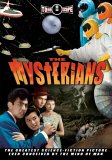
Mysterians
Savant is an old booster of Japanese fantastic films, especially Toho's first wave of science-fiction spectaculars from roughly 1957 to 1964. The Mysterians was one of the company's first films in color and Tohoscope; it's obviously patterned after The War of the Worlds by way of Flash Gordon with a little added Japanese flavoring.
I've already written about The Mysterians in an old Savant article from 1998 prompted by a reader who wondered (as I did, at the time) why MGM hadn't released the film on home video. Only a few years after its debut, the American version of The Mysterians was already deep into the shadowy world questionable rights. I had happened to catch a collector's print at a Pasadena showing in 1990, but for decades the only other viewing choices were gray-market VHS tapes with transfers of the old television prints. It appears that all of the 16mm optical tracks for these prints were made with an annoying flutter for about a quarter of the picture, ruining Akira Ifukube's relentless martial music score.
Although some rip-off EBay discs are still in circulation, Media Blaster's DVD is a licensed and authorized edition from Toho sources. As was the old laser disc, it is also the uncut Japanese version.
RKO folded in 1958, which is why its acquisition The Mysterians migrated to MGM, a fire-sale deal that probably accounts for the American rights to the movie almost immediately drifting into limbo. That and a general attitude of "dump it on the market" also explains why many surviving advertising materials for the film still bear RKO's imprint. In contrast to the lavish Japanese artwork, U.S. posters for the movie look like they were designed by amateurs in an afternoon.
Finally reaching U.S. screens in 1959, The Mysterians was a big kiddie hit that helped Toho find more import interest from Columbia (The H-Man, Battle in Outer Space, Mothra), Universal (King Kong vs. Godzilla) Warners (Gigantis the Fire Monster) and American-International (Matango, Atragon).
Toho's first outer space epic continues their house style of fanta-science, a slightly juvenile tone that appeals to many adults in addition to millions of kids. After a reasonably slow build-up, the personal stories take back seat to unending battle scenes. Jarring music crashes in as the Mysteroid battle dome repels wave after wave of attacks by Sherman tanks and Super Sabre jets. The sky is filled with battling flying saucers and jets, and the noisy blasts of gigantic death rays. A few announcements later, and the Americans are volunteering futuristic super-weapons for use against the invaders. A pair of airships called Beta-One and Beta-Two are giant horizontal rockets that float in the air - we're unclear exactly how they fly. They are meant to be rigged with a special atomic cannon that isn't quite ready yet. Markalites are colossal weapons that look like radio telescopes mounted on a tripod of tank feet. They gather the Mysteroid rays, amplify them and then shoot them back again. Apparently those crafty Americans have been developing defensive weapons against unknown technologies!
All of this hardware makes The Mysterians a wall-to-wall toy bonanza. The setting is an enormous miniature battlefield set with the alien battle dome in the middle. The tanks and the jets are the usual wire-rigged models. as are presumably the Mysterians' little hot-rod flying saucers that are still the coolest rides in the galaxy. Beta-One and Beta-Two look as though they were designed to be turned into toys; the Japanese at the time were very big on gaudy colorful electric toys that rolled on the floor and flashed lights around. The only really disappointing miniature is the rocket that delivers the Markalite to the battlefield - it's a collection of globes and cones that looks like a Playskool toy. We're only told of a ray pistol being marketed as a toy in Japan; was Toho in the 1950s rather reticent on the toy merchandising concept? 5
The Mysterians marks Toho's entry into full-on optical work, combining scenes from separately shot film elements in an optical printer. On Godzilla the Toho cameramen apparently didn't have access to pin-registered cameras; by the time of The Mysterians that problem has been solved. But it's easy to tell when a shot becomes an optical because the screen is suddenly inundated with white specks of dust, hair and other flotsam. In the next year's Battle in Outer Space the dirt problem would be cleared up as well.
The Mysterians has some terrific moments that mix puerile fantasy with interesting takes on the conventions of the Sci-fi genre. The first appearance of the robot Moguera was a white-knuckle experience for little kids back in 1959 - the build-up to its emergence from a mountainside is stunning. In the American cut the robot's function is never explained. Two brief added cuts in the full-length version reveal it as a Mysterian tunneling machine. It buzz-saws its way underground, and emerges in the final battle to topple one of the Markalite weapons.
The first appearance of the battle dome is core Science Fiction poetry. Professor Adachi and his colleagues walk toward the eerie dome waiting on the horizon, which seems to represent some fearsome, unknown science fiction future. Two other 1957 movies made similar uses of ominous dome structures. The first view of Kronos is an enormous dome-like shape on the ocean, a complete mystery. In the English Quatermass 2 humans walk toward a set of refinery domes in almost the exact same composition used in The Mysterians. Again, the feeling imparted is that we puny Earthlings have been ushered into a frightening future of alien concepts.
Joji and Etsuko flee Moguera over a railroad bridge and notice a trio of glowing flying saucers flitting across the sky. Joji has tried to make sense of unexplained radioactivity, subterranean heat that burns forests from the roots up, and an entire valley that's been tossed about as if it were in a blender. But the sight of the saucers finally explains everything ... it's something that we recognize, just like the appearance of the saucer in This Island Earth as explained by Raymond Durgnat. 1
The Mysterians have openly demanded mating rights with Japanese women, and have apparently gone through the effects of the Quisling Ryoichi and liked the looks of his sister Etsuko enough to ask for her by name. This development tells us two things - that the Japanese aren't about to give up their most precious "possessions" and that the Mysterians aren't so mysterious after all - they're just space wolves with the same needs we have. Of course, neither side asks the women if they want to become the consorts of space pirates. The kidnapping of Etsuko and Hiroko is a ghostly fairy-tale incident thrown into the middle of a noisy war picture. Two saucers park motionless above Etsuko's house, their lights dimming. Helmeted Mysterians descend on cables, seize their captives (who faint, naturally) and disappear with them into the saucer's underbelly. It plays like more of a 'magic coach' fantasy than science fiction.
And the Mysterians themselves are pure Flash Gordon bad guys, chortling villains who nod in approval when Earth's puny weapons bite the dust, and rub their hands in anticipation of villages being wiped out by Mysterian-made floods. When all is said and done, the pitiful intruders crawl back to their saucers and flee to their retreating space station. Better luck next time, losers. 4
The Japanese title of The Mysterians means "Earth Defense Force," the name for an imaginary military branch of the United Nations. 3 In western films like War of the Worlds the emphasis was usually on the futility of fighting the superior weaponry of the invaders from space. Western populations are presumed to be one step away from panic (or mob violence) at any time. In Japan it's different. With every cataclysmic disaster, invasion or Kaiju threat, civil defense monitors appear from nowhere to help the people flee from danger. The crowd runs, but it's an orderly evacuation and not a rout, as in the impressively chaotic mob scenes in the English Gorgo.
Likewise, the military response is always a group effort. Every meeting and decision takes place in rooms crammed with dozens of officials and experts working as a team. Individual attacks are usually suicide efforts, like the little tank commander who ends up popping out of his tank like a Jack-in-the-Box. This is where the music comes in ... Akira Ifukube's martial score alternates between jarring brassy notes representing the Mysterian threat, and an orderly, insistent march that honors the Earth defenders. Japan is a country with a strongly defined communal identity, and most of the action tends to be group action. Important individuals like Dr. Adachi are always sure to make gestures indicating their humility. What's important is being responsible to the needs of the group. That's what makes it necessary for the turncoat Ryoichi to atone by forfeiting his life, even though a scientist like him would presumably be worth a lot more to society alive and being productive. The Mysterians celebrates traditional values.
In my First Mysterians article I quoted Phil Hardy's contention that The Mysterians is a vaguely anti-American film, and that the Mysterian invaders who want military bases on Japanese soil and mating rights with Japanese women are a transparent cipher for occupying U.S. forces. Note that the two American 'scientists' played by George Furness and Harold Conway are probably meant to be United Nations officials, and not Americans. When the miraculous new weapons arrive from America (on U.S. cargo planes) they are taken into battle by Japanese personnel. The Mysterians has an equally fantastic outlook for American cooperation with the U.N..
Still, it's tempting to see The Mysterians as a movie made by a pacifist nation in need of martial fantasies. Americans don't get to see many of their general entertainment films about WW2, just anti-war art pictures like Fires on the Plain. Some historians claim that MacArthur's film censorship tempered certain themes (until 1955?) but there were definite large-scale battle films made. It would be interesting to find out what kind of attitudes they took regarding the war experience.
Most everyone will recognize Takashi Shimura from Seven Samurai, but Mysterian leader Yoshio Tsuchiya played Rikichi in the same film. One of the gangsters in Mothra, Tetsu Nakamura, here plays a scientist. Momoko Kochi, the actress with the cute Gene Tierney- like overbite, had a more demanding role in the original Godzilla.
In 1959, Daily Variety called The Mysterians "a red-blooded phantasmagoria" and that assessment still holds true. It's one of the first movies Savant saw as a kid filmgoer choosing his own fare, and nostalgia is a big factor in overlooking the film's flaws ("What flaws?"). Spread out across a big monitor, it's still a big, fun action circus of spaceships, death rays, explosions and wholesale destruction.

Media Blasters' Tokyo Shock DVD of The Mysterians is the video presentation fans have been looking for. The enhanced picture is brightly colored, with mostly good black levels. Japanese color films from this period tend to favor the green-blue side of the spectrum, but the multi-hued rays, color-coded Mysterian costumes and crimson blasts of flame throwers all look correct. It's possible that a tad of digital image-processing has been applied, as the white dirt-storms that were distracting on the old laser disc are slightly subdued, with the image a tiny bit softer.
The original Japanese sound is robust, with the Akira Ifukube track at original levels. There are new English and Spanish dub tracks; the Spanish is excellent but the English voice direction too campy (and the music mixed a tad too low). I'd say that they couldn't use the original English mix for several possible reasons: 1) They couldn't find a copy in 35mm, 2) The 16mm tracks had that bad warbling flaw; 3) The existing English dub wouldn't have covered material clipped from the film for American release. Media Blasters has also retained Toho's isolated Ifukube score, a great extra. The original soundtrack for this film sells in the $20 to $40 range, if it can be found at all. One can really appreciate the hypnotic martial rhythms this way; when the first Markalite weapon rockets into the battlefield, the raucous swipes of the string section sound like the slashes of a giant metallic sword.
Latter-day Toho effects supervisors Koichi Kawakita and Shinji Higuchi speak on a feature length commentary track, subtitled in English. They offer much illuminating information (like the candy product placement) about the film and praise its makers without a great deal of analysis - but there are few insights on the film's origin and they don't seem to have re-viewed it prior to recording the track. They mostly marvel at production values they are routinely denied today, mainly crowd scenes or the huge resources that Honda and special effects supervisor Eiji Tsuburaya had for their pre-CGI visuals. A big part of the appeal of The Mysterians is the miniature photography that creates a world of toys in fantastic, semi-realistic action; the CGI employed in the new pictures hasn't the same appeal. The commentators say they still insist on men in rubber suits for their 90s Godzilla movies, and that their desire to do a Mysterians remake finds no interest. The newer films can't equal the level of creativity in early Toho.
The disc offers brief galleries of photos, a poster or two, and an enticing selection of trailers for the short list of Toho classics Media Blasters has licensed. I recommend reading the books on Japanese monsters and Fantasy films by Stuart Galbraith IV to get a better picture of why so many of these films aren't available. The Mysterians is the first Toho film about space invaders in color and scope, but there is a now almost-forgotten color Daiei picture called Unknown Satellite Over Tokyo released a year earlier. 6
On a scale of Excellent, Good, Fair, and Poor, rates:
Movie: Excellent
Video: Excellent
Sound: Excellent
Supplements: commentary,
Packaging: Keep case
Reviewed: March 28, 2005
Footnotes:
1. Raymond Durgnat's book FILMS AND FEELINGS is highly recommended by Savant. The Chapter Pulp and Poetry concentrates on fantastic films.
Return
2 2. Interesting that the betrayer of the human race should be a scientist. The Mysterians is no libertarian picture like Godzilla; the guilt of Ryoichi seems to be an extension of the Cold War suspicion of eggheads who dare hold values like science higher than their nation's flag. He doesn't become aware of his stupidity until his own sister is kidnapped.
Return
3. and the Japanese word for Earth or World is apparently Chikyu. Listen to the saucers broadcasting entreaties to the public and you'll hear what sounds like chi-i-kyew used repeatedly. The word is used constantly in all of these sci-fi pictures. One has to be careful, however. In Mothra Savant repeatedly heard the word nani and assumed it referred to the two miniature princesses. Nani really means "Say what?" Nice try.
Return
4. Those helmets with the vertical white patches covering the nose and the mouth - when my daughter saw them, she thought they were cute: "Look, it's Attack of the Parakeet People!"
Return
5. In the satirical black comedy Giants and Toys, released one year after The Mysterians, advertising executives play with dozens of new space toys and use them to hawk their candy products. Interestingly, in The Mysterians there are several "product placement" instances for a major Japanese candy company!
Return
6. Beware the inexpensive Gotham disc available of this title - it's dubbed and 21 minutes shorter than the original. Some sources say the original was in Daiescope as well. Perhaps a reader can straighten me out on this one - I haven't seen it since 1964, on television.
Return
| |
|


| Popular Reviews |
| Sponsored Links |
|
|
| Sponsored Links |
|
|
| Release List | Reviews | Shop | Newsletter | Forum | DVD Giveaways | Blu-Ray | Advertise |
|
Copyright 2024 DVDTalk.com All Rights Reserved. Legal Info, Privacy Policy, Terms of Use,
Manage Preferences,
Your Privacy Choices 
| |||||||