
| Reviews & Columns |
|
Reviews DVD TV on DVD Blu-ray 4K UHD International DVDs In Theaters Reviews by Studio Video Games Features Collector Series DVDs Easter Egg Database Interviews DVD Talk Radio Feature Articles Columns Anime Talk DVD Savant Horror DVDs The M.O.D. Squad Art House HD Talk Silent DVD
|
 DVD Talk Forum |
|
|
| Resources |
|
DVD Price Search Customer Service #'s RCE Info Links |
|
Columns
  



 
|
|
|
Leaves From Satan's Book
"I let the actors do what they liked - I was more interested in the composition of the image" - Carl Theodor Dreyer
Director Carl Theodor Dreyer was one of the artists of the silent cinema. He created beautiful films that are still as moving and attractive today as when they were first released. Several of his movies are considered masterpieces, and with good reason. Films such as The Passion of Joan of Arc are filled with stunning images and deep emotions. Even his earliest films were wonderful to look at, and in these you can see Dreyer's style evolve. Image in association with David Shepard's Film Preservation Associates has just released one such early film, Leaves from Satan's Book.
Blade af Satans Bog (Leaves from Satan's Book - 1920) was director Carl-Theodor Dreyer's second feature film1 and the last film he made for Danish film powerhouse Nordisk Films Kompagni. At it's peak, Nordisk was the largest film producer in Denmark by far, releasing 103 of the 160 films made in that county in 1912 for example. Being so prolific necessitated that they make movies in almost an assembly line fashion.
Though Dryer got his start in the film industry at Nordisk, he never wanted to make the commercial films that the studio was know for, he wanted to create art. That is what he set out to do with his adaptation of the novel Sorrows of Satan by Marie Corelli. Inspired by the grandeur and spectacle of D. W. Griffith's Intolerance, Dreyer set out to create a large scale production that would be a work of art. Unfortunately, he ran into trouble almost immediately. Dreyer initially gave the studio an estimate of 120,000 Kroner for this picture, which they accepted. After three months of rewriting the script and scouting locations, Dreyer decided that the budget was too small by half, and announced that he would need 240,000 Kroner to create his film. This led to fights and difficulties with the studio management of course, and a figure of 150,000 Kroner was finally agreed upon, but only after the studio manager threatened to remove Dreyer from the project.
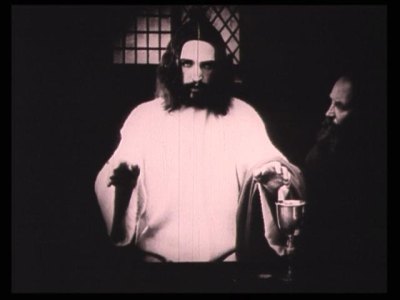
After the budget was set, Dreyer's problems continued. The main problem he had was the filming of the Christ character. Dreyer had wanted an artistic version of Christ, but the studio insisted that he film this sequence with a convention representation. The result of this compromise is the weakest section of the film.
Even once the film was finished, his problems continued. For the world premier in Oslo, the film was cut from its two hour running time to ninety-minutes without Dreyer's knowledge. This outraged the director, and probably added to his decision to leave Hordisk after this film.
The Movie:
Like its inspiration, Intolerance, Leaves from Satan's Book contains stories from four historical periods linked thematically. Unlike Griffith's film though, Dreyer chose not to cross cut between stories, which makes for a less confusing film.
Satan is the character who links the four stories. The film starts with his fall from grace, as told through intertitles, and God's proclamation that he walk the Earth tempting humanity. For each soul that turns from God, 100 years will be added to Satan's sentence, but for every person who resists his temptations, 1000 years will be removed. Hoping to fail in his duties so that he may be admitted back into heaven, Satan tries to get men to betray what they hold most dear in four eras of history.
The first section of the film is the biblical story of Jesus' betrayal by Judas. Starting two days before his crucifixion, this tells how, goaded on by Satan in the disguise of a high priest, Judas identifies Jesus for the Roman soldiers.
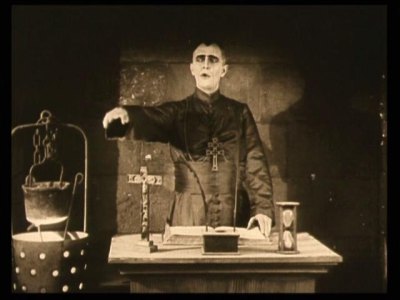
The next story takes place during the Spanish Inquisition. A young monk, Don Fernandez, is enamored of the beautiful daughter of a local teacher, Isabella. Soon after taking his vows to the Inquisition though, Isabella and her father are accused of being heretics. Satan, as head of the Inquisition, assigns Don Fernandez the job of arresting and torturing a confession out of the woman he loves.
The third section of the film takes place during the French Revolution. Joseph is the footman to a Lord who is accused of plotting to help Marie Antoinette escape from jail. Before being beheaded for this crime, the Lord asks Joseph to help his wife and daughter, Genevieve, escape to Paris. Joseph is in love with Genevieve, so he gladly guides them. Once in Paris, Joseph rises in the ranks of the local government. He wants to marry Genevieve, but she says that they can never be more than friends. Through a trick by Satan though, Joseph is put into a position where he has to choose between gaining a higher political office by betraying his love, or letting her leave to go to another country.
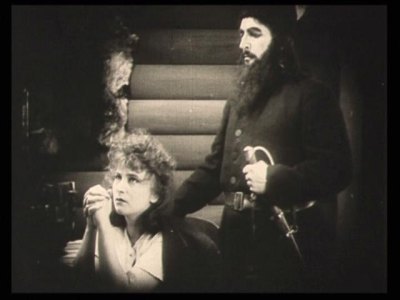
The final segment is set in the Finland during the Russo-Finnish war of 1918. This time Satan is a Russian monk, leading the Russian forces in the Finnish town of Hirola. When the Reds discover that a telegraph line has been laid by the Finnish to a railway station, they capture it. Satan then makes the operator choose between sending a telegram that will lead the Finnish army into an ambush or letting her husband and son be killed.
As a film, this wasn't Dreyer's best, but it was fairly entertaining. The Biblical scene that starts the movie off was by far the weakest of the four, with the drama of the story not coming through. DeMille's King of Kings did a much better job with this story. The other episodes were better, but only in the last one was I really drawn into the story and feel that I could relate to the characters. The one aspect of the movie that sets it apart from other films of the time is the unusual take it had on Satan. Commanded to do evil, but secretly hoping that his victims wouldn't fall for his schemes, this portrayal of the devil was unique and interesting.
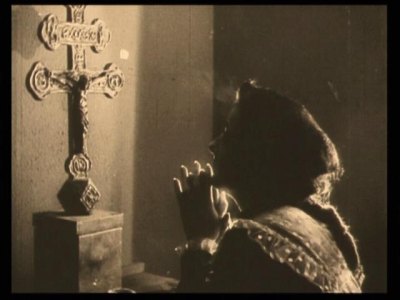
This early Dreyer film shows his almost innate ability to compose attractive images within the limits of the frame. He would become more adept at this as his body of work progressed, but even in this early film you can see his talent at composition. There are a few close-ups, but not none of the very close shots, where a face takes up the whole frame, that Dreyer would use to such great effect in The Passion of Joan of Arc. Other techniques that Dreyer would further refine are present in this film, such as the irising in and out of scenes for emphasis.
The acting in this film is not the greatest. At times the actors are very wooden, and in other scenes they are overly melodramatic. A good example of the former is when Jesus tells Judas that he knows he will betray him. Judas gets up and leaves the last supper. His walk looks like an actor told to slowly exit stage right, rather than a traitor who has been discovered. Isabella, the heroine in the second story, overacts much of the time she is on the screen. When Don Fernandez, comes to arrest her in the name of the Inquisition, she clutches at her breast and backs away with he eyes wide opened. Generally the acting isn't broad, as was the style at the time, but just average.
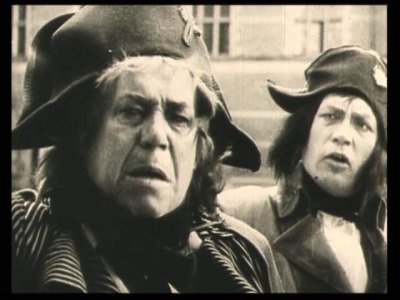
Though this film isn't the grand spectacle he was hoping for, Dreyer did a wonderful job with it. His use of the film frame and style of story telling make this a movie interesting and attractive to watch.
The DVD:
Audio:
The movie is accompanied by a piano score written and preformed by Phillip Carli. It was very good, and fit the movie well. Being a recent recording, there was no hiss or other audio defects.
Video:
The full frame video, restored by David Shepard through his company Film Preservation Associates, from a 35mm print and very good, but not great. The quality of the picture was markedly less than The Parson's Widow, which Shepard also worked on. There was a bit of a problem with blooming in white areas, and details were quickly lost in shadow. This print also had more damage in the form of scratches and dirt, than The Parson's Widow too. On the plus side, there was a good amount of detail, and the image was strong, not washed out like many silent movies. There was some tinting in a few scenes. An above average looking DVD that should please.
Extras:
There are no extras on this DVD.
Final Thoughts:
Dreyer is one of my favorite directors, and this is a good early example of his work. Though not as powerful as his later endeavors, there is still a good amount of drama in these tales of Satan tempting people. The DVD looks very good, though not as good as Image's release last year of The Parson's Widow. This film is well worth checking out. Recommended.
1: The film premiered in Oslo on November 17, 1920, but it didn't play in Denmark until January 24, 1921. This leads some sources to site the year of release as 1921 instead of the correct 1920, and also to state that this was filmed after The Parson's Widow. It was not.
|



| Popular Reviews |
| Sponsored Links |
|
|
| Sponsored Links |
|
|
| Release List | Reviews | Shop | Newsletter | Forum | DVD Giveaways | Blu-Ray | Advertise |
|
Copyright 2024 DVDTalk.com All Rights Reserved. Legal Info, Privacy Policy, Terms of Use,
Manage Preferences,
Your Privacy Choices 
| |||||||