
| Reviews & Columns |
|
Reviews DVD TV on DVD Blu-ray 4K UHD International DVDs In Theaters Reviews by Studio Video Games Features Collector Series DVDs Easter Egg Database Interviews DVD Talk Radio Feature Articles Columns Anime Talk DVD Savant Horror DVDs The M.O.D. Squad Art House HD Talk Silent DVD
|
 DVD Talk Forum |
|
|
| Resources |
|
DVD Price Search Customer Service #'s RCE Info Links |
|
Columns
  


 
|
|
|
Agatha Christie's Marple - Set 1
I'm a big fan of adaptations of Agatha Christie's Poirot mysteries, but I had never really been enthusiastic about her other famous detective, the deceptively clever little old lady, Miss Marple. That is, until now: the new British series Agatha Christie's Marple brings the four mysteries presented in its first season to life with considerable panache. With David Suchet, we got the definitive Poirot; as far as I'm concerned, Geraldine McEwan is now the definitive Miss Marple.
It's not as though Christie's Miss Marple novels haven't had their fair share of movie and television adaptations. Most notably, there was the fairly long-running series with Joan Hickson in the title role. Hickson certainly did an excellent job as Marple, and many viewers will probably still feel that she's the "real" Miss Marple, but the series had its ups and downs in terms of episode quality, as I noted in my review of the Agatha Christie Megaset.
Marple isn't "just another version" of the stories, though. The episodes here have a distinctly different style than the other television adaptations I've seen, giving them a fresh and revitalized feel. Rather than just being the detective figure, Miss Marple is more integrated into the story as a fully realized character; for instance, in The Murder at the Vicarage, we learn something important about her as a young woman. The pacing and cinematography is also lively and film-like; rather than confining the camera to fairly static interior shots, the filmmakers tend to open things up and keep them moving. The 1940s setting is also fully realized, in a way that I never felt it was in the Hickson episodes. It would seem that the creators of Marple took a page from the art-deco world of Poirot, and embraced the idea of evoking a period atmosphere rather than a generic "everytime." It works well, with little details like Miss Marple reading Raymond Chandler novels and the characters having to deal with postwar inconveniences like rationing building up to provide a nice atmosphere for the stories.
As I noted, I was really impressed with Geraldine McEwan as Miss Marple. I was immediately interested when I saw that she'd taken on the role, as I've been impressed (or amused, as the case may be) by her work in programs ranging from Mapp & Lucia and The Barchester Chronicles to The Magdalene Sisters. McEwan plays Miss Marple to perfection; it's completely believable that this mild-mannered spinster sees everything, forgets nothing, and has a mind like a steel trap when it comes to putting one and one together. On the other hand, it's true that she doesn't have the quality of blending quietly into the background, only to surprise everyone with the fact that she wasn't really half asleep, which is more the way Hickson played the role. You can't have it both ways, though, and of the two approaches I like McEwan's better, as it makes for a livelier and more engaging performance. McEwan also does a very nice job of handling the humor in the role; we get some mild comedy at times from Marple's apparently odd behavior, and from the reactions of the police to the "interference" of this little old lady, but it's kept to a subtle level.
Four Miss Marple stories are presented here, each with a running time of 94 minutes, which feels just about right. The filmmakers have taken some liberties with the original stories at times, which may offend die-hard Agatha Christie fans, but I think it's a very good thing indeed that we're seeing things shaken up a bit. What works well on the printed page seldom works perfectly on the screen; they're two different media, with different strengths and weaknesses. In being less faithful to the exact way that Christie wrote her novels, the Marple stories are being more faithful to the spirit of the stories... which is to entertain and captivate the audience.
The set starts out on an excellent footing with The Murder at the Vicarage. I'd previously only seen the Hickson version and found it dreadful. This adaptation, in contrast, is positively engrossing. As the title suggests, a murder does indeed take place at the vicarage... and any number of people had both motive and opportunity to do in the victim, who was roundly despised by pretty much everyone in town. The scene is set, the characters are introduced, and the plot unfolds at just the right pace, so that the viewer is always intrigued but never overwhelmed, which is no mean feat with the large cast of suspects here. The use of sepia-toned flashbacks and the attention paid to Miss Marple's character lets us know right away that this is a different style of Marple stories, and it's all to the good.
The Body in the Library isn't as good, though it's still entertaining. The body of a young dancer is found in the library of an old country house, with no indications of why she's there or who might have killed her. Miss Marple is soon on the trail, however, finding that there may have been more behind the murder than meets the eye. Here, a large cast of characters is introduced in two different locations, and it's at times confusing as to who's alleged to have done what to whom, and where.
Hands down, the best episode in the set is A Murder Is Announced. In a quiet village, a notice appears in the local paper that a murder will happen at a particular time in a local woman's house. Of course, all the neighbors think it's an invitation to a parlor game and gather on cue... only to have a real murder take place. This version of the story tightens up the original novel considerably, and adds in some additional elements that enhance the mystery of who's behind the whole thing. (Incidentally, the lesbian characters are – if you'll excuse my pun – taken straight out of Christie's original novel; Christie was no prude, even if later adaptations tried to make her into one.) The mystery is cleverly presented and nicely developed, with enough clues to let the viewer feel involved in the process while still being surprised by how it all turns out at the end.
The set wraps up with 4:50 from Paddington, with Miss Marple investigating a "crime" that the police refuse to bother with: her friend says that she saw a woman being strangled on a passing train, but as there's no body, it's hard to prove that any foul play took place. Not that a little thing like that would stop Miss Marple from ferreting out the truth, of course!
The DVD
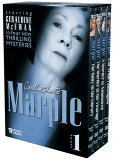
Agatha Christie's Marple – Set 1 is a four-DVD set, with one feature-length episode per disc. Each has its own plastic keepcase, inside a glossy paperboard slipcase.
Video
The Marple episodes are presented in an attractive anamorphic widescreen transfer, at the show's original aspect ratio of 1.85:1. The widescreen format gives the episodes a nicely film-like, expansive feel that works nicely with the more energetic visual style of the show. The image is clean and clear, though a bit soft because of some grain; overall it looks very nice.
Audio
The Dolby 2.0 soundtrack presents the dialogue in a clean, crisp manner. There's nothing particularly remarkable about this soundtrack, but it gets the job done perfectly fine.
Extras
There's nothing of particular interest here. The 60-minute "Behind-the-Scenes Featurette" looks promising but is disappointing, as it's promotional in style; we get lots of long clips from the episodes interspersed with the actors explaining what their characters are like. On the same disc (The Murder at the Vicarage), we also get a moderately interested text section on "Miss Marple on TV and Film" and a biography of Agatha Christie. Each disc also has cast filmographies and a photo gallery.
Final thoughts
I thoroughly enjoyed seeing a fresh take on the Miss Marple stories. Yes, they have a completely different atmosphere and pacing from the 1980s Joan Hickson version, and Geraldine McEwan stamps her own personality on the role... but isn't that the point? Agatha Christie's Marple (clearly taking its style of title from Agatha Christie's Poirot) does the "unthinkable" and gives Miss Marple a fresh, modern (yet appropriately period-style) presentation. McEwan's performance is lively, and the episodes are for the most part well written and nicely paced. If you're obsessed with comparing every little change in the story from the original novels or from previous adaptations, you probably won't enjoy this set... and you'll thereby be missing out on four entertaining mysteries that the rest of us viewers will be having a fun time with. I'll give this set a solid "recommended."
|



| Popular Reviews |
| Sponsored Links |
|
|
| Sponsored Links |
|
|
| Release List | Reviews | Shop | Newsletter | Forum | DVD Giveaways | Blu-Ray | Advertise |
|
Copyright 2024 DVDTalk.com All Rights Reserved. Legal Info, Privacy Policy, Terms of Use,
Manage Preferences,
Your Privacy Choices 
| |||||||