
| Reviews & Columns |
|
Reviews DVD TV on DVD Blu-ray 4K UHD International DVDs In Theaters Reviews by Studio Video Games Features Collector Series DVDs Easter Egg Database Interviews DVD Talk Radio Feature Articles Columns Anime Talk DVD Savant Horror DVDs The M.O.D. Squad Art House HD Talk Silent DVD
|
 DVD Talk Forum |
|
|
| Resources |
|
DVD Price Search Customer Service #'s RCE Info Links |
|
Columns
  


 
|
|
|
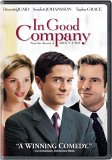
In Good Company
 Paul Weitz has come a long way since American Pie. From creating a teen sex comedy that, while it had its laughs and heart, was more about gross-out humor than anything else to crafting an intelligent, heartfelt British drama (About a Boy), and now to writing and directing an excellent, little film that carefully straddles the line between comedy and drama that is so apparent in everyday life. Like I said, Paul Weitz has come a long way.
The marketing campaign for In Good Company would have loved for you to believe that the film was either a comedy or a romance. In reality, however, the film is so much more than those simple genre definitions describe. About a Boy allowed audiences to see that Paul Weitz could handle more serious fare with a sure hand and a penchant for the unconventional. In Good Company solidifies his place as a Writer/Director that knows his subject so well as to be able to recreate the feeling of actual, real life situations. He shows that, as most of know, real life is not usually made up of all comedic or all dramatic moments (like Hollywood movies would often has us believe). Life, instead, is most often made up of moments that combine the two. Comedy usually softens the blow of a very dramatic moment, or can even work to make that moment all the more awkward. Drama, on the other hand, can step in during very funny moments in life to really turn things on their head. Weitz uses this dichotomy to create a heartfelt story that actually comes a lot closer to true life than most of today's films.
 What makes In Good Company such an interesting film is the fact that Weitz never allows the conventional or the clichéd moments that we see in so many movies to sneak into his film. This is an admirable feat, especially considering that the storyline is ripe for such "Hollywood moments" to occur. Let's see: Younger man becomes older man's boss. Younger man then begins dating older man's daughter, until older man finds out and they break it off. Older man teaches younger man a thing or two. There's you're basic storyline. In the hands of a less capable director, that storyline would foster so many conventions and clichés that you could probably guess exactly what would happen. In your typical Hollywood movie, this is how it would most certainly all turn out: Younger man and older man become buddies after older man teachers younger man the values of good business. Older man finally says its okay for younger man to date his daughter. Younger man and older man's daughter get back together. Everyone lives happily ever after. Weitz, however, has other plans for his characters.
 In Good Company eschews that conventional, clichéd pattern of events for something much more true to life. Weitz leaves his ending somewhat open, but gives the viewer enough closure to know that everyone will be okay. They've all been changed by what's taken place throughout the film, but it looks as though they're going to be okay. Instead of telling us exactly where these characters are going or explaining away every little detail about why they're making these decisions (as would be the case in so many Hollywood movies that resemble a film like In Good Company), Weitz shows confidence in the audience to actually figure it out on their own. He doesn't condescend to his audience, and that's what has made him such a good filmmaker over his last two films. He believes in the intelligence of his audience, and it clearly shows in his films.
In Good Company, though, isn't a perfect film. It's slightly longer than it needs to be and, at times, seems a little too precious. The good, however, far outweighs the bad here. Weitz casting is spot-on as Topher Grace proves that he'll have a career long after his days on That 70's Show are over. His performance is assured and awkward - everything that his Carter Duryea character needs to be - and his chemistry with Scarlett Johansson (who finally gets a chance to kiss someone her age) is highly believable. Dennis Quaid is at his best when he shows just how simultaneously vulnerable and strong his Dan Foreman character can be. Throw in some great excellent little touches by character actors David Paymer and Philip Baker Hall, and you've got yourself an all-star cast that only helps make the story that much stronger.
 Paul Weitz in only getting better and better with each film. About a Boy has slowly become one of my favorite films and I'm confident that, with repeat viewings, In Good Company will do the same. His visual style is starting to become more distinct - his use of the extreme close-up as a visual motif is one of the most visually exciting aspects of In Good Company - and each successive film shows an increase of self-assuredness that allows Weitz to test the limits of the conventional Hollywood film. This latest film isn't simply a good comedy or a good romance or a good drama. It is, instead, an amalgam of all three. It blends each aspect into something resembling real life that we don't often see in film today. And for that reason alone In Good Company is a film worth watching.
The DVD
Video:
 In Good Company is presented in an anamorphic 1.85:1 widescreen transfer that shines in just about every way possible. The film itself isn't all that visually dramatic, but the highlights are certainly captured in this visual presentation. The film's visual motif of the extreme close-up is portrayed beautifully by this transfer's intricate detail. Shadow, lighting, and depth are well delineated and even the exterior shots of New York City come across beautifully. While there are not a lot of vibrant colors throughout the film, the few times that they do appear bright and rich. Fleshtones are accurate, and blacks are deep. The only issues with this transfer are a bit of grain and spots from time to time and a few instances of slight edge enhancement. Overall, however, this is a stunning visual presentation of a film that's not entirely visually stunning.
Sound:
The audio on this disc is presented in Dolby Digital 5.1 format that handles the balance of dialogue and soundtrack very well. In Good Company is a somewhat dialogue-heavy film, and this track always allows the dialogue to be the main attraction. It is always clear, crisp, and distinct, and never becomes overwhelmed by the rest of the soundtrack. Spatial separation is very nice across the front channels and, although you won't hear a lot of surround effects throughout the film, the surround channels do a great job of providing the soundtrack with a bit more power and ambience. The soundtrack itself plays a very important role in the film, and the score and songs come across beautifully balanced on this track. For a film that doesn't exactly have an incredibly dynamic soundtrack, this is a wonderful audio presentation.
Extras:
 The first, and best, extra feature on this disc is an audio commentary with Writer/Director Paul Weitz and Actor Topher Grace. The two obviously became very friendly while working on the film, and their relationship certainly shows on this track. Their chat is breezy and conversational, which makes for a very entertaining listen. They talk specifically about many scenes in the film and explain some of the film's influences, but also take the time to tell plenty of fun anecdotes from the set. Weitz and Grace do a little bit of congratulatory back patting, but this track is, for the most part, highly entertaining, funny, and informative.
 Also included on this disc is an approximately 23-minute featurette called "Synergy," which can be viewed all at once or as seven separate segments ("Stars," "Youth," "Getting Older," "Real Life," "New York Locations," "Editing," and "Story"). These short features are your basic behind-the-scenes clips, but these are slightly more interesting. There are fewer clips from the film, more interviews and behind-the-scenes moments, and some intriguing commentary from people outside of the film world. The best segment is "Story," as it tells about the impetus of the film and the actors' takes on the power of the story itself. Each segment, however, is unique in its own way. "Real Life," for instance, features interviews with people in real corporate jobs, and "New York Locations" follows Paul Weitz around the city as he gets some of his exterior shots. Played as a whole, the featurette proves to be much more than your typical EPK fare.
There are also ten deleted scenes with optional commentary from Writer/Director Paul Weitz. The scenes run about 16 minutes long and include some very funny moments that simply didn't fit into the film. Since the original cut of In Good Company was nearly 3 hours, there are quite a few scenes here that could have easily worked in the film. Weitz does a nice job of explaining why each scene was cut, and even why he would have liked to keep it in the film if it were possible time-wise. This is a good collection of scenes that make for a nice addition to the film itself.
Finally, we have text biographies and filmographies for Dennis Quaid, Scarlett Johansson, Topher Grace, Marg Helgenberger, David Paymer, Paul Weitz, Chris Weitz, Rodney Liber, and Andrew Miano.
Final Thoughts:
 Do yourself a favor. Whatever you might be thinking about In Good Company from seeing the trailer or reading the basic description of the storyline, throw it out the window. The film itself is much more nuanced and wide-ranging than anything you could have seen in that 2-minute preview. Paul Weitz not only gives us romance, drama, comedy, and commentary about corporate downsizing, but he does it skillfully enough to combine the elements into something that actually resembles real life - not something we usually get to see in Hollywood movies. In Good Company is a much better film than its trailer wants you to believe. It's much more heartfelt and lasting, and its certainly much more than your typical cookie-cutter romantic comedy. In addition, Universal has provided a very nice audio-visual presentation and some excellent extra goodies. All of which adds up to a disc comes highly recommended. I urge anyone that might be reluctant to sit down and watch In Good Company to give it a shot. You might just be surprised to see that it's not at all what you expected.
|



| Popular Reviews |
| Sponsored Links |
|
|
| Sponsored Links |
|
|
| Release List | Reviews | Shop | Newsletter | Forum | DVD Giveaways | Blu-Ray | Advertise |
|
Copyright 2024 DVDTalk.com All Rights Reserved. Legal Info, Privacy Policy, Terms of Use,
Manage Preferences,
Your Privacy Choices 
| |||||||