
| Reviews & Columns |
|
Reviews DVD TV on DVD Blu-ray 4K UHD International DVDs In Theaters Reviews by Studio Video Games Features Collector Series DVDs Easter Egg Database Interviews DVD Talk Radio Feature Articles Columns Anime Talk DVD Savant Horror DVDs The M.O.D. Squad Art House HD Talk Silent DVD
|
 DVD Talk Forum |
|
|
| Resources |
|
DVD Price Search Customer Service #'s RCE Info Links |
|
Columns
  


 
|
|
|
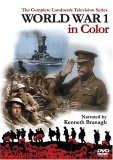
World War 1 in Color
World War I always seems to get less attention than World War II, whether it's in documentaries or in films set in the period. Yet it's equally important to modern history, and in fact arguably more so, as World War II was directly set in motion by the conclusion of World War I. With that in mind, I was looking forward to World War 1 in Color, the six-part documentary series that focuses strictly on the "Great War."
It's a mixed bag, though. World War 1 in Color gets some things right, but it's flawed in a number of ways, some big and some small. Throughout the series, I was interested in the material, yet frustrated with the way that it was presented.
We can start off by looking at the new "twist" that gives the series its title: the black-and-white footage that until now has been our only view of World War I has been colorized for the documentary, giving us a view that more closely approximates what the people of the day really saw. Though it may sound like a gimmick, this is actually one of the things that the documentary does very well. It's true that the black and white nature of the footage does serve to distance the viewer from the events being displayed, while seeing those same events in color helps bring home the fact that yes, this was really happening. And since the footage of the war was always intended just to capture the events as realistically as possible, colorizing the footage doesn't raise artistic issues the way it does with black and white films, whose cinematography takes into account light and shadow to create their effect.
The archival footage has been colorized with a painstaking and fairly cautious hand (if that's the right way to describe work that was done with the aid of computer technology), so it looks extremely natural. The filmmakers wisely chose not to push the boundaries too far: rather than trying for bright colors as from a modern film, the colors here are fairly muted and often brownish, as if captured with the earliest color film. The result is a fairly subtle job of colorization that feels like a good match with the worn and soft nature of the early archival footage.
The series takes a generally chronological approach to describing the events of the war, with some episodes being more focused on different aspects of the war, such as the rise of air warfare or submarine warfare. Tactics are explained well, and maps are used fairly often and to good effect, so that we do get a good sense of what's happening where.
But that's about where the good points of World War 1 in Color come to an end, and the weaker areas start showing up. To begin with, while the overall plan of the series is solid, the quality of the individual episodes is distinctly weaker. To me, the most important aspects of the entire war are why it began, why it continued as long as it did, and what its aftereffects were. However, the origins of the war are only briefly discussed in the first episode, and aren't gone into in any depth whatsoever. Most of the series is devoted to painstaking detail on the give-and-take of the battles during the war itself; this is of interest in a tactical sense, but it doesn't address the big picture at all. And the final episode gives scant treatment to the devastating consequences of the Treaty of Versailles, only briefly mentioning how it contributed to World War II.
The episodes are also marred by sentimentality. We get to hear interviews with a handful of surviving WWI veterans (in their 100s at the time of filming), which is in itself quite interesting... except that their recollections are used far too often, even when they're fairly tangential to the point of the episode. What's more, they're quite repetitive, both in the general sense of having the veterans reiterating points that had already been made by readings from memoirs or letters, and in the quite specific sense of having some of their interview clips used multiple times across the program.
The pro-British tenor of the series comes through loud and clear, and in fact is rather annoying. All those WWI veterans whom I mentioned are British; couldn't the filmmakers have tracked down even one or two German, Russian, or French survivors? Clearly they didn't feel it was worth the trouble. Then there's the slant of the material itself, which clearly puts Britain and the Allies as the "good guys" and the Germans as the "bad guys." It's evident even down to the theme music. When the British soldiers advance and are successful, we get a rousing, thrilling score; when the Germans advance, we get an ominous or downbeat score.
And on top of everything else, the voice acting for the non-British participants is downright grating, if not actually insulting. Whenever a memoir or letter from a non-English-speaker is read, it's presented in English... with a heavy accent. And a bad one, at that, clearly being faked by a native English speaker. It really detracts from the credibility of the program when we have a French or German general explaining his tactics in a thick, phony accent. (The U.S. is not spared, either: it's quite amusing to hear the "Yanks" being voiced very obviously by Brits trying to fake an American accent.)
Overall, World War 1 in Color is reasonably watchable if you haven't seen other programs covering the same topic, but it's certainly not the definitive or high-quality documentary that I had been hoping for. I found the six episodes on WWI that are included in the larger documentary The Century of Warfare to be much more satisfying (though the footage is not in color, of course).
The DVD
World War 1 in Color is a two-disc set, packaged in a single-wide plastic keepcase.
Video
In a nice surprise, World War 1 in Color is presented in anamorphic widescreen, at its original 1.85:1 aspect ratio, even though it doesn't say this anywhere on the DVD case.
Obviously, the archival footage of WWI shows its age; the condition of the print varies from piece to piece, with some showing a lot more wear and tear than others, but in general the material is in better shape than you might expect. I imagine that a lot of restoration work went on at the same time that the footage was colorized, and the result is that the material is very watchable. As for the colorization, as I mentioned in the body of the review, it's nicely done, so that the effect is of watching early filmed-in-color footage, not color-added-later footage.
Audio
The Dolby 2.0 soundtrack is quite satisfactory, with all the various elements sounding clear and distinct. Kenneth Branagh sounds a bit different than usual in his voiceover here, as he seems to be using a lower-than-usual register (perhaps to match the weighty subject?), but in any case he does a fine job handling the narration. English and French subtitles are included.
Extras
The special features here are a bit of a disappointment. The 50-minute "Tactics and Strategy" program is not particularly impressive; the content is adequate, but it rehashes a great deal of material from the main feature, so if you've seen the full World War 1 in Color, you'll find it very repetitive. It's also presented only in 1.33:1, rather than anamorphic widescreen like the main feature. The "Making the Series" featurette is moderately interesting, as it concentrates on interviewing the filmmakers, but it's only 15 minutes long.
Apart from that, we get some text material: biographies of major figures involved in the war, a timeline of events, and facts about the casualties on each side of the war.
Final thoughts
There's certainly room for a definitive documentary about World War I, but unfortunately World War 1 in Color isn't that program. To its credit, the documentary succeeds in bringing the war to life in a new way, using the well-done colorization of the archival footage to bridge the distance between the viewer and the people who fought and died in the war, but it's too flawed to really succeed. If you're interested in the history of modern warfare, I'd say it's a better idea to take the plunge and get The Century of Warfare instead. I'd suggest World War 1 in Color as a decent rental if you're intrigued by the colorized footage.
|



| Popular Reviews |
| Sponsored Links |
|
|
| Sponsored Links |
|
|
| Release List | Reviews | Shop | Newsletter | Forum | DVD Giveaways | Blu-Ray | Advertise |
|
Copyright 2024 DVDTalk.com All Rights Reserved. Legal Info, Privacy Policy, Terms of Use,
Manage Preferences,
Your Privacy Choices 
| |||||||