
| Reviews & Columns |
|
Reviews DVD TV on DVD Blu-ray 4K UHD International DVDs In Theaters Reviews by Studio Video Games Features Collector Series DVDs Easter Egg Database Interviews DVD Talk Radio Feature Articles Columns Anime Talk DVD Savant Horror DVDs The M.O.D. Squad Art House HD Talk Silent DVD
|
 DVD Talk Forum |
|
|
| Resources |
|
DVD Price Search Customer Service #'s RCE Info Links |
|
Columns
  


|
|
|
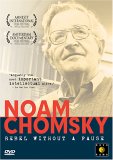
Noam Chomsky - Rebel Without a Pause
Noam Chomsky is a Renaissance man for the 21st century: he's been tremendously influential in the fields of linguistics and computer science, and on top of that, he applies his intellect to analyzing modern politics and culture. In a world of "news" that tends to be nothing more than sound bites and political mud-slinging, Chomsky's ability to look at the big picture and see how everything adds up already makes his opinion valuable. When you add in the fact that he's willing to be openly critical of the status quo, and to question things that we tend to take for granted, Chomsky's voice becomes one that we really ought to listen to more often, and more closely. No matter whether you agree or disagree with his interpretations of the political issues of the day, the important thing is that he actually raises these issues and looks at them in depth.
Rebel Without a Pause is a documentary that essentially stands as an introduction to Chomsky and his work. Rather than focusing just on one topic or recording one speaking engagement, the film offers a sampling of Chomsky's ideas on topics ranging from media manipulation to terrorism, taken from a variety of venues. Interspersed with these segments are interview clips with other intellectuals who offer insights into Chomsky's contribution to society, and his popularity (and the controversy he stirs up). While the most interesting material comes from Chomsky himself, the context provided by the other participants does allow viewers to get a better sense of who Chomsky is and what he's been doing.
"Controversial" is sometimes used as a polite way of saying "crackpot," and given how provocative some of Chomsky's ideas are, there's a danger that the isolated, out-of-context clips of his lectures used in the film might present Chomsky as an extremist, thus turning off viewers who would otherwise be interested in what he has to say. Fortunately, Rebel Without a Pause shows us that Chomsky is in fact a very rational person, and that he's not just being critical of society for criticism's sake. For instance, in one lecture clip, Chomsky discusses the high degree of freedom that we enjoy in the modern U.S., and the benefits that come from that; it's a nice balance to the segment in which he discusses the ways in which the media is controlled by government and business. The same balance can be seen in the interviews with other people about Chomsky's influence; on the one hand, the interviewee who suggested that Chomsky might end up a target for assassination sounded a bit paranoid, but on the other hand, the other interview subjects make excellent points about Chomsky's positive influence on social activism.
The film also does a good job of establishing Chomsky's credentials: first, simply by letting us know that he's a professor at MIT, and second, by including segments of lectures in which Chomsky demonstrates his almost encyclopedic knowledge of what's going on in the world. The modern world is complex, and difficult situations rarely have simple causes or simple solutions; it would be a good thing indeed if more of our leaders were as thoughtful and well-informed as Noam Chomsky.
The DVD
Video
Rebel Without a Pause looks fine for what it is: a documentary whose footage comes largely from recordings of lectures and informal interviews. The material is watchable, though there's edge enhancement and the overall image is not particularly sharp. The film is presented in its original 1.85:1 widescreen aspect ratio, but it is not anamorphic.
Audio
Like the video transfer, the Dolby 2.0 soundtrack does the best it can with sound that was recorded on so-so equipment, often in less-than-ideal surroundings, like in the hallway outside a conference room. Most of the time, the sound is perfectly fine, and when it does sound a bit off, it's still passable.
Extras
Viewers will be pleased with the main special feature here: an additional 38 minutes of footage of Chomsky speaking. It's edited and presented in the same way as the main feature, and looks very much like material that could have been included, but didn't quite make it to the final cut. We get to hear more of Chomsky's ideas on various topics; essentially, it's an extension of the main feature.
There's also a text "director's statement," giving some background on the project, crew biographies, and trailers for other Docurama DVDs.
Final thoughts
Rebel Without a Pause is a solid introduction to Noam Chomsky's fascinating critical take on modern society and politics; after watching this documentary, it's easy to see why the New York Times called him "the most important intellectual alive." Chomsky is less well known inside the U.S. than abroad, which is lamentable given the importance of his ideas. Rebel Without a Pause does a nice job of bridging that gap, providing an interesting overview of Chomsky's ideas and of his importance as an intellectual. It's also a nicely done documentary overall; the pace of the 75-minute main program is brisk, and the material is presented in an engaging manner. Recommended.
|



| Popular Reviews |
| Sponsored Links |
|
|
| Sponsored Links |
|
|
| Release List | Reviews | Shop | Newsletter | Forum | DVD Giveaways | Blu-Ray | Advertise |
|
Copyright 2024 DVDTalk.com All Rights Reserved. Legal Info, Privacy Policy, Terms of Use,
Manage Preferences,
Your Privacy Choices 
| |||||||