
| Reviews & Columns |
|
Reviews DVD TV on DVD Blu-ray 4K UHD International DVDs In Theaters Reviews by Studio Video Games Features Collector Series DVDs Easter Egg Database Interviews DVD Talk Radio Feature Articles Columns Anime Talk DVD Savant Horror DVDs The M.O.D. Squad Art House HD Talk Silent DVD
|
 DVD Talk Forum |
|
|
| Resources |
|
DVD Price Search Customer Service #'s RCE Info Links |
|
Columns
  


 
|
|
|
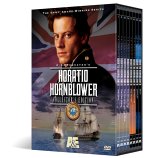
Horatio Hornblower: Collector's Edition
Adventure on the high seas! It's a theme that has an undeniable appeal for film and television, and it finds a polished and delightful expression in the fine A&E series Horatio Hornblower. If there's anything we can trust British filmmakers to do better than anyone else, it's to handle period pieces with exactly the right touch. Set in the tail end of the 1700s and the early 1800s during the Napoleonic Wars, Horatio Hornblower follows the career of its eponymous hero in the British Navy.
The Horatio Hornblower programs are, in a sense, parts of a mini-series, but they're much more like individual films that happen to be part of a larger sequence than episodes in a series. That's a strong point in the series' favor: each 100-minute program has the heft and depth of a full-length feature film, and all the polish and attention to detail that you'd expect from one.
It's tough to keep a consistently high standard across eight films, but the Hornblower series does remarkably well. To start with, there's the aforementioned historical accuracy, which lends a sense of depth and realistic texture to the stories and makes them not just entertaining in their own right, but also interesting as glimpses into a different era and culture. Filmed on board real ships, with all the details just right, the Hornblower films feel real in every detail, from clothing to food to details of how the characters do their jobs. Even the little touches aren't neglected: we get wind and bad weather contributing to the realistic feel of being on board the ships: it's clear that the scenes weren't filmed on a sound-stage in Hollywood.
The period accuracy isn't limited to the sets and costumes, though. The characters think and behave as they would at the time... not as modern people who happen to be dressed up in period clothing, which is a common flaw of less polished "period" films or television shows. Certainly people in the 1800s were people just like us, in the broadest sense, but we also get to see how the motivations and beliefs of the characters reflected the times. For instance, what may seem to us like a rather foolish obsession with personal honor is treated with utter and deadly seriousness, as it would have been at the time, and by being presented that way, we're given the opportunity to understand what was important to a gentleman of the 1800s, whose career and social standing would have been helped or hindered by many factors other than his ability to do his job. Or as another example on a different note, Hornblower, along with all the other characters, unselfconsciously refers to the French as "frogs" in casual conversation (even when referring to French who are putative allies: those are the "good frogs," as Hornblower puts it). We're not meant to see this as a bad reflection on Hornblower - the days of political correctness being far in the future - but rather a simple illustration of the prevailing attitudes of the time.
Those prevailing attitudes include a system of shipboard discipline that's surprising to modern viewers in its arbitrary, dictatorial, and often cruel nature. Without spelling things out - these are films, not documentaries - the stories nonetheless gradually paint a detailed picture of life in His Majesty's Navy at the turn of the 19th century. The methods of dealing with an uneducated crew, many of them "pressed" involuntarily into service, were harsh, with death being the punishment not just for offenses like mutiny but also for something like merely disobeying an officer. Physical punishment, as well as the physical hardships that were just part of the daily grind, is an accepted part of the system, as Hornblower finds out to his dismay. As the son of a doctor rather than a nobleman, (making him somewhat of an odd man out in trying to become an officer, Hornblower has to learn to deal with this system, which of course means that as the audience, we can learn along with him (fortunately, this aspect of Hornblower's character is handled subtly: we never get any awful "As you know, Bob" type of exposition). It's another case in which the demands of character and accuracy are balanced nicely: Hornblower has the kind of independent spirit that makes him appealing as a character to us modern viewers, but in the strictly rule-bound world of the British Navy, he has to learn how to obey and when to keep his mouth shut, as well.
The look and feel of a film is only one part of what makes it worth watching, and the least important part, at that. What really matters is that the Hornblower films are examples of excellent storytelling. Each film offers a considerable amount of plot action, so that the story moves briskly forward, yet the stories are never frenetic in the way that the stereotypical "action-packed" movie is. The tension in the story might come from the characters sorting out the pecking order below decks in "The Duel," trying to avoid an engagement with the enemy in "The Duchess and the Devil," dealing with hunger and disease in "The Fire Ship," or dealing with internal tensions in the crew in "Mutiny." That's not to say that we don't get great action sequences, because we most certainly do: it's just that they're far from the only exciting parts of the story.
A solid cast of actors across the board certainly helps make the films a success. Ioan Gruffudd does an excellent job as Hornblower, with the ability to portray his character's weaknesses and uncertainties as well as his decisiveness and sense of honor. The supporting characters are uniformly well handled, with standouts such as Robert Lindsay as the captain of the Indefatigable in many of the films.
The Collector's Edition includes all eight Hornblower films. The series starts off with a bang in "The Duel" (1998, original title: "The Even Chance"), immediately getting the viewer hooked by the story as Hornblower joins the Justinian as a new midshipman. "The Fire Ships" (1998, original title: "The Examination for Lieutenant") is likewise excellent. "The Duchess and the Devil" (1999) is entertaining, if not quite as crisp as the first two. The fourth film, "The Wrong War" (1999, original and much better British title: "The Frogs and The Lobsters") is again entertaining, but does sag a bit. Things pick right back up again in the two installments of Horatio Hornblower: The Adventure Continues, with 2001's "Mutiny" and "Retribution." The series ends on a strong note with the two episodes of Horatio Hornblower: The New Adventures, 2003's "Duty" and "Loyalty," which continue to follow Hornblower's adventures as he moves up the ranks.
The DVD
A&E has treated viewers to a very polished DVD set. The eight discs are packaged in ultra-slim cases inside a glossy paperboard slipcase, so this large set is very compact while also being convenient to use.
Video
With the various films having been made over the course of five years, there's some variation in the video presentation. The first six films were shot in 1.33:1, while the final two were shot in widescreen 1.85:1, a more appealing aspect ratio for a program that often features great sea battles. The image quality for the earlier films is satisfactory but not outstanding, as the image is often slightly soft, with colors sometimes looking a bit muted. The last two films look the best, as we'd expect, with good colors and a clean, crisp print. The two widescreen programs are anamorphically enhanced.
Audio
The Dolby 2.0 soundtrack is generally satisfactory, delivering dialogue and sound effects clearly and cleanly for the most part. Some of the episodes sounded a little flat or muffled at times, but on the whole it's fine.
Extras
The special features are spread throughout the set; with one exception on Disc 8, these are the same features as on the separate releases of the Hornblower DVDs. We get a text biography of C.S. Forester, nautical terms and definitions, and a guide to royal warships, along with some cast and crew biographies and the occasional photo gallery. Another small feature is a 3-D cannon, which allows you to select and then zoom in on various parts of it and get a short text explanation of what that part does. There's also a light promotional-style featurette on Disc 3; the 21-minute piece has the promising label of "Behind the Scenes" but doesn't offer much real content.
For more substantial features, Disc 4 has a reasonably interesting 45-minute program called "England's Royal Warships," which describes life on board a warship in the early 1800s, and contrasts it to modern life in the British Navy. Additionally, Disc 5 has a 46-minute program called "Sail 2000." It doesn't have anything specifically to do with Hornblower, but instead describes how sailing ships are still used today to train modern sailors. The final two episodes include commentary tracks:"Loyalty" features director Andrew Grieve and producer Andrew Benson, and "Duty" features Grieve, Benson, and costume designer John Mallo.
The one brand-new feature is an 18-minute interview with Ioan Gruffudd, in which the actor provides some interesting commentary on what it was like to be part of the whole Hornblower experience. It's one of the more interesting pieces here.
Final thoughts
Horatio Hornblower: Collector's Edition is a solidly entertaining set, giving viewers eight polished, classy, well-acted films that pull us into the middle of the excitement of the high seas. In terms of historical accuracy and attention to detail, the films are spot-on, recreating the world of the British Navy in the early 1800s with all its highs and lows. Each film stands well on its own, but one thing that makes the set especially enjoyable is the way that there's continuity from one story to the next, mainly through the constantly developing character of Hornblower (well played by Ioan Gruffudd) but also in terms of plot and secondary characters. I would say this is worth a "highly recommended" rating for anyone who enjoys a rousing tale of adventure.
|



| Popular Reviews |
| Sponsored Links |
|
|
| Sponsored Links |
|
|
| Release List | Reviews | Shop | Newsletter | Forum | DVD Giveaways | Blu-Ray | Advertise |
|
Copyright 2024 DVDTalk.com All Rights Reserved. Legal Info, Privacy Policy, Terms of Use,
Manage Preferences,
Your Privacy Choices 
| |||||||