
| Reviews & Columns |
|
Reviews DVD TV on DVD Blu-ray 4K UHD International DVDs In Theaters Reviews by Studio Video Games Features Collector Series DVDs Easter Egg Database Interviews DVD Talk Radio Feature Articles Columns Anime Talk DVD Savant Horror DVDs The M.O.D. Squad Art House HD Talk Silent DVD
|
 DVD Talk Forum |
|
|
| Resources |
|
DVD Price Search Customer Service #'s RCE Info Links |
|
Columns


|
|
|
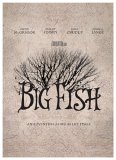
Big Fish Special Edition With Book
I'm a fan of Tim Burton's films in general, whether he's writing or directing: his The Nightmare Before Christmas is one of my all-time favorites, and I've enjoyed the slightly off-beat (or downright bizarre) sensibility displayed in Edward Scissorhands, Sleepy Hollow, or even Planet of the Apes. With that in mind, I was intrigued by Big Fish, a film I knew almost nothing about, save that it had Burton's name on it. I was hoping for something strange and delightful, and I wasn't disappointed: while Big Fish falls a bit short of being as good as it could have been, it's most definitely worth watching.
The film opens with a definite hook in its opening credits: we see the narrator's father recounting a story of what happened on the day his son was born... a story that, we see from the changing scenes, he's been telling and retelling so many times over the years that his grown son has gotten completely fed up with it (and all the other tall tales his father was always spinning). The estrangement comes somewhat to an end when the son is called to the bedside of his ailing father, and determines at last to get to know the "real" man, the man behind all the grandiose stories. All this is set in the frame of the son telling us, the audience, that he will recount the story of his father's life, as his father would have told it himself. So, as we come to the bedside of the ailing Edward Bloom, the story launches into a series of further flashbacks depicting the events of his life, in all their far-fetched glory.
Many films have a good beginning (as this one does) and a solid ending, but it's not surprising to see them sag in the middle, as that's always the hardest part of a story to sustain. Big Fish goes against the grain and gives us a story that is at its strongest right in the center of the film. Ed Bloom's adventures, told in a style that seamlessly intertwines fantasy and reality, are the real substance of the story: his larger-than-life childhood, his brief sojourn in the town of Specter, his career in the circus, his pursuit of his true love, his quite varied career as a traveling salesman. These are the stories that Bloom has been telling all his life, shown as he told them. Are they true? Or are they all a complete fabrication?
That's the interesting question of Big Fish, and unfortunately for the film, it tries to answer it. The ending is the weakest part of the story, as it shifts away from the tall tales themselves and instead focuses more on the son's attempt to understand what parts of his father's stories were true. Billy Crudup does a reasonable job as William Bloom, the son, but in truth his character is a fairly shallow one, its only real function to be a stand-in for the audience as we listen to his father's stories. Trying to develop the father-son relationship just doesn't seem to work, and as the film tries to do so anyway, it pulls the story further away from the delightful magical-realism world and into the more prosaic real world. I won't reveal any spoilers, but I'll add that the ending falls flat because it gives us an answer to the question of "was it real?", and that answer is not really satisfactory.
As a whole package, though, Big Fish is very enjoyable, taking us on a wild and thoroughly off-beat journey in which it doesn't really matter where the film is going, since it's so much fun seeing the sights along the way. The performances throughout the film are quite solid. Albert Finney is perfect as the elder Edward Bloom, and Jessica Lange brings substance to the role, as his wife, that could otherwise have been pushed to the sides. There's also some very interesting casting for the secondary roles. Danny DeVito is absolutely perfect as the circus owner Amos Calloway, Helena Bonham Carter is intriguing as the witch, and Steve Buscemi is excellent as the slightly sidetracked poet Norther Winslow. And, as a nice finishing touch, visually Big Fish is a great deal of fun; Tim Burton has just the right eye for the fantastic and unexpected touches that make a difference in the final film.
The DVD
Big Fish: Special Edition with Book contains the Special Edition DVD (in its regular plastic keepcase), packaged inside a paperboard slipcase along with the 24-page companion book.
Video
Big Fish appears in an anamorphic widescreen transfer, at its original 1.85:1 aspect ratio. It's a very attractive transfer, though not a perfect one. Colors look excellent, which is a good thing considering the lavish use of bright primary colors throughout the film. Contrast isn't handled quite so well: in evenly lit scenes everything looks fine, but shots that have high contrast, such as a dark foreground and a bright background, go too quickly to black and lose some detail. A touch of grain and some minor edge enhancement appear as well, but nothing distracting, and other than that, the print is clean and clear. All in all, it looks very nice.
Audio
The Dolby 5.1 soundtrack provides a solid, enjoyable listening experience. The sound is clear and crisp, with dialogue sounding natural, and the music well balanced with the rest of the track.
Extras
Big Fish: Special Edition with Book is... well, it's the Special Edition with an accompanying book. You might think that the book is a copy of the original novel by Daniel Wallace that the film is based on, but in fact it's not. The slim 24-page hardcover volume that accompanies the DVD, subtitled "Fairy Tale for a Grown-Up" is a rather odd piece: it's a selection of quotes from the film, with accompanying colorful, slightly stylized illustrations of scenes from the story.
The DVD itself is the same release as the Special Edition that's sold separately. The main attraction here is an audio commentary track with Tim Burton. Other than that, we get a selection of promotional-style featurettes that give a glimpse into the making of the film, but not much more than that. The section called "The Character's Journey" has sections on Edward Bloom (8 minutes), Amos (4 minutes), and "fathers and sons" (7 minutes), while the section on "The Filmmakers' Path" is slightly more interesting, with a piece on Tim Burton (7 minutes), the overall fairytale quality of the film (9 minutes), the creatures made for the film (6 minutes), and the author of the book that the film is based on (8 minutes).
The feature called "Fish Tales" allows you to play the film with icons periodically appearing to take you to related featurettes. Since these are the same featurettes that you can watch separately in the featurettes section, I see no reason to use this feature. Lastly, there's a trivia quiz and a set of previews of other Columbia films.
Final thoughts
Big Fish is an interesting and unique film, one that is well worth watching for its creative, off-beat, imaginative storytelling. As far as DVD editions go, there's no difference in transfer or bonus content between the "with book" edition and the Special Edition released separately. I didn't find the short book (which just has illustrations and a few quotes from the film) to be anything special, so I'd suggest just going for the separate release rather than paying more for this one. For the DVD itself, though, it definitely gets a strong "recommended" rating.
|



| Popular Reviews |
| Sponsored Links |
|
|
| Sponsored Links |
|
|
| Release List | Reviews | Shop | Newsletter | Forum | DVD Giveaways | Blu-Ray | Advertise |
|
Copyright 2024 DVDTalk.com All Rights Reserved. Legal Info, Privacy Policy, Terms of Use,
Manage Preferences,
Your Privacy Choices 
| |||||||