
| Reviews & Columns |
|
Reviews DVD TV on DVD Blu-ray 4K UHD International DVDs In Theaters Reviews by Studio Video Games Features Collector Series DVDs Easter Egg Database Interviews DVD Talk Radio Feature Articles Columns Anime Talk DVD Savant Horror DVDs The M.O.D. Squad Art House HD Talk Silent DVD
|
 DVD Talk Forum |
|
|
| Resources |
|
DVD Price Search Customer Service #'s RCE Info Links |
|
Columns

|
|
|
Harry Potter and the Goblet of Fire
Few balancing acts are as difficult as the adaption of a beloved book to the screen. When that favorite book is part of the Harry Potter series, with its devoted fans of all ages worldwide, the problem becomes even more difficult. You see, while books and movies have many similarities - both, after all, tell narrative stories - they are also very different media. What works in one format may or may not work in another. Or, to put it another way, a book/movie adaptation is like the famous description of a poem translated into another language: it can be beautiful, or it can be faithful, but it can't be both.
When I reviewed Harry Potter and the Prisoner of Azkaban, I commented that the film is very faithful to the book (and that it's this tenacious adherence to the book's structure that's the film's one weakness), but in retrospect, I can see that The Prisoner of Azkaban is a much "looser" adaptation than The Goblet of Fire. In The Prisoner of Azkaban, the story is slimmed down to focus on the key plot elements, with many details and secondary threads from the book left out. The result is a highly effective film, one that I considered (and still consider) to be the best in the series so far. But my point of view wasn't shared by a lot of diehard fans who wanted to see Every. Single. Scene. Unfortunately, it's those fans who seem to be the target audience for this newest film in the series.
Let's be totally clear: I'm a Harry Potter fan, and I was really looking forward to the film version of The Goblet of Fire. But the straight news is that The Goblet of Fire isn't really a Harry Potter film: it's a scene-by-scene video version of the book. And while that's likely to please a certain segment of the audience, it means that as on its own merits as a film, The Goblet of Fire just doesn't work very well. It manages to hold itself together, sure... but it never gets all its ducks in a row, either.
The Goblet of Fire gets off to a shaky start with the first scenes, which follow the exact sequence of events in the first few chapters of the original novel: an elderly Muggle stumbling upon evildoings in a ramshackle old house, Harry waking from a dream, and the friends trekking off on an adventure with the Weasley family. All of this leads into the Quiddich World Cup sequence, and in the novel Rowling uses it to start getting the action warmed up and to set the scene for later events. In the film, though, it's rushed and will almost certainly be confusing to viewers who don't have a precise recollection of how those scenes fit together in the book, where these events are given an explanation by Rowling that's missing in the film. Who was the old man? Was that what Harry was dreaming about? Where are they all going? A thorough familiarity with the book is necessary to keep the characters and events at all straight... and the longer it's been since you read the book, the more confusing the opening will be.
It's not just that the opening scenes are rushed, though: the entire movie is. The decision to make The Goblet of Fire a single, fairly long film rather than two films was a perfectly reasonable one, but in order to make that decision work, the story needed to be pruned much more aggressively than it actually was. The emphasis seems to be on preserving as many of the story elements and references as humanly possible, even if it means spending very little time on each one. The entire film follows the same formula: we see filmed versions of nearly all the plot and character-development points of the novel (major and minor), with the story abruptly cutting from one to the next without any real sense of flow. In essence, the film is asking the viewer to fill in the narrative context with information from the book.
One of the effects of this "follow the book page by page" approach is that there's a curiously flat feeling to the narrative: with each scene delivered in the same hasty, breathless manner, there's little to distinguish key dramatic scenes from minor details. Since it's impossible to sustain a constant high note of dramatic tension for an entire film (much less a two-and-a-half-hour film), the result is a general middling tone, with no building of suspense and only a weak rise in tension in important scenes.
The "include everything" approach for the plot might have worked if the film were a miniseries, but since it's not, it just means that many elements are included in a perfunctory manner and not really exploited. The dramatic events at the Quiddich World Cup seem overdone in the context of the surrounding scenes, since there was very little buildup; on the flip side, the murder of an important secondary character midway through the film is included but subsequently completely ignored. Why wasn't it just omitted entirely? The character of reporter Rita Skeeter is given a substantial amount of screen time, but while in the book we see the consequences of her involvement in the story, and there's a well-developed plot thread that makes her character relevant, in the movie the significant aspects of her role are dropped. She becomes just a random secondary character with no real function. On a smaller scale, Sirius Black is brought in for one scene that turns out to be completely irrelevant to anything in the story, and his character is never mentioned again; the only effect is to confuse viewers who don't have a crystal-clear recollection of the book.
Even the Triwizard Tournament, which ought to give structure to the film as a whole, feels like a random set of challenges with no connection to anything else in the story. In only one of the challenges is there any build-up featuring Harry trying to figure out how to deal with it, and that challenge suffers from too much time being spent showing off the underwater CGI effects. The final challenge in particular suffers from a lack of context. It's supposed to be the most frightening and challenging of the three, but the subtle psychological effects of the maze, which are explained in the book, are unexplained here, making the maze scene seem to be nothing more than an exercise in not being eaten by a living hedge. Once again, if you have the book fresh in mind, you can flesh things out slightly by interpreting the scenes here according to how they're "supposed" to be read... but this is an example of a storytelling failure on the part of the film, and truth be told, this setpiece doesn't work well even if you know what to look for.
In the meantime, havoc is being played with the characters as well as the plot. Snape and McGonagall, characters who are important for the story overall and who are played by excellent actors, are shoved to the sidelines, with barely a line or two apiece. Cedric, Fleur, and Victor are colorless as the other Triwizard champions. Neville Longbottom is shoved to the fore in several scenes that seem to have no other function than to highlight him as an up-and-coming character; certainly in The Goblet of Fire his scenes could have (and almost certainly should have) been cut to focus the audience's attention where it belongs.
That focus should have been much more squarely on the trio of Harry, Hermione, and Ron. One of the key themes of The Goblet of Fire is their restlessness as they enter puberty, and the tensions that erupt among them when Harry is thrust into the limelight once again. With the frantic pace of the film, there's no time to draw out the character development in a natural way. Instead, we have the fast-forwarded version. They're friends! They're mad at each other! They're friends again! As with everything else, the film tries to do too much too fast.
The best way to see how the book-to-film translation is mishandled is to compare it to Peter Jackson's adaptations of The Lord of the Rings, another "fan favorite." Jackson very wisely did not attempt to do a scene-by-scene rendition of the book; instead, he cut some parts and emphasized others, and significantly rearranged the narrative structure of the book, changing the order of events and sometimes reassigning roles or combining them in a single character. The result was a set of films that manage to succeed as films, while also being extremely faithful to the feel and spirit of the original book... which is a very different (and far better) thing than being blindly faithful to the way the author put the words down on paper. But it takes a certain degree of courage and confidence to do this with a popular story, and it would seem that with The Goblet of Fire, we see the director take the "safe" (and ultimately less successful) way out.
After reading this far, you might justifiably ask whether I think there's anything worthwhile in the film. The answer is yes; The Goblet of Fire does manage to be moderately entertaining. It's simply that The Goblet of Fire is disappointing, considering the expectations that we as viewers quite justifiably have for it, especially after seeing three films that handled the book-to-film transition more effectively, if not perfectly.
I suspect that if director Mike Newell had been given more leeway with the material, he could have done a much better job. Whenever the film settles down to spend a moderate amount of time on a particular sequence, the quality markedly improves. As a result, the film has entertaining set-pieces scattered throughout the film's running time. The Quiddich World Cup scenes do a great job of capturing the revelry of the wizard world, and the "wow" factor of magic. Parts of the challenge with the Hungarian Horntail dragon are top-notch: the dragon itself is simply stunning, and the tense scenes with the dragon on top of the castle roof are fantastic, even if the overall sequence feels like it's padded with a too-long aerial chase. The Yule Ball section also feels almost right; the scene with Professor McGonagall teaching the Hogwarts students to dance is handled very well, with just the right touch of humor drawing on the different reactions of the girls and the boys to the prospect of a formal dance.
Harry Potter and the Goblet of Fire is a film that's certainly hampered by the expectations of its fans, which is too bad; with a more confident approach to adapting the book (with an emphasis on adapting, not just recreating), we could have had a rousing success. After all, The Goblet of Fire is an excellent story. As a film, though, it's a prime example that "faithful" is not synonymous with "excellent."
The DVD
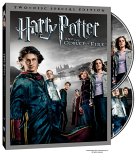
Harry Potter and the Goblet of Fire is a two-disc set, packaged in a single-wide plastic keepcase inside a cardboard slipcase.
Video
The Goblet of Fire looks good, but not as good as I'd have expected it to look, given that it's a high-profile release. The main issue that I noticed is that the contrast feels a bit "off." In a number of scenes, the contrast feels too heavy, so that we lose detail in dark areas of the scene; in others, though, it seems like there's not enough contrast. Overall, the print is clean; we don't get any flaws, and I saw minimal edge enhancement. It's not a particularly sharp or crisp transfer, though. Close-ups look good, but in longer-distance scenes seem a bit softer, without the detail that I'd have liked to have seen.
The film appears in its original theatrical aspect ratio of 2.35:1, and is anamorphically enhanced.
Audio
The Dolby 5.1 soundtrack is consistent with the video transfer in being quite good, but not as good as what we got for the DVD of the previous release. The sound is clean and crisp, with a nice depth to it; dialogue is always distinct and easy to understand. The overall sound is spread well across the channels, but when it comes to the use of the rear channels for the surround, the track doesn't stand out. Directional effects are used occasionally, and are quite effective when they are used, but they're not a consistent part of the soundtrack. Similarly, the rear channels aren't used to their best effect for an immersive sound; scenes like the ones with rainstorms could have been a lot more aggressive in the use of the surround sound. The action sequences ramp up the volume, but again the emphasis is on the front and side channels rather than the full surround package. We certainly get enough to feel that yes, it's a surround experience, but it's not as engaging as it could be. It's nice to hear, though, that even when the volume climbs, the various elements in the track are still balanced properly.
A Dolby 5.1 Spanish track is also provided, along with English, Spanish, and French subtitles. On the second disc, viewers are prompted to choose either English or French for the subsequent menu choices.
Extras
As a two-disc set, Harry Potter and the Goblet of Fire presents the film on the first DVD and all of the bonus content on the second DVD. It's a mixed bag, with a few features of genuine interest shuffled in among weaker material that's probably aimed at the younger viewers.
The special features are divided into themed sections. In the "Dragon Arena" section, the bonus features start off with a fairly silly game called "Triwizard Tournament: Dragon Challenge." (Does anyone actually play these DVD games?) "Harry and the Horntail: The First Task" turns out to be a 16-minute featurette that focuses on the creation of that sequence for the film. Last in that section is "Meet the Champions," a 13-minute "behind the scenes" segment that follows the actors who play the Triwizard Champions. It's a moderately interesting segment.
In "The Lake," we get another installment of the DVD game, and the mildly interesting ten-minute featurette "In Too Deep: The Second Task," which focuses on the visual effects required for the second task in the film.
"The Maze" section has two silly games: the last segment of the Triwizard game, and another one called "To the Graveyard and Back Challenge." A short featurette on "The Maze: The Third Task" (7 minutes) gives some background on the making of that sequence, and "He Who Must Not Be Named" (11 minutes) covers the character of Voldemort and the actor who brings him to life.
For adult viewers, the "Hogwarts Castle" section has the most substantial content. A ten-minute set of "Additional Scenes" is certainly worth viewing, with some scenes that really should have made it into the final cut and others that were definitely best left out. "Preparing for the Yule Ball" (9 minutes) is another short scene-specific featurette. The most substantial piece here is "Conversations with the Cast," which runs a full 30 minutes. Here, we have the three young actors in a casual setting, with host Richard Curtis drawing them out to discuss their thoughts on the making of the film. Following on the heels of this segment is "Reflections on the Fourth Film," a 14-minute piece that has various actors commenting on the changes they've seen over the years they've been involved with the Harry Potter projects.
The theatrical trailer is also included, as is some minor DVD-ROM content.
Final thoughts
If you've been following the Harry Potter films, but haven't seen The Goblet of Fire yet, you can predict your reaction to the film quite well by considering how much you liked The Prisoner of Azkaban compared to the two earlier films. If you found The Prisoner of Azkaban to be the best of the films, as I did, you'll almost certainly find The Goblet of Fire to be a letdown. If you agonized over the fact that not every single scene that Rowling wrote made it into The Prisoner of Azkaban, you're likely to be a lot happier with The Goblet of Fire than I was, since it's basically a video-illustrated version of the book rather than a strong film in its own right.
But if you've already seen the film... let's be realistic. If you (or your kids) are interested in Harry Potter and the Goblet of Fire, you're going to pick up the DVD no matter what I say about it. I could say that it's a good choice for a rental, but then if you already own the first three films, as I do, are you really going to leave a gap on your shelf when the fifth film comes out? I didn't think so. With that in mind, I'll go ahead and generously give a "recommended" for this film. Sure, pick it up; just don't feel you have to rush out and get it in a hurry. Wait for a sale.
|



| Popular Reviews |
| Sponsored Links |
|
|
| Sponsored Links |
|
|
| Release List | Reviews | Shop | Newsletter | Forum | DVD Giveaways | Blu-Ray | Advertise |
|
Copyright 2024 DVDTalk.com All Rights Reserved. Legal Info, Privacy Policy, Terms of Use,
Manage Preferences,
Your Privacy Choices 
| |||||||