
| Reviews & Columns |
|
Reviews DVD TV on DVD Blu-ray 4K UHD International DVDs In Theaters Reviews by Studio Video Games Features Collector Series DVDs Easter Egg Database Interviews DVD Talk Radio Feature Articles Columns Anime Talk DVD Savant Horror DVDs The M.O.D. Squad Art House HD Talk Silent DVD
|
 DVD Talk Forum |
|
|
| Resources |
|
DVD Price Search Customer Service #'s RCE Info Links |
|
Columns
  


 
|
|
|
Midnight Cowboy: SE
Chances are, if you're reading this review, that you've already seen Midnight Cowboy and think it's a great movie; you're just interested in finding out whether this two-disc Special Edition is worth picking up to replace the earlier release. (Go ahead and skip down to the DVD section, if so.) Then again, even if you're a movie fan, there are so many famous "must-see" films that it's impossible to see them all. (Or very difficult, anyway.) Midnight Cowboy is certainly flagged with some interesting elements: a Best Picture Oscar, an X rating (later changed to R, without any cuts to the film), and Dustin Hoffman and Jon Voight as the leads. But does this 1969 film hold its own today, more than thirty-five years after its initial release?
Yes and no. In short, I would say that Midnight Cowboy is dated, though not to the point of being unwatchable. At this point, it's interesting from the point of view of cultural and film history - seeing how daring some of the material would have been, in 1969 - and for its performances from Hoffman and Voight.
Certainly, Hoffman and Voight do a outstanding job of portraying the unlikely friendship of "Ratso" Rizzo and Joe Buck. That's really what makes the film worthwhile to watch, especially since the film deals directly with Buck's sexual past and present, including his homosexual encounters. With that topic so much in the foreground of the film, it would have been very easy to imply that there's a sexual relationship between Rizzo and Buck. In fact, given some of the comments I'd read about the film beforehand, I expected to see something there. But in fact the film gives us what I think is a more honest and ultimately more challenging idea: that what we have here is a genuine friendship and love between two very different men, a relationship that does not include a sexual element. In our hyper-sexualized culture, that seems to be a difficult story to sell; any close relationship between men seems to be reduced to a sexual one, as if that somehow "explained" things. By avoiding that aspect of Buck and Rizzo's relationship, Midnight Cowboy asks us to look at the two men as human beings who desperately need love, friendship, companionship, and simple human interaction... and who find in each other some hope for the future. This depth of character is exactly what's missing from a film like Brokeback Mountain, which reduces the two protagonists' feelings for each other to a simple, inarguable sexual attraction, and never really develops their relationship as human beings. Can we invent a sexual relationship for Rizzo and Buck? Sure, but it's outside the bounds of the film, which asks us to pay attention to the more interesting question of how they relate to each other as friends.
Midnight Cowboy is also interesting in its portrayal of a bleak and inescapable city landscape; New York is a grim and heartless place, where Rizzo lives on the fringes, and where Buck finds that his fantasies hit a blank wall of reality. The idea of "the city" as a place where people seek their dreams - and where dreams sometimes die - is a powerful one, and Midnight Cowboy gives us 1969's vision (through the eyes of a British director) of the quintessential U.S. city of dreams.
But those interesting elements are only part of the whole package; what gives Midnight Cowboy much of its power is its shock appeal. For 1969, the film's frank and up-front view of topics like prostitution, rape, and homosexuality were absolutely shocking. Seeing it in 2006, I didn't find any of these sequences particularly controversial or difficult to watch. To make a comparison, I found Requiem for a Dream to be absolutely devastating, for instance... and I suspect that when it originally screened, Midnight Cowboy had that effect on viewers. It's challenging to be faced with scenes of parts of society that you'd rather not think about, and Midnight Cowboy tries to do that. In 1969, effectively. Now? Not so much. The film does still work, to a certain degree, because it does still address how Buck's experiences shape him; still, I think that the simple fact of touching "untouchable" ideas made it hard for the filmmakers to move to the next stage, of doing truly engaging and timeless art with those ideas.
The style of Midnight Cowboy, quite modern at the time, has also since then migrated into more mainstream film. We get a lot of artistic messing around in the film: the disordered flashbacks to Buck's past, the fantasy sequences, the surreal camera work in the trippy drug scene, and tricks like flicking between color and black and white film. The effect is disorienting, to a certain extent; if you are already feeling shocked by the sexuality and the raw life-on-the-streets material, this approach will underscore the emotional effect of the film. But if you don't feel that immediate sense of shock and slightly guilty titillation, then the film's style ends up feeling overdone and pretentious. It's not unwatchably pretentious, but I'd say that there's definitely a sense that we're supposed to be wowed not just by the story and characters, but by the avant-garde presentation. That slight touch of self-consciousness - perhaps more apparent now than it was in 1969 - makes the film feel a bit artificial at times.
When all's said and done, Midnight Cowboy remains an interesting film, but more so for its place in cinema history and the career of its leading actors than for its own merits. It's worthwhile for film enthusiasts, but I found it to be sufficiently dated that it's not something I'd jump out and recommend for viewers who are looking for an excellent film on its own merits.
The DVD
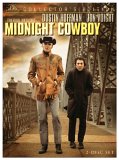
Midnight Cowboy: SE is a two-disc set, packaged in a cardboard fold-out case in a glossy cardboard slipcover.
Video
Midnight Cowboy appears here in an anamorphically enhanced widescreen transfer, at the film's original aspect ratio of 1.85:1. In general, I was very pleased with the appearance of the transfer; it's not perfect, but it's free of the issues that often crop up in transfers of 1970s-era films. The color balance looks right; this is a film with a fairly drab color palette, appropriate to the theme, but the colors look natural, and bright colors are vibrant when they do show up. The colors are clean-looking, as well; there's none of the tint or fading that we might have expected. Some edge enhancement shows up in particularly challenging scenes, but there's very little of it, and overall the image is clean. The print is very clean, and most scenes are also nicely free of noise. I did notice that there's some grain in the darker scenes, and in those scenes the contrast tends to be a bit heavy, but all in all this is a well-handled transfer.
Audio
Two audio tracks are offered here: the original Dolby 2.0 mono soundtrack and a new, remastered Dolby 5.1 track. The 5.1 offers a bit more depth to the track, but the DVD producers have (wisely) not messed around to force a more aggressive surround experience on this dialogue-centered film. The music sounds clean and clear. Dialogue is sometimes a bit harsh-sounding when voices are raised, but this is a fairly minor point. The mono track seems to have been given attention as well, as it's clean and pleasing to the ear.
Dubbed Spanish and French soundtracks are also included, as are English, French, and Spanish subtitles.
Extras
The first "bonus material" that viewers will find isn't mentioned on the packaging: the DVD package includes a set of oversized Midnight Cowboy postcards. The seven postcards each have a different sepia-toned photograph from the film on the front, with a quote from the film on the back.
Disc 1 contains the film, along with a full-length audio commentary from producer Jerome Hellman. I wasn't all that impressed with the commentary; it has some interesting parts, but Hellman seems to suffer from not having someone else to talk to during the commentary. There's a lot of dead air time, and what Hellman discusses is often fairly general, not related to the particular scene happening on-screen. Enthusiasts of the film will probably enjoy it, but it's not something that brings the film alive for new viewers.
Disc 2 has the rest of the special features. A thirty-minute featurette called "After Midnight: Reflecting on the Classic 35 Years Later" offers an interesting and fairly comprehensive look at the making of the film. Many of the cast and crew members involved in making the film are interviewed, providing insights on the film throughout its creation, from the generation of the idea through writing, casting, and filming.
Two shorter featurettes are also included. "Controversy and Acclaim" (10 minutes) focuses on the film's reception and surprising critical success, and "Celebrating Schlesinger" (9 minutes) is an homage to the late director.
A photo gallery and a set of previews is also included (no trailer for Midnight Cowboy itself, though).
Final thoughts
The Special Edition of Midnight Cowboy offers a solid video and audio presentation, with a reasonable (if not overwhelming) amount of special features. Viewers who know that they like the film will probably find it worthwhile to choose this DVD as the one to add to their collection, or perhaps to upgrade. Considering the film itself, though, I didn't find that Midnight Cowboy has aged very well; it's not bad, but it's interesting more in terms of its place in film history than on its own merits in the current day. I'll give this DVD a general "rent it" suggestion.
|



| Popular Reviews |
| Sponsored Links |
|
|
| Sponsored Links |
|
|
| Release List | Reviews | Shop | Newsletter | Forum | DVD Giveaways | Blu-Ray | Advertise |
|
Copyright 2024 DVDTalk.com All Rights Reserved. Legal Info, Privacy Policy, Terms of Use,
Manage Preferences,
Your Privacy Choices 
| |||||||