
| Reviews & Columns |
|
Reviews DVD TV on DVD Blu-ray 4K UHD International DVDs In Theaters Reviews by Studio Video Games Features Collector Series DVDs Easter Egg Database Interviews DVD Talk Radio Feature Articles Columns Anime Talk DVD Savant Horror DVDs The M.O.D. Squad Art House HD Talk Silent DVD
|
 DVD Talk Forum |
|
|
| Resources |
|
DVD Price Search Customer Service #'s RCE Info Links |
|
Columns
  


 
|
|
|
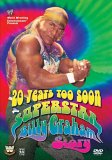
20 Years Too Soon - the ''Superstar'' Billy Graham Story
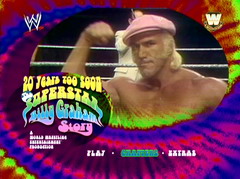 "I'm the man of the hour, the man with the power. Too sweet to be sour. The women's pet, the men's regret. What you see it what you get. And what you don't see, is better yet."
After watching 20 Years Too Soon: the Superstar Billy Graham Story, you'll come away either recognizing that Graham was a trendsetter who was a clear influence on wrestling today or you'll blame him for being a trendsetter and a clear influence on wrestling today. Whichever way you're inclined to think, there's one thing that's clear - Billy Graham was responsible for shaping the way the WWE is today. 20 Years Too Soon examines his life from his very first set of weights to the steroid scandal instigated by Graham and his health problems later in life.
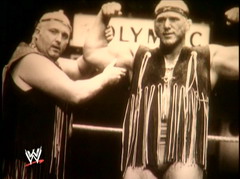
Clocking in around ninety minutes, Graham's story starts in Phoenix, Arizona where, growing up the youngest of four children, he has to deal with his family's low economic income and an abusive father with MS. We learn how he became interested in weightlifting and why he assembled his own set of weights using coffee cans and concrete. He competed in track and field events when he was in high school, but threw away any chance of college scholarships or competing in the Olympics after dropping out.
One day, while bringing his father to work, he noticed a sign outside a tent that read "You Must Be Born Again". This sign, and a chance meeting with the preacher inside the tent, inspired his religious conversion. He toured with the group for a short time, before hitting Venice Beach in 1968 where he resumed weightlifting, working out and training with another new Venice Beach resident - Arnold Schwarzenegger. After taking a another shot at football, he headed up to Calgary to train with Stu Hart in "the Dungeon". Hart sensed that Graham didn't know how to wrestle and spent two whole weeks literally kicking his ass. At Stu's suggestion, Billy spent his first week in the square circle arm wrestling audience members and other wrestlers before getting in the ring to wrestle - something he still didn't know how to do - the following week.
Graham also spent some time traveling, hooking up with people that would help him hone his ring persona and ability. In Phoenix he met Dr. Jerry Graham, with whom he toured Indian reservations. In LA, he crossed paths with "Classy" Freddie Blassie (who promptly had his ass kicked by Graham during an arm wrestling match). After that, Billy spent a year in San Francisco, meeting Pat Patterson, Ray Stevens, Rocky Johnson and Peter Maivia. Later on, a phone call from Ray Stevens was responsible for Billy heading to Minnesota and the AWA where he worked with "the American Dream" Dusty Rhodes. In the midst of meeting and working with all of these legends of the wrestling industry, he found time to meet his second (and current) wife, Valerie at a Tampa International House Of Pancakes. Graham didn't know it, but his life was about to change when Vince McMahon Sr. called him and invited him to work in the WWWF. There, he became Heavyweight Champ and had memorable matches with Bruno Sammartino, Ivan Putski and Dusty Rhodes (all three matches are included as extras). Despite Graham's popularity with the fans and his colorful personality (and costumes), he had to drop the belt to Bob Backlund since Graham was a "heel" while Bob was a "face" and the "All-American" boy that Vince Sr. was looking for. This incident devastated Billy so badly, that he left the WWWF, went home to Phoenix and eventually became addicted to drugs.
He would return to the WWF twice, the first time with an entirely new look: a bald head, black outfits and expertise in martial arts. The second time, he decided to (thankfully) ditch the martial arts gimmick and return as the "Superstar" Billy Graham that everyone knew and loved. Unfortunately, his body was rapidly deteriorating and he'd find himself needing hip replacement surgery and an operation to fuse his ankle. During these medical emergencies, Vince was as accommodating as he possibly could've been. He had Billy managing wrestlers, doing commentary - just about anything to give him work. Graham's condition was so bad that, during the fusing of his ankle, Vince realized that there was nothing left for him to do and let him go. Billy sunk into a severe depression and since he was broke, desperate and bitter, decided to bring up allegations of steroids against Vince, the WWF and Hulk Hogan. He went through one more major operation, a liver transplant, before being finding religion again and being welcomed back into the WWE when he was inducted into the 2004 WWE Hall Of Fame.
It's a unique story and, much like Bret Hart's DVD, it was facinating to watch wrestling matches from back in the day. I would've liked it if there was more depth to the steroid incident, but I understand why there wasn't. The documentary is divided up into 24 different chapters:
- Growing Up
- Religion
- Bodybuilding & Football
- Training In Calgary
- Meeting Dr. Jerry Graham
- "Going To School" in San Francisco
- AWA
- Meeting Valerie
- Winning the WWWF Heavyweight Championship
- Ahead Of His Time
- Selling Out Main Events
- Feud With Dusty Rhodes
- Loses WWWF Heavyweight Championship To Bob Backlund
- Superstar Takes A Sabbatical
- Martial Arts Look
- the Superstar Is Back
- Hip Replacement
- Superstar's Fall From Grace
- Superstar Is Fired
- Steroid Scandal
- Dedicating His Heart To the Lord
- Liver Transplant
- Superstar Is Reborn
- Hall Of Fame
In addition to the main documentary, Vince has seen fit to pad this disc with some great extras:
In the Ring - There are six of Billy's matches as "extras". The four WWWF matches should be of particular interest since they were the ones that helped defined Graham's career. Unfortunately, compared to the older AWA footage, the picture is watchable, but slightly lacking.
- vs. Armando Rodriguez AWA All Star Wrestling 8/25/73
- vs. Angel Rivera AWA All Star Wrestling 10/6/73
- vs. Bruno Sammartino World Wide Wrestling Federation Heavyweight Championship Match Baltimore, MD 4/30/77
- vs. Ivan Putski World Wide Wrestling Federation Heavyweight Championship Match MSG 8/29/77
- vs. Dusty Rhodes Texas Death Match for the World Wide Wrestling Federation Heavyweight Championship MSG 10/24/77
- vs. Bob Backlund World Wide Wrestling Federation Heavyweight Championship Match MSG 11/21/82
On the Mic - Graham states that, though his persona was created solely by himself, he borrowed his mic ability from Muhammad Ali. Included are seven
- "I am the Arm Wrestling Champion Of the Universe" - All Star Wrestling 10/6/73
- "These Hands Can Crush Coconuts" - AWA
- "I Don't Want You To Ask Me Any Questions" - All Star Wrestling 8/27/75
- "This Is the Beauty Of A Champion" - Madison Square Garden 6/27/77
- "I Am the Most Colorful Man In All Of Wrestling" - Worldwide Wrestling 9/3/85
- "the People Want the Real Thing" - Mid-Atlantic Wrestling 9/10/85
- the Comeback - Wrestling Challenge 11/29/86
Director's Cut:
- Overdose - A short recollection of Graham's drug abuse.
- Apache Reservation - Graham recounts some experiences on the Indian Reservations with Dr. Jerry Graham.
- Jimmy Hart Story - Hart talks about a Memphis show and the differences between metal chairs up north and down south.
- Bruce Prichard Imitation - A useless waste of 30 seconds where Prichard does a "Superstar" impression for those who've ever wondered what Bruce Prichard imitating "Superstar" Billy Graham would sound like.
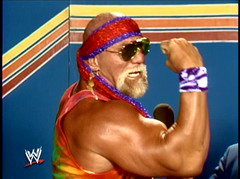 Video: 20 Years Too Soon: the Superstar Billy Graham Story had a fairly sharp picture during the new interview footage. Some of the archival footage were flawed, but that should be expected since wrestling was far from the industry that it is today. It's presented in the WWE's standard full frame 1.33:1 ratio.
Audio: The Dolby Digital 5.1 track was crystal clear and enveloped my living room while I was watching it. Dialogue was clear and there was a nice balance between the vocals and the constant background music.
Conclusion: After watching this documentary, you'll be amazed at how many wrestlers "borrowed" various aspects of Graham's in-ring personality. Wrestlers such as Hulk Hogan and Jesse Ventura owe him a debt of gratitude for inspiring their flamboyant wrestling personas and others like John Cena should feel reassured that it is possible to possess limited ring skills and still be popular thanks to their mic skills. After my first viewing, I was under the impression that the main documentary skimmed over his life and was lacking depth, but the more I thought about it, I realize I was wrong. I might not be the most knowledgeable wrestling fan, but there was enough here to inform and entertain. Sure, there could've been more matches included (or even some more clips of his mic work), but this is still a Recommended disc.
|



| Popular Reviews |
| Sponsored Links |
|
|
| Sponsored Links |
|
|
| Release List | Reviews | Shop | Newsletter | Forum | DVD Giveaways | Blu-Ray | Advertise |
|
Copyright 2024 DVDTalk.com All Rights Reserved. Legal Info, Privacy Policy, Terms of Use,
Manage Preferences,
Your Privacy Choices 
| |||||||