
| Reviews & Columns |
|
Reviews DVD TV on DVD Blu-ray 4K UHD International DVDs In Theaters Reviews by Studio Video Games Features Collector Series DVDs Easter Egg Database Interviews DVD Talk Radio Feature Articles Columns Anime Talk DVD Savant Horror DVDs The M.O.D. Squad Art House HD Talk Silent DVD
|
 DVD Talk Forum |
|
|
| Resources |
|
DVD Price Search Customer Service #'s RCE Info Links |
|
Columns
  


 
|
|
|
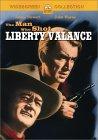
Man Who Shot Liberty Valance, The
Although his crown is fading now, John Ford was the undisputed king of film directors during the heyday of the 'auteur theory'. He was perfect for the role, having made 75 post-silent movies with consistent themes and a varied but personal selection of styles. Just as his career was finally coming to an end, he made two last pictures for Paramount that sum up both his career, and many of the ironies of his personal philosophy.
Highly entertaining, if a bit slow-moving, Liberty Valance is a delight for those who wish to celebrate John Wayne. His fractured diction, accompanied by his theatrical pauses and shorthand gestures, makes this the key film for Wayne imitators, Pilgrim. Wayne interacts gracefully with a number of acting styles, and only James Stewart stands out as being possibly a bit too much for his role. His constant emoting, as if he were still in Mr. Smith filibuster-mode, is tiring, and he's ridiculously too old for the role ... but then again, so is Wayne, if we want to get technical. Vera Miles is stock-professional, but Lee Marvin got his star-making break as the loathsome but fun dirty-rat Liberty Valance. The lizardlike Lee Van Cleef and the perverse Strother Martin hit perfect notes that would later elevate them into stardom with Leone and Peckinpah.
Stagebound and talky, Liberty Valance doesn't have much action and almost plays like a picture from the '30s, which is not a complaint. Colorful characters like Ken Murray's Doc and Edmond O'Brien's Dutton Peabody come right out of the Stagecoach school of 'alcoholism-is-cute.' Considered Ford's final word on the Western genre, most of the ideas here are depressingly retro, after Ford's (assumed) liberalization that began with The Searchers. 1 Showing that the colorful reputation of the noble politician is based on a lie might sound subversive, until the end, when it's smugly declared that inconsistencies with the 'official story' are best swept under the carpet. As a truth-killer, it's the equal of the ending of Fort Apache, where military stupidity and the double-crossing of the Indians are hidden in the interests of Army pride, sentimentality, and tradition. 'When the facts conflict with the legend, print the legend,' has a sentimental appeal to everyone who wants history to be a rosy tale of simple conflicts, nobly resolved. But it's the same ideal that made the politics of beloved actors Stewart, Wayne, Reagan, and others come off as fascism to my generation. 'Trust us', they said so paternalistically ... 'We have charisma'.
Ford's second major Western theme is the turning of the desert into a garden. Ford's Westerns make more overt claims to historical importance than those of other major directors of his time. Howard Hawks' heroes are just making a professional's living, while Ford's are almost always glorified as building a nation. Even his My Darling Clementine has a profound symbol, in its half-built Church, of an American Utopia in the making. Strange, however, that these Western movies are all set in the most barren of deserts, that can grow almost nothing and could barely support goats for grazing. Are all the denizens of Shinbone miners, perhaps? Even the farms of The Searchers are cropless nothings. But Tom Doniphon brings Hallie a cactus rose, the symbol of the garden in the West he wants to build, as if it were some kind of fantasy. The harshness of desert settings in Westerns is more photogenic than the rural-agricultural kinds of places that were the object of strife in the old West; by eliminating complex political issues and sticking to open vs. closed-range politics, things are kept simple. Ford's simplification of the O.K. Corral into Good Earps vs. Bad Clantons, makes John Sturges' revisionist Hour of the Gun a must-see. Here in Valance, we're handed the old idea that eliminating one demonized bad man (wonderfully played by Lee Marvin) will solve all of Shinbone's problems. This is incredibly conservative, this fairy tale that there are no complicated issues to understand and resolve, only demonized baddies to eliminate, and it's the way we Americans tend to look at the world.
But Savant needs to back-track away from these critical readings of Ford to emphasize the honesty in Valance. John Ford IS America, they used to say, and they're right, as his sentimental way of smoothing over the rough edges of American society expresses well the virtues of the country even as it exposes shortcomings. No matter how I try to analyze his films, the better ones have a ring of truth and pride that is almost familial. Enjoying movies doesn't mean you have to agree with them, and Ford's movies are the perfect vehicle for understanding the American mindset, which has a strange relationship with its Western myths. The Western doesn't even begin to come into focus without the foundation of Ford's West; all the movements that came afterward are a reaction to him. Sergio Leone started with abstract cynicism but eventually made his masterpiece, Once Upon a Time in the West as an anti-capitalist response to the world of Ford; Sam Peckinpah in his major Westerns deconstructed the John Ford world, with frequent direct quotes of his films. 2 John Ford's idealizing of the West is the conservative's way of finding peace and rest in the safe and secure past ... where the big issues are already resolved, and controversy is the tool of petty troublemakers. Ford's followup Paramount film would make this Ford world-view even more acute ...
Paramount's DVD of The Man Who Shot Liberty Valance is a snappy pressing of this b&w classic, finally back in its proper aspect ratio. Some viewers balked at this version that (correctly) mattes off the top and bottom of the frame: The problem is that they've gotten too used to seeing the movie on TV, with a mile of head and foot room above and below the essential compositions. If you doubt this, look at how perfectly framed are the main title text blocks; more picture could be cut off and it would still look fine. Savant's grudge against Paramount's late entry into the DVD biz is just a memory now, after a long succession of consistently well-transferred films with fine 16:9 formatting. On a big screen TV, Valance looks as good as it did theatrically. There's a 5.1 surround remix, plus the original mono. No additional languages are offered, and the only extra is a trailer. The liner notes are misinformed and generally dumb, trying to plug the movie as a simplistic love triangle.
On a scale of Excellent, Good, Fair, and Poor,
The Man Who Shot Liberty Valance rates:
Movie: Excellent
Video: Excellent
Sound: Good, although you'll have to read elsewhere to get a critique of the 5.1 audio remix
Supplements: Trailer
Packaging: Amaray case
Reviewed: June 3, 2001
Footnotes:
1. The liberal taint in latter-day Ford never coalesces into anything like a changed point of view; The Searchers very strongly communicates a moral dilemma, suggesting that the Indians might have had justification for resisting Yankee encroachment ... a huge admission for the maker of Fort Apache. Cheyenne Autumn, on the other hand, comes off as pitiful whining that expresses very little except some urge to cleanse himself of the cultural ills his earlier movies had foisted on native Americans.
Return
2. Yes, sure, the obvious Peckinpah lift is his use of Ford's favorite hymn 'Shall we gather at the river;' I'm talking about tiny references, like the shawl on the old lady that Pike Bishop helps across the street. William Holden takes the old lady's arm and shawl just as Henry Fonda in the classic Ford filmhad taken Clementine Carter's. It's one of the highest expressions of instinctive chivalry in all of Ford. Then Peckinpah make a vicious comment by having that same shawl be what Holden pulls from his spur and discards, after trampling the old lady to death under his horse!
Return
| |
|



| Popular Reviews |
| Sponsored Links |
|
|
| Sponsored Links |
|
|
| Release List | Reviews | Shop | Newsletter | Forum | DVD Giveaways | Blu-Ray | Advertise |
|
Copyright 2024 DVDTalk.com All Rights Reserved. Legal Info, Privacy Policy, Terms of Use,
Manage Preferences,
Your Privacy Choices 
| |||||||