
| Reviews & Columns |
|
Reviews DVD TV on DVD Blu-ray 4K UHD International DVDs In Theaters Reviews by Studio Features Collector Series DVDs Easter Egg Database Interviews Feature Articles Columns Anime Talk DVD Savant Horror DVDs The M.O.D. Squad Art House HD Talk Silent DVD
|
 DVD Talk Forum |
|
|
|
Columns
  

 
|
|
|
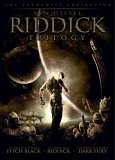
Riddick Trilogy
In the Riddick Trilogy, we have two movies and one short piece nicely packaged together to give us a wild ride through writer/director David Twohy's imagination. The Chronicles of Riddick is the star of the collection, but along with the first film, Pitch Black, and the accompanying animated bridge piece Dark Fury, the Riddick Trilogy gives viewers the definitive Riddick collection.
Pitch Black
Pitch Black is a movie that's not quite "there" by itself, but that's given more merit by a significantly better sequel (as I discuss below). On its own, Pitch Black has some excellent qualities, and some very weak points; what is clear is that they don't average out to a mediocre movie, but rather a movie that could have been truly outstanding – but isn't.
The story is fairly straightforward: A space freighter carrying both cargo and passengers (including a dangerous criminal on his way to a high-security prison) encounters difficulty en route and crashes on an arid, apparently lifeless planet scorched by the constant light of three suns. Of course, the planet turns out to be much more dangerous, and much more complicated, than it looks... setting the scene for an action-adventure movie with some interesting special effects.
The filmmakers get a lot of things right in terms of setting the scene and creating an atmosphere of a truly alien planet. The special effects are reasonably well done, but it's the cinematography that is probably the best part of the movie. The image is tinted to show how things would look in the light of the alien suns: sometimes red, sometimes bluish, sometimes a washed-out yellow. It's dramatic and memorable, and gives a true feeling of being on an alien world. We'll see more of this memorable style in The Chronicles of Riddick.
On the other hand, the two story lines feel like they were simply tacked on to each other, possibly by the marketing department. The attempt at complexity and meaningful character interaction falls painfully flat in the absence of good writing and any real concept of effective characterization. None of the main actors are particularly convincing, and Vin Diesel seems especially awkward as the convict Riddick. All in all, we get a movie with excellent cinematography and special effects, and some truly imaginative moments, but that falls short in the script and acting department.
The Chronicles of Riddick
There are so many bad sequels out there in movie-land that it's worth sitting up and taking notice when a follow-up is equally successful as its predecessor... so it's even more of a pleasant surprise when the sequel is better than the first film. That's the case with The Chronicles of Riddick, a film that is better than Pitch Black on pretty much every count.
The Chronicles of Riddick is a weird, thoroughly engaging wild run through a very strange and interesting science-fictional world. The story itself seems to follow some standard tropes, with Riddick thrust into the position of being the only person who can save humanity from the assault of the deadly Necromongers, but the film persists in taking a slightly off-center approach. Riddick is the classic anti-hero, as he's a dangerously violent escaped convict rather than a respectable hero figure, and he's thoroughly resistant to the idea of becoming humanity's savior; one of the things that makes the film different is that he doesn't undergo a renovation of character by the time the end credits roll.
What's even more surprising is that The Chronicles of Riddick is an original story, because it has a depth of detail and believability that in my experience generally comes from an origin in a novel or comic book. The Chronicles of Riddick gives us a richly textured future world that looks genuinely lived-in, and that shows signs of a fecund imagination at work at all levels of detail. There are many little details that makes us feel that we're in a different time and place, such as the weird Necromonger way of communicating long-distance, that are not relevant to the plot; the fact that there's so much incidental richness of detail suggests that there's a wealth of story material just off camera.
Everything in The Chronicles of Riddick seems to be done on a lavish scale, from the costumes and sets (all very impressive) to the story (which at two and a quarter hours manages to pack in a lot of adventure, intrigue, and action) to the cast (which includes the illustrious Judi Dench in a great supporting part as an "Elemental"). Vin Diesel doesn't do anything fabulous with his character of Riddick, but with all the support that he's given in the film, he doesn't really have to: he does a solid job of going where the story takes him, and being believable as the slightly creepy, definitely scary criminal who just might be a little more complex than he seems. (It's saying a lot in to the film's credit that Diesel can be given lines like "I'll kill you with my teacup" and have them actually work.)
All told, The Chronicles of Riddick is vastly more successful than Pitch Black; the first film was acceptable action-adventure fun, but the second takes the fun and delivers it with a better spin and a much more substantial helping of style and energy.
The Chronicles of Riddick: Dark Fury
The Chronicles of Riddick: Dark Fury is a short animated feature (35 minutes) that bridges the gap between the feature films Pitch Black and The Chronicles of Riddick. I actually think that The Chronicles of Riddick is improved by the sense of mystery and unanswered questions surrounding it, and especially with the extra footage in the extended edition, the film doesn't really need further explanations. On the other hand, if you like tying up loose ends or just are intrigued by the questions of what Riddick might have been up to before we see him again in The Chronicles of Riddick, then Dark Fury will be a fun short adventure. Vin Diesel and others from Pitch Black provide the voice acting for Dark Fury.
Extended editions
Both Pitch Black and The Chronicles of Riddick are presented here in their unrated versions, giving us more footage than in the theatrical versions. For Pitch Black, that's fairly insignificant, with only about three minutes of additional material being added. In the case of The Chronicles of Riddick, though, we get a more genuine "director's cut," with material that was originally intended to be in the film. The extended cut of The Chronicles of Riddick includes several scenes that help the film as a whole make more sense; we get more action in some scenes, more development of the backstory, and more fleshing-out of the Necromonger plot threads as well.
The DVD
The Riddick Trilogy is a two-disc set with quite attractive packaging.
Video
Pitch Black
The picture quality is excellent. It's an anamorphic transfer with a 2.35:1 aspect ratio. Images are sharp, with good color, giving full justice to the gorgeous cinematography in the planet's sunlit phase, and providing good contrast in the eclipse phase. The movie does include some challenging scenes in terms of image quality: on the one hand, there are scenes of full, flooding light with almost no shadows, and on the other hand, there are scenes with small sources of intense light surrounded by complete blackness. The transfer copes very well with both circumstances, and shows good detail.
The Chronicles of Riddick
Again here we get a very nice transfer. The 2.40:1 anamorphic widescreen image is clean and nicely detailed, with the various colors and textures of the alien worlds captured very well. As in Pitch Black, there's good use of colored light filters to evoke the atmosphere of different planets, but with a somewhat subtler touch here than in the earlier film. Contrast is handled well, and overall it's very pleasing to the eye.
Dark Fury
The animated short feature is presented in a non-anamorphic 1.85:1 widescreen transfer. Colors are bright and clean, and overall it looks fine.
Audio
All three films are presented here with Dolby 5.1 soundtracks. For Pitch Black, that's a bit of a letdown, since the earlier release that I'd seen had a DTS track as well as a 5.1 track. Overall, though, there's really nothing to complain about: the 5.1 surround sound is used effectively in the films, with action scenes feeling intense and involving. The dialogue is clear and clean, and the music is well balanced with the rest of the tracks.
Extras
For Pitch Black, two full-length audio commentaries, are included, one by director David Twohy and actors Cole Hauser and Vin Diesel, and another by producer Tom Engelman and visual effects supervisor Peter Chiang. Apart from that, we get promotional-style material: a 4-minute "Making of Pitch Black" segment and "A View into the Dark," another 4-minute promotional featurette covering essentially the same ground. There's also a 1-minute clip promoting the Dark Fury piece, a Chronicles of Riddick Visual Encyclopedia, and the "Johns Chase Log."
The Chronicles of Riddick has more interesting material on the whole. We get a commentary from director/writer David Twohy and actors Karl Urban and Alexa Davalos, along with optional director commentary on an interesting 8-minute section of deleted scenes. Another commentary option is to turn on the "Riddick Insider," which pops up trivia and facts on-screen during the film. In "Visual Effects Revealed," we get a 6-minute peek at the special effects, and in "Riddick's Worlds," viewers can pan through views of eight different sets used in the film. Lastly, we get a "Virtual Guide to the Chronicles of Riddick" and "Toombs' Chase Log."
Dark Fury includes a few special features as well. An 8-minute piece on "Bridging the Gap" provides some interesting material on why they chose to make the animated feature, and "Peter Chung: The Mind of an Animator" (5 minutes) offers interview footage with Dark Fury's director/animator. Lastly, "Into the Light" (5 minutes) offers a few thoughts on the making of the sequel.
Final thoughts
The Riddick Trilogy is a solid package, with two feature films, one animated short film, and a generous helping of additional material. Pitch Black is a fun, if flawed, adventure; The Chronicles of Riddick is a highly entertaining and wildly creative adventure that's definitely worth the price of admission. The fact that both films are presented in their unrated, director's cut forms is another plus. I'll give this set a solid "recommended" rating.
|



| Popular Reviews |
| Sponsored Links |
|
|
| Sponsored Links |
|
|
| Release List | Reviews | Forum | Blu-Ray | Advertise | |||
|
Copyright 2026 DVDTalk.com All Rights Reserved. Legal Info, Privacy Policy, Terms of Use,
Manage Preferences,
Your Privacy Choices 
| |||||||