
| Reviews & Columns |
|
Reviews DVD TV on DVD Blu-ray 4K UHD International DVDs In Theaters Reviews by Studio Video Games Features Collector Series DVDs Easter Egg Database Interviews DVD Talk Radio Feature Articles Columns Anime Talk DVD Savant Horror DVDs The M.O.D. Squad Art House HD Talk Silent DVD
|
 DVD Talk Forum |
|
|
| Resources |
|
DVD Price Search Customer Service #'s RCE Info Links |
|
Columns
  


 
|
|
|
Doctor Who - The Complete First Season
Well the wait is finally over. After being put on the release schedule and then taken off again, the first season of the new, revamped Doctor Who has finally made it to region one. A long time fan of the original series, I was a bit apprehensive when approaching this new version that was touted as being updated for the 21st century. More often than not, remakes like this don't work well (as the string of recent movies based on classic TV shows illustrates.) I needn't have worried however. The 2005 version of Doctor Who keeps a lot of the charm and excitement of the original (as well as the premise), while making the series easily accessible for new viewers. A great show that will surely create a new generation of fans.
Background:
Okay, most of you probably already know this, but for those who aren't familiar with the long running SF show, here's a bit of history. Doctor Who started in 1963 with William Hartnell creating the role of The Doctor, a mysterious and crotchety old man who traveled through time and space with his granddaughter Susan, and two of her teachers. They traveled in the TARDIS, a device that looked like a small London Police Call Box on the outside, but on the inside was a huge time machine.
The show was a hit but in 1966 there was a problem. Hartnell became ill and had to leave the show (though some say it was the new production team rather than illness that caused the departure.) In order to keep the show going the producers and writers came up with an ingenious idea: Since there wasn't much known about the Doctor (aside from the fact that he was an alien) why not have him die and then regenerate his entire body in the form of a new actor. This turned out to be not only a good gimmick to keep the show going, but also made the main character more interesting and mysterious. As the show went on, more details of exactly who and what the Doctor was slowly emerged. It turned out that he was a 700+ year old Time Lord from the planet Gallifrey who stole the TARDIS from a repair bay, which explains why it doesn't always work as well as it should, and was on the lam. He did this because he didn't see eye-to-eye with the rest of his race. He much prefered to get involved and help people out when he could rather than just sit back and watch things happen like the rest of the Time Lords.
As the years went on the show continued to be popular and the BBC went through many actors playing the Doctor and even more traveling companions. That is until 1989 when, after facing countless alien menaces and seven incarnations, Doctor Who was put "on hiatus" due to low ratings.
It was widely reported after the show's cancellation that the BBC was looking for a buyer for the show. There was an attempt to launch a new series in 1996 starting with a made for TV movie produced by Universal in the US. While the movie was aired in both the US (on Fox) and Britain, but it was generally abhorred by fans, and the less said the better.
In 2005 the BBC finally decided to relaunch the series. It is the first season of this new, updated show that has just been released.
The new series:
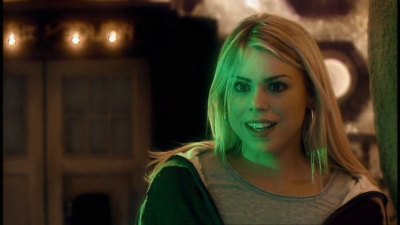
This season opens by recalling a story from a previous incarnation of the Doctor. Like the first story from Jon Pertwee's run, the Autons (though they are never referred to by that name in the episode) are trying to invade the Earth once again. They're taking the place of clothing dummies in department stores in London, including the one that young Rose Tyler (Billie Piper) works in. At closing one evening, Rose goes down in the basement to find the head of maintenance only to stumble upon a group of the plastic invaders. Fearing that their plot has been discovered, the aliens try to kill the hapless woman and would have surely succeeded if not for a lanky stranger with big ears who pops out of nowhere. He manages to save the clerk, blows up the building destroying the menace and then leaves Rose to get home by her own means.
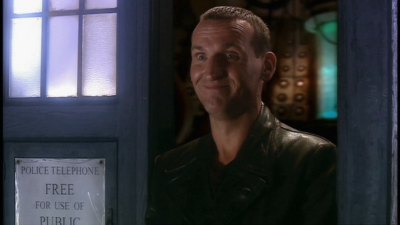
The next day Rose still isn't sure what happened when this odd man, who only identifies himself as "The Doctor" (Christopher Eccleston) shows up once again, this time at her door. It seems that the menace isn't totally eradicate and the mannequin's arm that Rose brought home is still alive and murderous. The mysterious Doctor easily deals with the animated apendage, and Rose, drawn to the dynamic if quirky man, decides to follow him and see if she can figure out just what's going on.
Over the course of the story, Rose makes herself useful and helps the Doctor quite a bit, so when the aliens have been finally vanquished, he invites her to join him in his travels in his time machine, the TARDIS. With a new companion by his side, the traveler through space and time starts a new series of adventures, relying on his wits to solve the problems that seem to crop up where ever he goes. The pair travel to the far into future to see the Earth's destruction when the sun turns into a red giant and into the past to meet Charles Dickens, not to mention saving the present day Earth a couple of times.
Things have changed since the last series ended however. First of all, time has passed, a lot of time. The Doctor is now over 900 years old, and things haven't gone well for him in the intervening years. As is revealed in the second episode, he's the last of the Time Lords. The rest of them are dead, apparently having perished in a horrible war. Being the very last member of his race, and having seen the rest of his people perish, has caused him to be filled with a lot of pain that is always lurking just under the surface. This is a trait that the other Doctors haven't had, and it adds a new dimension to the show. As the series progresses viewers find out what happened to this seemingly all powerful race, and just who was responsible for it.
This is a great revival that takes the strengths of the original show and builds on them while making the series feel fresh, new and inviting to viewers who aren't familiar with the original show. They've updated the show a bit, changing the look of the interior of the TARDIS, changing the logo and modifying the opening music, and making the show more fast paced. One of the biggest changes is in the format of the show. Doctor Who is now an hour long and many of the stories are self contained. There are a couple of two-part episodes, but they've done away with the four and six-part stories that marked the earlier series. All in all this isn't a bad thing. It keeps the show moving along at a good clip and eliminates some of the slower parts that would sometimes plague the longer stories in the original series. (I'm thinking of War Games here.)
Doctor Who has always been an interesting combination of characterization and plot. While the individual stories are often plot driven, (how is the Doctor going to defeat the Daleks and save the world?) the show as a whole was more character driven. People tune in week after week to see what mess the Time Lord is going to get into and how his companion will react. Because of this, the actor playing the Doctor has always had the weight of the show on his shoulders. A poorly executed Doctor can really drag the show down, while an interesting lead can carry every weaker stories.
So how does Christopher Eccleston do in the role? In a word that this Doctor uses frequently, fantastic. Probably best known (in England at least) for his role as DCI David Bilborough in the excellent crime drama Cracker [review here], Eccleston is a very talented actor who has played a wide variety of roles in his career. Watching this first season though, he gives the impression that the Doctor was the role he was born to play. Retaining the eccentric personality of the previous doctors, he makes the role his own by adding a touch of sadness and deep pain as well as more than a dollop of humor. His character can change from childish glee to being intimidatingly intense in a flash and back again. He's extremely confident too, laughing when he says that he has no idea how he's going to get out of a trap, sure that something will pop up.
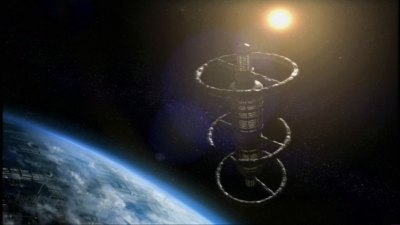
This confidence is infectious and really adds a lot to the show. In one episode Rose has been kidnaped by a powerful alien enemy. There's a fleet of nearly half a million warriors heading towards Earth, and the invaders tell the Doctor that if he attempts to stop them, they'll kill Rose. Against these insurmountable odds, the Doctor stares the alien commander in the face and says "No!"
He continues "This is what I'm gonna do: I'm gonna rescue her. I'm gonna save Rose Tyler from the middle of the [alien] fleet, and then I'm gonna save the Earth. And then, just to finish you off, I'm gonna wipe every last stinking [one of you] out of the sky!
To which the alien commander mocks "But you have no weapons! No defenses! No plan!"
"Yeah, and doesn't that just scare you to death?" replies the Doctor.
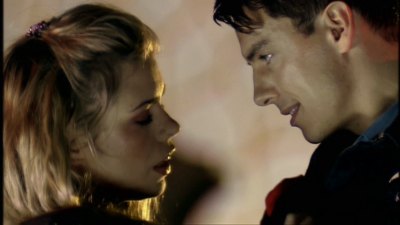
Most American viewers don't know Billie Piper who plays Rose Tyler, but she's a well known face in England. Dubbed the 'Pop Princess', Piper had a string of hit records starting when she was just 15, her first four singles all making the top 5. After her singing career took a nose dive, as it often does for pop stars, Piper turned to acting staring in a BBC production of The Canterbury Tales, and a couple of films. When she was tapped for the role of Rose, most people in the UK were familiar with the young actress.
She does a good, though not outstanding, job as this new Doctor's companion. She's mainly hampered by appearing opposite of Eccleston, who is a much better actor than she is. Still, Piper manages to do a credible job in the role, complementing the Doctor's enthusiasm with a healthy does of scepticism. She's not solely a hostage either, though she does fill that role a few times. Roses has a good amount of pluck, and assists the Doctor in dangerous jobs on more than one occasion.
As much as I enjoyed this series, I have to admit that the writing was a bit uneven. Head writer Russell T Davis wrote a good number of scripts and is certainly responsible for the tone and characterizations that work so well. Unfortunately, the scripts that he penned are the least exciting of the lot. He is great at characterization and dialog, but most of his scripts are just slightly flawed. There will be some aspect that doesn't work as well as it should. A good example is the subplot that runs through the series involving Rose's mother and boyfriend. They stay in London while she's off adventuring with the Doctor, but her frequent visits allow them to worry about her and fuss. This storyline is rather weak and the scenes involving it are the least interesting. His scripts become a bit silly at times, such as in the episode The Aliens of London. In this show the nemisis, the Slitheen family, is marked by extreme flatulence when they are in human form. This is obviously supposed to be comic relief, but it isn't really all that funny.
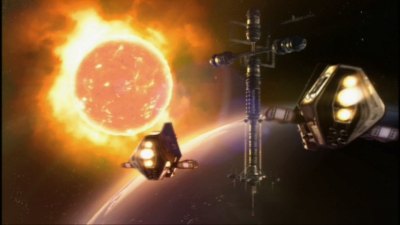
There are a couple of episodes that where very good, but the ending didn't work as well as it should. While the resolution to Father's Day was satisfying, some parts of it didn't make a whole lot of sense. The last story, a two-part season finale, was filled with excitement and edge of your seat suspense, but the deus ex machina ending was a bit of a disappointment.
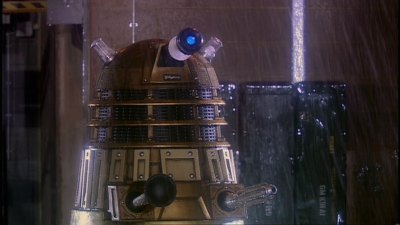
Even the shows that are flawed are fun to watch and very enjoyable, and the shows that manage to sidestep the pitfalls are just plain fantastic. The opening story, Rose, was also a lot of fun and full of surprises. The Empty Child is the most eerie episode of Doctor Who that's every been broadcast, with a child in a gasmask stalking through war time London chasing after homeless waifs asking "Are you my mummie?" The conclusion to that story, The Doctor Dances, is one of best single episodes of Doctor Who ever, with a excellent solution to the perplexing mystery that started in the previous show and a very uplifting conclusion. Dalek, which reintroduces the Doctor's most popular enemy, actually makes the mobile garbage cans seem formidable and dangerous, and the episode where Rose goes back to see her father who died when she was an infant is touching and very memorable.
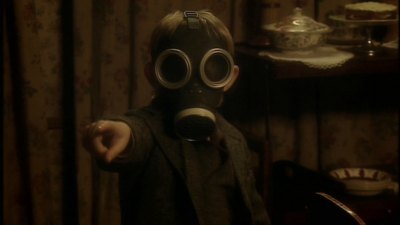
This season also has a fair amount of continuity, with sub-plots evolving over the course of the season. Not only the story about Rose's mother, but also just what happened to the other Time Lords and just who or what 'Bad Wolf' is, a phrase that keeps popping up in different times and places, with ominous implications. This gave the show a bigger feel, like each episode was part of a larger whole.
Another thing that works very well is that the series reminds viewers that, though he looks human, the Doctor is an alien. He's on the Earth, but not part of it; a visitor who is amazed at the things we take for granted. As such he has a nice way of commenting on the human condition (and occasionally waving the Union Jack at the same time.) A good example is in The Empty Child where the Doctor gets to cheer up a young orphan "living rough" in London at the height of the blitz:
1941. Right now, not very far from here the German war machine is rolling up the map of Europe. Country after country, falling like dominoes. Nothing can stop it. Nothing. Until one tiny, damp, little island says "no". No, not here. A mouse in front of a lion. You're amazing, the lot of you. Don't know what you do to Hitler, but you frighten the hell out of me.
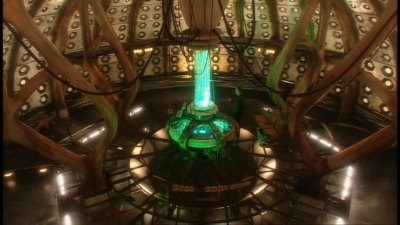
For long time fans of the series, there's also some familiar trappings that are revisited. The TARDIS is still bigger on the inside than it is on the outside, but the interior look has changed pretty dramatically. Gone is the antiseptic white main room, being replaced with a cavernous space with tree-like roots running vertically thought it. The central column still rises and falls as the TARDIS travels, but the control panel looks even more complicated than before.
The Doctor still carries his trusty sonic screwdriver with him and it's as handy as ever. The absurdity of the device is mentioned though, as Captain Jack Harkness (John Barrowman), an ex-time agent from the 51st century, points out: "Who looks at a screwdrivers and thinks 'Ohhh, this could be a bit more sonic.'?"
A great revitalization, this show has all of the charm of the old series while being more palatable for today's viewers. Whether you're an old or new fan, this show has something to offer.
The DVD:
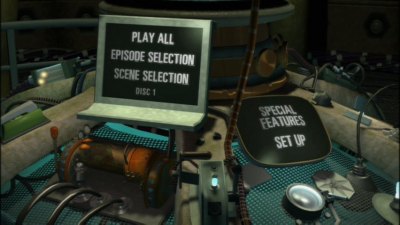
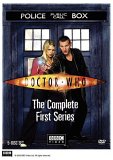
The thirteen episodes that make up this season come on four single-sided DVDs with another disc filled with extras. All five DVDs come in a fold out case that looks like a police box while compacted and shows an image of the inside of the TARDIS when unfolded. A nice looking package, there is also a boolet that has an introduction by head writer Russell T Davis and a synopsis of each episode.
Audio:
The show comes with a 5.1 DD English soundtrack that is overall very good. They make good use of the full soundstage during the action sequences and this is very effective. Hearing a Dalek's metallic voice emerge from all corners of the room makes these villains seem even more intimidating. The one complaint I have with the audio is that sometimes it's a bit too busy which makes it hard to hear the dialog. At the beginning of The Empty Child the Doctor and Rose are chasing an object through the space/time vortex and there's a lot of noise in the TARDIS making it hard to hear what they are saying. On the upside it create a frantic mood, which is what the director was going for.
Video:
The 1.78:1 anamorphic widescreen image is good and quite solid. The image is generally sharp with good contrast. At times the colors are a bit weak, I imagine it was shot that way, and some details are lost in some of the dark scenes but these are minor quibbles. Overall a nice looking set.
Extras:
This set is just packed with extras. First off there is a commentary track on each and every episode with various people involved with the show; writers, directors, and actors. The one conspicuous absence is Christopher Eccleston. He does not appear on any of the commentary tracks, which is too bad. Billie Piper gives her thoughts on two episodes, Father's Day and the last episode of the season, A Parting of the Ways.
In addition to that, each disc has a few other extras too. There's an interview with Christopher Eccleston, a couple of behind the scenes reels, several short items that explain how a particular effect was created, an interview with John Barrowman (Captain Jack Harkness) and several TV commercials advertising the series.
That would be enough to please most fans, but the fifth disc is devoted to a very in depth look behind the scenes of the new show. Doctor Who Confidential, which takes up the entire fifth disc is a 2 hour and 45 minute feature (broken into 14 different episodes) that completely covers the making of this new series. This is an excellent addition to the package and really rounds out the set. These apparently are the edited versions of the show however, with each episode running at about 12 minutes. While I haven't seen the unedited versions, these play very well.
Final Thoughts:
When all is said and done, this a fun, exciting, and eminently enjoyable season. Christopher Eccleston has a lot of fun in the role. Obviously influenced by Tom Baker's take on the role, he brings a good amount of humor to the Doctor while still keeping the show serious. He has quickly become one of my favorite Doctors. The stories are very good, and though there are a few flaws in some shows, the quality is excellent overall. If you've never seen the show before, never feat this set is very accessible to novice viewers, while long time fans will have just as much fun revisiting this classic character. The set is just chocked full of extras too, which were very enjoyable and added a lot to the package. One of the better SF shows I've seen recently, this set is highly recommended.
|



| Popular Reviews |
| Sponsored Links |
|
|
| Sponsored Links |
|
|
| Release List | Reviews | Shop | Newsletter | Forum | DVD Giveaways | Blu-Ray | Advertise |
|
Copyright 2024 DVDTalk.com All Rights Reserved. Legal Info, Privacy Policy, Terms of Use,
Manage Preferences,
Your Privacy Choices 
| |||||||