
| Reviews & Columns |
|
Reviews DVD TV on DVD Blu-ray 4K UHD International DVDs In Theaters Reviews by Studio Video Games Features Collector Series DVDs Easter Egg Database Interviews DVD Talk Radio Feature Articles Columns Anime Talk DVD Savant Horror DVDs The M.O.D. Squad Art House HD Talk Silent DVD
|
 DVD Talk Forum |
|
|
| Resources |
|
DVD Price Search Customer Service #'s RCE Info Links |
|
Columns
  



 
|
|
|
Civilisation - The Complete Series
It's hard to argue with a documentary on art and culture that was as resoundingly popular as the lavish BBC production Civilisation. On its airing in 1969, it was a smash hit, not just in England but even more so in the United States. I'd be the first to agree that it's a very good thing to get people in touch with the larger cultural world, and to give them a sense of the marvelous depth of history and culture that our society is built on. But is this more than 35-year-old documentary going to have anything like the same effect on its DVD release?
I have to admit (with a distinct note of disappointment) that while the concept is very worthwhile, the actual program itself doesn't quite hang together to my eye. Part of the problem is that Civilisation was the forerunner of many other documentaries: it was the first to show that an intellectual topic could be successfully addressed in a lengthy, lavishly produced documentary series. For that, if for nothing else, Civilisation is worth noting. But it's that ground-breaking nature that can explain both its initial success and its awkward aging. There was nothing quite like it before it was made, and it's easy to see how impressive the extensive 13-part series was in 1969. As a new type of program, though, it would have been difficult to know exactly how it would all turn out. In retrospect, I'd say that Civilisation takes on too much, and attempts to synthesize too much, in too short a time. Ambitious, yes - but precisely that ambition makes it problematic.
What is Civilisation? Is it a history program? It's subtitled "A Personal View," which is an honest attempt to indicate that it's not trying to make conclusive statements about the nature of "civilisation." As the title suggests, though, the program does get pulled rapidly into that very attempt. Narrator Kenneth Clark starts out at the very beginning of the first episode by drawing a sharp line between "them" and "us": between the barbarians and the civilized. What is civilization, he asks? He doesn't have a clear answer, he says, but he knows it when he sees it... and he gestures at a looming cathedral in the background. What it turns out he means is refined culture, established empire, monumental architecture... and Western Europe. Islam is mentioned only as a force that overwhelms "civilization"; it is not represented as the highly developed civilization that it was. It's clear from this perspective that what Civilisation is really about is, at a minimum level of distinction, "Christian civilization in Western Europe." Don't get me wrong: that's an enormous subject and one that's certainly well worth a full and loving documentary treatment. But it's biased in the extreme (not to mention historically and culturally short-sighted) to look at this slice of world civilization and take it as the whole thing. Clark does mention, later, the earlier civilizations of Mesopotamia, Greece, India, and the like, so it seems that he's not as narrow-minded as the start of Civilisation suggests, but it would have been much better to put the series in a more historically accurate context from the beginning.
By the end of the program, it becomes more evident that Clark's idea of civilization is more complex than that; he defines civilization still quite loosely, but in terms of creative energy and societies that encourage the development of human faculties. But perhaps by the very fact of dancing around what "civilization" really means, Clark never faces up to the periods of history that he ignores, or all the elements that he's completely left out in the history that he does cover. Later critics would point out - rightfully, I think - that Clark is too concerned with monumental public art, and not enough with other aspects of society and culture. (For what it's worth, Clark conceded the point, but felt that it was still a reasonable approach.) Even within the limits of Clark's approach, there are gaping holes; for instance, as far as Civilisation is concerned, Spain either didn't exist or had no contribution whatsoever to Western culture. The interview with David Attenborough in the special features is particularly revealing on this count: apparently Clark simply couldn't make Spanish culture fit into his view of what civilization was all about, so he simply avoided talking about it at all. The "A Personal View" label attempts to deal with that... but doesn't quite do the job.
I think that has the problem of falling between two stools. On the one hand, it doesn't really work as a history program; it's too broad, and so ends up being shallow, and it's too biased in its interpretation to offer a really convincing analysis of Western civilization... but Clark gives a sense that, with the right material and the space to work with, he could have done an excellent job on that front. For instance, in the final episode, Clark discusses in detail the social and cultural consequences of the Industrial Revolution in England, following through to the challenges facing humanity in the present day of machines and industry. It's interesting material, suggesting that Clark could have had a lot to say of interest if given the chance to explore social and cultural history in more depth, as he doesn't in Civilisation. On the other hand, it doesn't work as a full overview of "civilization" as a whole: it's too narrowly focused on specifically Western culture, and doesn't touch on the vast sweep of time leading up to and including the great Mesopotamian civilizations, Greece, and Rome.
The best way to think of Civilisation is not as a history program, but as an art-appreciation program. This is where Clark excels. Not in explaining historical events or tracing cause and effect; he's often overly simplistic. But when he calls our attention to a finely wrought candlestick, or the carvings on a cathedral, or the artistry of a drawing or sculpture, his genuine love of beauty is evident. Clark has a good eye for detail and for seeing what makes a particular work of art or architecture compelling or memorable. Clark has a keen and valuable insight into the emotional qualities expressed by a work of art, and how art reflects the pressing concerns and underlying characteristics of its age.
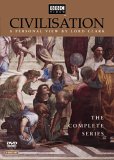
In fact, Civilisation's qualifications as an art program, rather than a history program, is clear in the choice of Kenneth Clark as narrator and writer. He was later given the title of Lord, hence the Lord Clark on the DVD cover, but he's not a "celebrity" host in that way. Clark's qualifications for Civilisation come from his long and illustrious career as an art historian... so we can see that it's no coincidence that the art aspect of Civilisation is handled so much better than the other aspects of it.
Civilisation runs 13 50-minute episodes. The program starts with "The Skin of Our Teeth," covering the Dark Ages (a dreadfully dated and fairly inaccurate label for the Middle Ages...). After that, there is "The Great Thaw" on the re-awakening of Europe's culture in the 12th century, "Romance and Reality" on the late Middle Ages in France and Italy, and "Man: The Measure of All Things" and "The Hero as Artist" on the Italian Renaissance. "Protest and Communication" covers the Reformation, with "Grandeur and Obedience" on the Counter-Reformation. "The Light of Experience" looks at the start of the Enlightenment, followed by "The Pursuit of Happiness" on 18th-century culture, and "The Smile of Reason" on the Enlightenment spreading forward to revolution. "The Worship of Nature" looks at the shift in philosophy toward a love of a nature in the 18th century, while "The Fallacies of Hope" follows Romanticism through disillusionment. Finally, "Heroic Materialism" finishes up with a look at industrialization, materialism, and the future of human society. Clark does a nice job of summing things up, making it clear that he does have an interesting and valuable perspective on the history and culture that he has just wandered through.
The DVD
Civilisation is a four-disc set, packaged in a double-wide keepcase. It comes with a fat booklet that includes some interesting information on the making of the series.
Video
For a program from 1969- and one of the first color programs, to boot - Civilisation doesn't look half bad. While there's certainly some noise and the occasional picture flaw, it looks like the print has been cleaned up for its transfer to DVD. Colors are relatively muted but look natural; the overall image tends to be a bit soft, but as with the color, this is almost certainly how it looked in its original broadcast. In the end, it does look its age to a certain degree, but it also looks a lot better than I'd have expected (perhaps due to it having been filmed on film stock rather than standard television stock... thank the producers of Civilisation for having more forethought than even they expected). The program appears in its original 1.33:1 aspect ratio.
Audio
The sound quality here is satisfactory. It has a rather flat and sometimes rather muted sound, but the clarity is reasonable, and there's no distortion or sound problems. English closed captions are included.
Extras
There's one interesting special feature, on the last disc: a 23-minute interview with David Attenborough on the making of Civilisation. (Though most viewers will know Attenborough as a host of nature documentaries in his own right, he started out working for the BBC and was largely responsible for getting Civilisation on the air.) We also get a behind-the-scenes photo gallery.
Final thoughts
Civilisation didn't live up to my hopes as a history program; oddly it's both too broad and shallow, and too narrowly focused. The "A Personal View" subtitle gives some forewarning in that respect: this really is just one person's take on the subject. A very well-informed and interesting person, to be sure, but just one. On the other hand, if the program is taken as a guided tour of Western art and architecture, it's a worthwhile exploration. I would consider it to be a respectable rental choice if you're interested in European art. Rent it.
|



| Popular Reviews |
| Sponsored Links |
|
|
| Sponsored Links |
|
|
| Release List | Reviews | Shop | Newsletter | Forum | DVD Giveaways | Blu-Ray | Advertise |
|
Copyright 2024 DVDTalk.com All Rights Reserved. Legal Info, Privacy Policy, Terms of Use,
Manage Preferences,
Your Privacy Choices 
| |||||||