
| Reviews & Columns |
|
Reviews DVD TV on DVD Blu-ray 4K UHD International DVDs In Theaters Reviews by Studio Video Games Features Collector Series DVDs Easter Egg Database Interviews DVD Talk Radio Feature Articles Columns Anime Talk DVD Savant Horror DVDs The M.O.D. Squad Art House HD Talk Silent DVD
|
 DVD Talk Forum |
|
|
| Resources |
|
DVD Price Search Customer Service #'s RCE Info Links |
|
Columns
  


 
|
|
|
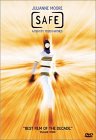
Safe
Todd Haynes is one of the most unique filmmakers working in America today. He initially got attention for his short film Superstar: The Karen Carpenter Story which was officially banned for its unlicensed use of the saccharine music of the Carpenters, but really got under Karen's brother Richard's skin for depicting his sister's slide into anorexia through stop-motion Barbie doll puppeteering. His most recent film, 1998's Velvet Goldmine, depicted the London 70's glam rock scene as teeming with all the ambiguous sexuality that went with it. His break-through feature film, 1995's Safe, turns the idea of modern domesticity on its head.
Safe stars Julianne Moore in an amazing performance as Carol White, a rich housewife who barely exists in the real world. She floats through her life, from one of the creepiest sex scenes on film to her daily rituals (aerobics class, dry cleaner, furniture ordering) with a sense of disconnect that makes her seem like a ghost. Slowly she starts to almost wilt from exposure to the real world. A blast of truck exhaust fumes causes an uncontrollable coughing fit and hair salon chemicals give her a nose-bleed. The film fetishizes the chemicals that she (and we) take for granted on a daily basis, like spray-on deodorant and additives in our food. After visiting her doctor and psychiatrist, neither of which are much help, she sees a dead-on new age infommercial and decides that she has chemical sensitivity and changes her diet and lifestyle to include an oxygen tank and a sterile "safe room" in the garage. In the film's final act Carol journeys to Wrenwood, a new age safe haven for chemically sensitive folks who can no longer function in regular society.
While the film does take an easy swipe at the self-serving new age guru who runs the retreat, the rest of the film makes for a totally unconventional atmosphere. Haynes wants us to be critical of Carol and her lifestyle, to see just how empty and mindless it is, but he also wants us to have deep sympathy for her. She is so frail and, as played by Moore, increasingly seems like a little girl. Her voice stays at an even, soft pitch that rises slightly at the end of each sentence making everything she says sound unsure and questioning. She carries herself in a vulnerable way and seems to be consumed by her clothes and hair. There are times when she is so still and her eyes so vacant that she looks like a doll.
The film itself seems to play out very cautiously. There is very little camera motion and so many scenes play out in master shots that cuts feel like seismic shifts. Haynes takes a cue from Stanley Kubrick and composes many shots to isolate poor Carol in a sea of indifference. In a telling early shot Carol enters her house in a very wide shot and approaches the camera. As she draws closer, however, the camera starts to track backwards, away from her, as if not to allow her to get too close. The film reflects her own life back onto her.
Safe is paced unlike just about any other film. Many scenes are very quiet with little motion or action at all. The details, a restaurant by a busy street or couch with the wrong color, tell the story. Some viewers may find the film slow to the point of being inert, but then suddenly Carol is lying on the ground, shuddering with spasms brought on by a cleaning solution, or sitting at a baby shower, gasping for breath, unable to breathe the still, claustrophobic air of suburban life anymore. The film, while filled with dramatic elements, is a deep, dark comedy with the human body as the joke. Carol's ambivalence about her life and her meek little attempts to fit in are pathetic and funny at the same time. The film never really answers the question of whether Carol's condition is psychosomatic or environmental but the idea that she can't survive in the bustling modern world is very real. The fear of disease and bodily invasion is particularly potent when taken in the context of viral disasters like AIDS, which is subtly referenced early on. Haynes puts Carol's situation in the context of a world where a person's own body can betray them. The talk of immune systems failing and the need to get safe creates this sense that there is a world of contamination waiting to victimize all of us.
VIDEO:
Safe was produced on a shoe-string budget, considering the ambitiousness of the scope of the project. Alex Nepomniaschy's cinematography, however, is key to this unique movie and the anamorphic transfer here is fairly good. Flecks of dirt appear throughout at regular intervals and little bits of print damage are occasionally evident. The compression itself seems to have been handled ok, but this is not one of the sharper, more vibrant renderings of a film that I've seen lately.
There were a couple of instances where I thought I detected the film shaking a little bit and wasn't sure if there was a problem with the print or if the camera got jostled. After listening to the commentary, however, it seems like these might have been caused by aftershocks from a then-recent LA earthquake. It seems inconceivable that tremors like that would have made their way into a finished film, but there it is. It's actually weirdly fitting for a film about the self-deluding fakeness of life in Los Angeles.
AUDIO:
The Dolby Digital 2.0 audio is fine. Much of the film is extremely quiet and the sound design is very subtle. Ed Tomney's score sounds nice considering the modest nature of the mix.
EXTRAS:
The only significant extra is a commentary track from director Haynes, star Moore, and producer Christine Vachon. This is a loose, conversational track that discusses numerous aspects of the film, from the script to casting and the shoot. Moore says early on that she has actually never seen the film in its finished form and Haynes is relieved to be releasing the film in its original aspect ratio. While there are long sequences where the contributors are just watching the film there are a lot of things to be learned here and overall the track is very entertaining. It is obvious that all of the contributors keep a special place in their hearts for sad old Carol and they constantly laugh at her predicament. A lively and informative track.
Trailers are available for Safe and The End of the Affair, which also starred Moore.
FINAL THOUGHTS:
Safe examines a set of circumstances in modern life that few other films have looked at. The combination of upper-middle class malaise with chemically-induced illness and disease paranoia speaks to a lot of modern fears. That Haynes was able to combine these elements with the blackest of comedy proves him a fascinating and intelligent filmmaker.
|



| Popular Reviews |
| Sponsored Links |
|
|
| Sponsored Links |
|
|
| Release List | Reviews | Shop | Newsletter | Forum | DVD Giveaways | Blu-Ray | Advertise |
|
Copyright 2024 DVDTalk.com All Rights Reserved. Legal Info, Privacy Policy, Terms of Use,
Manage Preferences,
Your Privacy Choices 
| |||||||