
| Reviews & Columns |
|
Reviews DVD TV on DVD Blu-ray 4K UHD International DVDs In Theaters Reviews by Studio Video Games Features Collector Series DVDs Easter Egg Database Interviews DVD Talk Radio Feature Articles Columns Anime Talk DVD Savant Horror DVDs The M.O.D. Squad Art House HD Talk Silent DVD
|
 DVD Talk Forum |
|
|
| Resources |
|
DVD Price Search Customer Service #'s RCE Info Links |
|
Columns
  


 
|
|
|
Ruth Rendell Mysteries, Set 1, The
Ruth Rendell doesn't have the name recognition of a, say, Agatha Christie, but she's a writer who has claimed a solid place in the modern mystery genre. It's no surprise, then, to see her work be adapted for television. In The Ruth Rendell Mysteries, Set 1, we get four of her stories: it's a chance for new viewers to get a taste of her work, while fans of Rendell's work will be interested in seeing her work brought to life. Rendell is interesting in that she's not the typical "mystery" writer. Really, she's more of what I'd call a "suspense" writer: there may or may not be an actual mystery puzzle to be solved, and there may or may not be a detective involved, but one thing is for sure: there's something weird going on.
Set 1 contains four separate episodes: "Master of the Moor," "Vanity Dies Hard," "The Secret House of Death," and "The Double." One thing that's interesting here is that the length of the episodes varies, depending on the complexity of the story (something that other mystery series would do well to consider). Both "Master of the Moor" and "Vanity Dies Hard" run about 155 minutes, each divided into three parts, while "The Secret House of Death" (103 minutes) runs in two parts; all three of episodes are based on novels. "The Double," based on a short story, is only one part, at 51 minutes.
The blend of suspense and mystery gives us a variety of settings and stories. In "Master of the Moor," Colin Firth gets the title role as a loner whose affinity for wandering around the moors makes him the prime suspect when bodies start turning up. "Vanity Dies Hard" follows two friends, one of whom finds happiness in marriage while the other struggles with poverty; when one woman disappears, the other is determined to figure out what happened. "The Secret House of Death" also sets up a tangle of intrigue and dark, hidden motives, which the main character stumbles into when she stumbles across the dead bodies of two of her neighbors. "The Double" takes a turn for the weirder, as the young and innocent Lisa, on the verge of marriage to a rising stockbroker, is distressed by a superstition involving what seems to be her "double."
It's apparent that Rendell's stories are focused on the psychological aspects of the story, rather than on the "whodunit" aspect. That gives these stories a different flavor, but it also makes it more of a challenge to have the stories succeed on-screen. While I appreciated the intent behind each of the stories in the collection, the it's pretty hit-or-miss when it comes to how well they actually work as stories. Some of them are successfully weird and surreal, in the sense that they deal with dysfunctional people doing very strange things; others are just weird and overly complicated. "The Double" is the worst of the lot in that respect; it may have worked as a mood piece in its original form as a short story, but in contrast to the other episodes, which have actual plots, "The Double" ends up as a muddled mess.
There are some solid actors here (especially Colin Firth in "Master of the Moor" and Jason Flemyng in "The Double") but there's also a general tendency for overacting across the board. It's unfortunate to see the characters come across as fairly one-dimensional, when I get the sense that they're intended to have a greater psychological depth.
The filmmakers' approach to conveying suspense is very heavy-handed, making use of all the tricks in the book to get the reader tense. I found my reaction to be curiously mixed. On the one hand, I recognized the way that the program was blatantly pulling strings... on the other hand, it was still making me jumpy. In the end, I had a half-annoyed reaction to the suspense: I was oddly irritated that the show was managing to get a reaction out of me even while I recognized how my reaction was being orchestrated. The upshot is that viewers should consider what kind of reaction they typically have to suspense. If you find it very easy to just go with the flow, then you'll probably enjoy the atmosphere created in these episodes; if you tend to be critical and notice elements of the program as soon as they get a little bit artificial, then the suspense balloon will probably never lift off.
The DVD
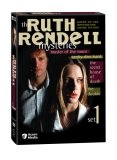
The Ruth Rendell Mysteries: Set 1 is a three-DVD set, with each disc in its own ultra-slim keepcase, and all three discs inside a glossy paperboard slipcover.
Video
Though the episodes are not all that old (1993-1996), I wasn't impressed by the image quality. All the episodes appear in their original 1.33:1 aspect ratio. The image is very grainy in all the episodes, with a lot of noise. Colors are usually bright and vibrant, but the tones seem a bit off, with a slightly orangey cast to the image at times. Contrast is handled adequately in the well-lit scenes, but when it's dark, the contrast is too heavy and we get much more black on-screen than we should. I also felt that a few times, the image looked just a little bit stretched, as if the aspect ratio were off by a tiny bit: I couldn't quite put my finger on it, in the few scenes that this appeared in (in "The Double") but certainly a few scenes looked just a bit "off."
Audio
The stereo soundtrack is adequately clear and clean when the dialogue is at normal volumes. When the volume goes down, though, as when the characters are in quiet conversation, the track gets a little bit muffled-sounding.
Extras
The only special features are a text biography of Ruth Rendell and cast filmographies.
Final thoughts
The Ruth Rendell Mysteries may be worth checking out if you are already a fan of Rendell's stories, or if you are looking for a moodier, more surreal alternative to traditional detective-story fare. It's not nearly as well done as it could be - I'd rank it as average at best - though, so I'll only give it a mild "rent it" rating.
|



| Popular Reviews |
| Sponsored Links |
|
|
| Sponsored Links |
|
|
| Release List | Reviews | Shop | Newsletter | Forum | DVD Giveaways | Blu-Ray | Advertise |
|
Copyright 2024 DVDTalk.com All Rights Reserved. Legal Info, Privacy Policy, Terms of Use,
Manage Preferences,
Your Privacy Choices 
| |||||||