
| Reviews & Columns |
|
Reviews DVD TV on DVD Blu-ray 4K UHD International DVDs In Theaters Reviews by Studio Video Games Features Collector Series DVDs Easter Egg Database Interviews DVD Talk Radio Feature Articles Columns Anime Talk DVD Savant Horror DVDs The M.O.D. Squad Art House HD Talk Silent DVD
|
 DVD Talk Forum |
|
|
| Resources |
|
DVD Price Search Customer Service #'s RCE Info Links |
|
Columns
  


 
|
|
|
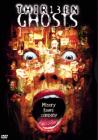
13 Ghosts
Everyone's favorite fast-buck horrormeister William Castle had a checkered career. He started out as a promising director with the occasional excellent sleeper hit (When Strangers Marry) hidden in his filmography. At the same time that Robert Aldrich was paying his assistant's dues, Castle was also working as an assistant director for luminaries such as Orson Welles, on The Lady from Shanghai. By now most fans are well aware of his string of horror-lite hits, that relied on clever gimmicks to distinguish themselves: insurance policies against dying while watching the movie, real props suspended in the air over the theater audience, chairs wired for vibrating motors, audience-participation polls. He tagged his gimmicks with words like Emergo and Percepto, names that stayed in the memory of impressionable and imaginative moviegoers longer than the movies themselves did. Castle was deified in Joe Dante's wonderful 1993 movie Matinee, which reinvented the huckster as a joyful showman every bit as impressionable and imaginative as the kids he catered to. 13 Ghosts was one of his biggest hits, and one of the few where his gimmick was actually seen in most of the theaters where the film played. 1
After the strange and original The Tingler, which advanced the idea of fun above story logic, 2 Castle and his unsung writer Robb White made 13 Ghosts a very light show without much sense at all. The scares all came from the moaning ghosts on the soundtrack and the gimmick itself, which every kid alive at the time remembers in detail. Probably fed up with her little brother while on vacation, Savant's sister went to see 13 Ghosts without him, and came back with one of the viewers, reporting that it was 'really scary.' Savant stared at the 'Illusion-O' glasses, wondering what it was all about ... older sisters never explained anything in detail back then.
Thanks to this DVD, Illusion-O is back in all its glory. One side of the disc is the straight movie with no gimmick, so if you start playing the film and the title sequence is not in color, stop and flip. The single viewer supplied looks something like 3-D glasses, but with the red & blue filters placed over and under instead of side-by side. 3 Every Illusion-O sequence is printed in color, with the ghosts a colored overlay. View through the red gel, and the ghosts are visible. Watch through the blue, and they disappear (well, almost). Of course, this caused some confusion in theaters because the ghosts were plainly visible without the glasses. The erasing gag did work, however, and was a fun novelty. The benefit of all this hoo-haw in 1960 was word-of-mouth enthusiasm. 13 Ghosts was a must-see movie, and the gimmick made a mostly tame film into a boxoffice sensation.
The show itself is an amusing oddity. The cast is good, with young Charles Herbert carrying the main role quite well. The rest of the Zorba family are so eccentric that you wonder if writer Robb White were trying to perpetrate some kind of inside joke, naming the daughter Medea, etcetera. The general thesping style in the film is so bland and cheerfully blasé, you'd think that everyone had been lobotomized, as if this were a satire on television families. White and Castle may have been trying for something like this, but if so, it's far too subtle. It actually adds to the tension when you're constantly thinking, "Is this for real?" Margaret Hamilton is underused, but makes a fine red herring; Martin Milner is the obvious villain. Dad Donald Woods and Mom Rosemary DeCamp (love her voice) remain calm beyond all reason. Events become surreal when the family grossly underreacts to real manifestations of ghosts and possible mayhem, and weathers the various threats as if they were minor annoyances. Since the movie is so consistently played along these lines, we watch in amused befuddlement, wondering if this disproportion is going to be part of some big surprise resolution. No such resolution ever happens. This is the kind of subtle WEIRDNESS in 13 Ghosts that's hard to describe. It doesn't make the movie any better (and it's not a film that holds up very well after you've seen it 2 or three times), but it is a puzzlement. Did White and Castle know what they were doing, or is this all just a gentle tug at our pant legs?
Columbia TriStar's DVD of 13 Ghosts is finally restored to its full Illusion-O majesty, for the curiosity of all. The picture quality changes during the special sequences, which were filmed on different Eastmancolor stock but were apparently not too difficult to restore. 4 Overall the 16:9-enhanced picture is excellent. Extras include a very educational short docu by Jeffrey Schwarz that smartly nails its subject; the Castle introduction showing you how to use the Ghost Viewer; trailers, notes, and a Spanish soundtrack.
On a scale of Excellent, Good, Fair, and Poor,
13 Ghosts rates:
Movie: Good
Video: Excellent
Sound: Excellent
Supplements: docu, "The Making of Illusion-0", notes, trailers, original William Castle intro.
Packaging: Amaray case
Reviewed: September 16, 2001
Footnotes:
1. Although all the advertising for House on Haunted Hill and The Tingler prominently featured the gimmick, very few theaters were ever wired for 'Percepto' chair buzzers or rigged for 'Emergo' flying skeletons. The poster for The Tingler just showed a theater chair, which promised the scary thought of some kind of REAL audience participation. Since people screamed in the movie, we kids assumed that only a few chairs could be outfitted for the gag, and that we hadn't been so lucky as to be seated in one.
Return
2. One of Tim Lucas' very best brainstorms in his magazine Video Watchdog was his perception of a big mystery in The Tingler. His theory is that Columbia thought the tone of the show too black and too 'dangerous', and that a clever reshoot of certain scenes was undertaken to lighten things up, to make Vincent Price a terrified hero instead of a diabolical villain. As finished, the movie plays straight until the third act, whereupon things simply don't make sense, especially in hindsight: the deaf-mute woman's hallucinations, the actions of her husband, carrying a body across town for a secret autopsy - and then taking it back home again? The movie ends without a real resolution, relying on sheer fun to carry it through. Lucas simply reasoned through the logic of Robb White's careful story setup, and realized that Price's now-isolated LSD session was originally just the first use of the drug. The deaf-mute woman's husband used LSD on her as well, which would account for the surreal scares in the bathroom and other 'impossible' occurrances. Also, Lucas thinks Price may originally have actually shot his wife dead, and that the Tingler was returned to HER body to dwindle and die, not the deaf-mute lady's. It's just a fascinatingly clever piece of film detection by Lucas, the kind of thing that made Watchdog a must-read. I wish I could get my hands on an original shooting script!
Return
3. Savant found the viewer provided with the disc to be rather on the small side, but adequate. A coupon provided offers to sell you more at an exhorbitant 2.95 each.
Return
4. Wayne Schmidt, who did the film restoration at Columbia, said that the elements for the Illusion-O version of 13 Ghosts were intact and that the photochemical production of new prints, etc., required some trial and error but basically went off without a hitch. The only problem was explaining the 'process' to the eager marketing people, who thought Illusion-O was 3-D or something. The Tingler was much more problematic in that all the original 35mm elements for that movie's color sequence had faded terribly. When faded to red, the bathtub effect just didn't work. A 16mm IN had to be used, instead. It's great that Columbia has the oomph in its DVD division to pursue these oddball restoration problems; these can't be million-selling DVD titles we're talking about.
Return
| |
|



| Popular Reviews |
| Sponsored Links |
|
|
| Sponsored Links |
|
|
| Release List | Reviews | Shop | Newsletter | Forum | DVD Giveaways | Blu-Ray | Advertise |
|
Copyright 2024 DVDTalk.com All Rights Reserved. Legal Info, Privacy Policy, Terms of Use,
Manage Preferences,
Your Privacy Choices 
| |||||||