
| Reviews & Columns |
|
Reviews DVD TV on DVD Blu-ray 4K UHD International DVDs In Theaters Reviews by Studio Video Games Features Collector Series DVDs Easter Egg Database Interviews DVD Talk Radio Feature Articles Columns Anime Talk DVD Savant Horror DVDs The M.O.D. Squad Art House HD Talk Silent DVD
|
 DVD Talk Forum |
|
|
| Resources |
|
DVD Price Search Customer Service #'s RCE Info Links |
|
Columns
  


|
|
|
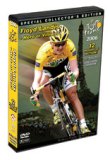
2006 Tour de France: Floyd Landis - Hero or Villain? (Extended 12-hour version)
"Hero or Villain" is an appropriate title for the 2006 Tour de France, with its intense drama both during and after the race. There's no middle ground: either Floyd Landis is an incredibly inspiring example of determination, courage, and talent, or he's a cheat, a devastating blow to the credibility of the sport of cycle racing. Which is it? He vehemently insists that he's innocent, despite failing a drug test. Meanwhile, the official title of winner bounced from Landis to the second-place finisher, and then tentatively back to Landis while he appeals. The DVD coverage of the 2006 Tour de France gives viewers the chance to see the action of the race firsthand and draw their own conclusions about Landis. It's also a thrilling race on other counts: one of the benefits of sitting back to watch the Tour again after the fact is being able to savor the excitement delivered by all the other riders in this grueling, three-week race. World Cycling Productions offers viewers the choice of a four-hour version or an extended twelve-hour set that covers the action in more detail. The review of the race overall is the same as I wrote for the four-hour review; if you're interested in some specifics about the twelve-hour set, jump down to the end of the review.
The 2006 Tour started out with a bombshell to begin with. The start list was dramatically altered when the Spanish authorities revealed the results of their "Operacion Puerto" anti-doping investigations. The backlash from the teams of the named riders was immediate: many of the top challengers were yanked from the race. Jan Ullrich, Ivan Basso, Francisco Mancebo, Joseba Beloki, and Oscar Sevilla were all sent packing, leaving a power vacuum the likes of which hadn't been seen since 1998's Tour (in which the Spanish teams pulled out to protest heavy-handed anti-doping police raids).
Who's who in the Tour? The 2006 Tour is actually surprisingly full of American riders, all glad of a little sunshine after seven years of being in Lance Armstrong's heavy shadow. After a devastating bike failure in the spring wiped out his Paris-Roubaix hopes, Discovery Channel rider George Hincapie is poised to do something exciting (though he's always super mellow about whatever he does. I like George. Who doesn't?). Not to strive for the yellow jersey, but perhaps to show off on individual stages, or maybe just support Jose Azevedo or Paolo Salvoldelli. Gerolsteiner fields Levi Leipheimer, a talented rider whom I like but never viewed as yellow-jersey material. Fred Rodriguez, riding for Davitamon, might not be a major player in the overall standings but could work some magic in individual stages. CSC's Bobby Julich reached the podium in 1998, but is this his year to do better? And then there's Phonak's Floyd Landis - a rider who generated some early buzz. Could this be the next American winner of the Tour?
With heavyweights Ullrich and Basso out of the way (unfortunately) the field is wide open and exciting (fortunately). Alejandro Valverde has had a fired-up Spring Classics season; what could he do in a Grand Tour? Fellow Classics star Tom Boonen is in the field as well, but while Boonen is clearly a man for the sprints and the green points jersey, Valverde is arguably a man for all seasons. As is, conceivably, Erik Zabel. (OK, maybe not. But stranger things have happened, and Zabel is one of my favorite riders.) Veteran stage-race champion Gilberto Simoni, along with fellow Italian Damiano Cunego, are worth watching. In fact, there are quite a few riders to watch... along with all the others who might find the right moment to leap out of the shadows.
The 2006 Tour route is a tough one, balancing out challenging mountain stages with two long, flat time trials; it's the kind of route that opens up possibilities for well-rounded riders, rather than handing off the leader's jersey to a climber for sure. Of course, the mountain stages are of great interest to viewers, since that's where a lot of the drama happens. So let's take a look at the mountain stages: Stage 10, including the Col de Marie Blanque; Stage 11, with the Tourmalet (unfortunately early in the day) and four other climbs; Stage 15, with L'Alpe d'Huez; Stage 16, with the Col du Galibier (again early in the stage); and Stage 17, with five climbs. Time trials are also key points for the switching around of the yellow jersey, and we get the prologue as well as one on Stage 7 and another on the penultimate day, Stage 19.
The first week of the Tour is quite exciting: it's been a long time since we've had actual, you know, suspense about who might finish in yellow. For the past few years, it's been pretty obvious that whoever was wearing the yellow jersey in the first week was just borrowing it from Armstrong, until such time as he decided to make his move. Finally, though, we have a jersey that's up for grabs, and it makes these early stages much more interesting. Stage 13 gives a preview of what kind of stunning come-back is possible in the Tour, when Oscar Pereiro came back from being down 29 minutes in the general classification to jump into the yellow jersey. Yes, that's 29 minutes, almost half an hour, and for a serious contender to boot, not just some domestique whom everyone knows will crumble in the next day's racing. The middle stages with the mountains are exciting, and the final week with its time trial and sprint stages (and continued possibility of the yellow jersey changing hands) is exciting as well.
But the epic center of the 2006 Tour is at Stages 16 and 17, where we see Floyd Landis' crippling, potentially Tour-losing drop of eight minutes... and his eye-popping recovery to burst back into yellow. There's really no way to describe just how amazing his performance is - it has to be seen to be believed.
What makes Landis' performance all the more inspiring is that all the time that he was riding, he was in incredible pain from a deteriorating hip joint. After a crash during training several years before, Landis had been suffering from osteonecrosis, causing his hip joint to literally wear away, with bone grating on bone. (Landis had surgery to replace his hip in September of 2006.) He kept the injury secret from his rivals and even from his teammates until during the Tour, when it was probably inevitable that it would be discovered at some point anyway, since he was allowed to take cortisone, an otherwise prohibited drug, for the injury. As an athlete myself, I know a little bit about what it's like to compete while suffering from injury (and how frustrating and difficult it is to continue to perform at a high level with ongoing pain). I can't even imagine how mentally tough Landis had to be, in order to ride the most physically grueling race on the calendar while suffering from a mostly-destroyed hip joint. And while it's just this reviewer's opinion, not backed up by any particular evidence, and not claiming to be definitive... I think that if Landis had the sheer willpower to train and race day in and day out, and to ride in the Tour, while dealing with that kind of pain, we're looking at a triumph of persistence and determination, not doping. Was Landis clean? I don't know. But I don't think he won the Tour by doping - I think he won it by courage. So, hero or villain? You decide.
For WCP's DVD coverage, we get Phil Liggett and Paul Sherwen commenting on the live race action, and Gary Imlach reprising his role as overall commentator. Imlach does a nice job of handling the transitions and providing background information, with a sense of humor that adds charm but doesn't go overboard. But of course it's Phil and Paul who steal the show, as always, with their enthusiastic play-by-play commentating. You gotta love 'em: they've been doing this for years - especially Phil -- and yet they get just as excited about every great move in the race as if it were the first time they'd ever seen such a thing. Phil in particular goes totally ballistic during the sprint finishes, and it's wonderful - he captures the energy and thrill of the sprint so that you feel like you're the one hammering the pedals to get across the line.
The 12-hour edition
World Cycling Productions puts out a four-hour and a twelve-hour version of the race. The twelve-hour version is split across six DVDs, and devotes its extra time to certain key stages of the race. For viewers interested in exactly what's here that's not in the four-hour version, here's the breakdown. Stages that are listed in bold include extra footage not in the four-hour version.
Prologue: Individual time trial. 17 minutes
Stage 1: 9 minutes
Stage 2: 4 minutes
Stage 3: 9 minutes
Stage 4: 6 minutes
Stage 5: 5 minutes
Stage 6: 9 minutes
Stage 7: Individual time trial. 10 minutes
Stage 8: 13 minutes
Stage 9: 5 minutes
Stage 10: Mountain stage, Cambo-les-Bains - Pau. 5 minutes
Stage 11: Mountain stage. Tarbes - Val d'Aran/Pla-de-Beret. 1 hour 46 minutes
Stage 12: 7 minutes
Stage 13: 9 minutes
Stage 14: 9 minutes
Stage 15: Mountain stage. Gap - L'Alpe d'Huez. 1 hour 54 minutes
Stage 16: Mountain stage. Le Bourg d'Oisans - La Toissuire. 2 hours 31 minutes
Stage 17: Mountain stage. Saint-Jean-de-Maurienne - Morzine. 3 hours 17 minutes
Stage 18: 5 minutes
Stage 19: Individual time trial. 12 minutes
Stage 20: 14 minutes
As you can see, by far the majority of the extended footage comes in the three crucial stages of 15, 16, and 17, where the most compelling drama of the 2006 Tour played out. It's nice to see, though, that some of the other stages are fleshed out a little bit as well; it makes for a more well-rounded viewing experience overall. One nice touch in the handling of the extra-long stages is that, when a stage is split over two discs, the coverage on the following DVD repeats the last 30 seconds of the footage from the end of the previous DVD. As a result, the transition from one disc to the next is smoother than we've seen in previous Tour DVDs.
The question is, of course, whether you want to have the more condensed 4-hour version (although four hours is still a very solid package of racing!) or whether you want to have the no-holds-barred 12-hour version. It really boils down to your own inclinations as a race fan, because the 12-hour DVD set is, like the 4-hour set, very nicely put together. I think that WCP has gotten the hang of doing these extended race DVDs, recognizing that for the most part it's the serious fan who'll be buying them; what we get is just lots and lots of racing.
Watching the 12-hour Tour DVD calls for a certain commitment (two or three hours for a single stage!) but in doing so, replicates more of the feeling of watching it live, with the action of the race unfolding in front of you in real time. Obviously that's not the case in reality, since the stages here are edited to a watchable length, but it feels very much like it. (It's worth noting that the climactic Stage 17 is, uniquely, given over three hours. It's not quite the "entirety" of the stage, as the promotional material claims, since there wouldn't even have been television coverage of all 5+ hours of the stage, but it's certainly the entirety of the action of the day: the first hour or two is generally a warmup for the riders. Here we really do get a "live" feel for the race.) In the end, whether you opt for the 4-hour or the 12-hour Tour DVD depends on how in-depth you want your race experience to be, because both DVDs deliver the product as promised: an exciting race, with solid commentary. If you're a Tour fan, you'll win either way.
The DVD
The 12-hour Tour DVD is a 6-disc set, nicely packaged in a double-wide plastic keepcase.
Video
The digital age hasn't been all that kind to cycle race footage; the image overall that we're getting from the television broadcasts just isn't as sharp and clear as it could be and sometimes was when we had analog transmissions. Colors are bright and clean, but the overall appearance is heavily pixellated; the shots of the racing tend to look soft, especially when the camera pulls away. This isn't an issue of the DVD transfer, though; the transfer itself is clean and problem-free, and WCP's footage of interviews, race results, maps, and so on look crisp and sharp.
Audio
The stereo soundtrack is clean and clear, with no problems showing up. All the commentators come across cleanly and clearly, and the race ambiance is nicely presented as well. This is a nice clean audio presentation.
Extras
The special features here are fairly interesting. Disc 1 has a 4-minute post-retirement interview with Lance Armstrong, a 7-minute interview with David Millar, who was re-entering competition after serving a two-year suspension; and a brief but entertaining set of clips from past races illustrating the "Curse of the Yellow Jersey." Disc 2 has a 5-minute segment on T-Mobile's preparation for the Tour (while they still thought they'd be fielding Ullrich). Disc 3 has a 3-minute interview with Robbie Ventura, Floyd Landis' coach. Disc 4 has a 2-minute interview with British rider Bradley Wiggins, who was participating in his first Tour, and a 3-minute piece on "How He Won It" in which Chris Boardman analyzes Landis' Stage 17 performance. Finally, Disc 5 has a total of four minutes with Phil Liggett, Paul Sherwen, and Chris Boardman answering questions that viewers sent in by email; they're fairly interesting questions and it's a section worth watching even if you're an experienced racing fan.
There's also a start list with all the teams and riders, printed on the inside of the DVD cover insert; it's nicely done with miniature illustrations of the team jerseys in full color.
Final thoughts
The 2006 Tour de France was a Tour to remember - the only question facing cycle racing fans is whether to remember it with the shorter 4-hour DVD or pull out all the stops with this massive 12-hour set? If you're looking for a faster-paced trip through the three-week Tour, the 4-hour set would be the best choice, while if you're hankering to get all the action and to really feel like you're there, seeing the stages live and sweating alongside the riders, then the 12-hour set has your name on it. The 12-hour set is nicely put together for the serious racing fan, with loads of coverage of the make-or-break stages of this year's Tour, and with some fleshing out of the other stages as well. The additional special features are a nice touch; they're interesting to watch and it's nice to be able to choose them from the special features menu as opposed to having them built into the race coverage. Overall this is a solid DVD set for hardcore cycling fans, and deserves a "Highly recommended" rating.
|



| Popular Reviews |
| Sponsored Links |
|
|
| Sponsored Links |
|
|
| Release List | Reviews | Shop | Newsletter | Forum | DVD Giveaways | Blu-Ray | Advertise |
|
Copyright 2024 DVDTalk.com All Rights Reserved. Legal Info, Privacy Policy, Terms of Use,
Manage Preferences,
Your Privacy Choices 
| |||||||