
| Reviews & Columns |
|
Reviews DVD TV on DVD Blu-ray 4K UHD International DVDs In Theaters Reviews by Studio Video Games Features Collector Series DVDs Easter Egg Database Interviews DVD Talk Radio Feature Articles Columns Anime Talk DVD Savant Horror DVDs The M.O.D. Squad Art House HD Talk Silent DVD
|
 DVD Talk Forum |
|
|
| Resources |
|
DVD Price Search Customer Service #'s RCE Info Links |
|
Columns
  


 
|
|
|
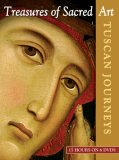
Treasures of Sacred Art: Tuscan Journeys
Treasures of Sacred Art: Tuscan Journeys takes viewers on an extensive tour through the Christian art and architecture of Tuscany, from Florence to Siena to Pisa and more. It's quite an extensive set, with 30 half-hour episodes over six DVDs; the question is, is it worth spending the time on this Tuscan journey? The answer depends on what you're looking for.
Tuscan Journeys is essentially a set of filmed museum visits, loosely tied together by tourist wanderings from one town to the next. In many of the locations visited in the program, the episode does in fact literally take the viewer on a tour through a museum: many of the churches in Tuscany have small art collections or associated mini-museums for the public. Even in the locations that aren't literally museums, the programs take a museum-tour-like approach, wandering through the area and stopping to admire the works of art as they're come upon.
The result is that Tuscan Journeys is both very rich and very shallow, at the same time. The richness comes from the sheer quantity of amazing art that we get to see: in churches, cathedrals, monasteries, abbeys, and so on, we see sculpture, decoration, frescoes, and paintings from master after master. Clearly, the patrimony of Christian art in Tuscany is incredible, and in its 15 hours, Tuscan Journeys fits quite a lot of it in.
The shallowness, though, comes from the fact that the museum-visit approach gives us, the viewers, very little information about the masterpieces of art that we're viewing. Yes, the voiceover tells us who painted such-and-such a piece, and offers some words of appreciation, but that's about it. We don't get any information about the history behind the pieces, how the different compositions relate to each other or how the artistic traditions developed, or any real sense of how these pieces - so important to the life of their day - fit into the culture. The narrator will make comments such as remarking that such-and-such a fresco is "very interesting"... and then leave it at that. Interesting in what way? More interesting than the other pieces, for what reason? We aren't told! It's a frustrating experience, because it ends up reducing all these masterpieces to "pretty things to look at"; these incredibly moving and powerful pieces of religious art lose much of their power by being so thoroughly out of context. (In general, the script is not a marvel of good writing. For example, at one point, an impressive cathedral is referred to - apparently in praise - as a "Gothic mastodon.")
That's not to say that we can't develop a great aesthetic appreciation for a piece of art unless we know how it fits into history; in fact, the beauty of many of the pieces of art and architecture displayed in Tuscan Journeys is precisely how they transcend history to touch us even in the modern day and in a different culture. But to develop that kind of appreciation, we'd need to spend sufficient time looking at a particular piece: observing it, responding to it, absorbing its details and developing an overall emotional and intellectual reaction to it. That, in fact, is what a person can do on his or her own in a museum: sit down on one of those benches and look at a particular piece for a sustained period of time. However, Tuscan Journeys puts viewers in the position of being guests on a guided tour, pausing before each piece briefly and then shuttling the group to the next one. In that sense, if the program wasn't going to provide much information about the pieces, at least it should have presented fewer pieces - something that's counter-intuitive, perhaps.
I suspect that another issue with Tuscan Journeys is that it was created originally with an Italian audience in mind, certainly not an American one. The voiceover narration is peppered with "everyone knows..." comments that clearly refer to information that this well-educated American reviewer certainly did not know. There's an implied assumption that viewers are already familiar with the artists displayed here, their importance, and their cultural background. If I had that background, I'm sure that I'd have enjoyed Tuscan Journeys a lot more. Unfortunately, I was interested in the program precisely because I don't know a lot about Christian art and architecture in Tuscany, and I wanted to know about it. Tuscan Journeys let me see a lot of it, but I can't say as I know a whole lot more about it than when I started. That's a shame, since the art truly is magnificent.
The DVD
Treasures of Sacred Art: Tuscan Journeys is a six-DVD set, with the discs packaged in an awkward gatefold format that has the discs overlapping each other in three pairs. The packaging is lovely to the eye, with details of various artworks used to decorate the gatefold pages as well as the slipcover.
Video
The episodes appear in their original 1.33:1 aspect ratio. Colors are bold and bright, with a clean appearance, well suited for the presentation of the various works of art. There's some pixellation apparent, especially in outdoor shots, but it's not too bad. Contrast is too heavy on the outdoor footage, but indoors it looks good.
Audio
The stereo soundtrack is crisp and clean, letting us hear the breathless-sounding narrator with clarity. The background music is clear and balances well with the voiceover.
Extras
There are no special features on this set.
Final thoughts
I didn't dislike this set, exactly, but I certainly didn't like it nearly as much as I'd hoped to. Watching Treasures of Sacred Art: Tuscan Journeys is like wandering through a museum without a handbook, looking at the pictures and thinking "that looks pretty" but not much else... and with the pressure of a tour guide always ready to hustle you off to look at the next masterpiece. If you're already well-versed in the art history of Tuscany, and you just want to see a lot of it, then this DVD set will be a treat; if you're looking for information and insight into that artistic tradition, this set will be a major disappointment. I'll split the difference and give this a "rent it" and point out that it's likely to be particularly of interest to those who teach art or art history.
|



| Popular Reviews |
| Sponsored Links |
|
|
| Sponsored Links |
|
|
| Release List | Reviews | Shop | Newsletter | Forum | DVD Giveaways | Blu-Ray | Advertise |
|
Copyright 2024 DVDTalk.com All Rights Reserved. Legal Info, Privacy Policy, Terms of Use,
Manage Preferences,
Your Privacy Choices 
| |||||||