
| Reviews & Columns |
|
Reviews DVD TV on DVD Blu-ray 4K UHD International DVDs In Theaters Reviews by Studio Video Games Features Collector Series DVDs Easter Egg Database Interviews DVD Talk Radio Feature Articles Columns Anime Talk DVD Savant Horror DVDs The M.O.D. Squad Art House HD Talk Silent DVD
|
 DVD Talk Forum |
|
|
| Resources |
|
DVD Price Search Customer Service #'s RCE Info Links |
|
Columns
  

|
|
|
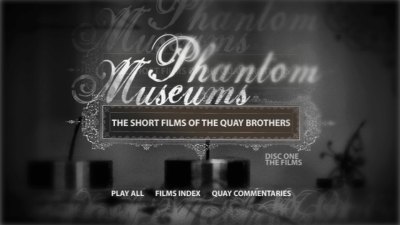
Phantom Museums: The Short Films of the Quay Brothers
The Quay brothers, Stephen and Timothy, are a pair of identical twins who studied art in Philadelphia and eventually found themselves in England making stop motion animated films. Over the past 25 years or so, the brothers have created a unique and interesting body of work, a set of oddly disquieting short films that are filled with fantastic images that are not easy to forget. Kino released a DVD containing several of their films in 2000, but that disc has been out of print for a while. Now Zeitgeist Video has released in region one BFI's wonderful collection of the brother's films Phantom Museums, The Short Films of the Quay Brothers, a set which includes all of the offerings from the Kino disc along with some additional shorts and new bonus items. The lovingly restored movies and copious extras make this a set to own.
The films of the Quay brothers are glimpses into another world. They are surrealist experiments that are powerful and imaginative and after viewing this collection it is easy to see why the Quay's have attained cult status. Their films tell stories, but they aren't really narrative films. They are stop motion animated journeys into other realms; worlds where little boys chase animate screws and pocket watches are made of meat. Places where form and texture and focus are used in unique ways to create feelings.
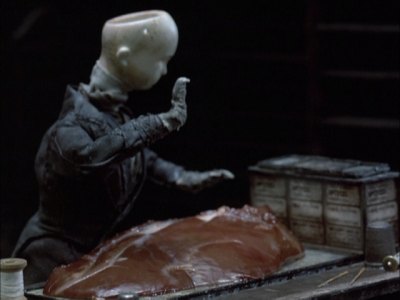 The films often feature puppet-like dolls, frequently broken or disfigured, that move and react like humans, almost. The landscapes are regularly drab and filled with objects that take on new meanings. The depth of focus is very narrow, causing objects even slightly in the background or foreground to be blurry and indistinct. These themes work together to give the films a nightmare-like quality.
The set starts off with a mini-masterpiece, The Cabinet of Jan Svankmajer. This is a film based on the life of the Czech animator who was a great influence on the Quays. Throughout this piece a clockwork Jan with a thick book for a skull teaches a young pupil, after removing all of the cotton in his head, how to look at things with a new perspective and how form can be a fluid thing. With dancing pins and drawers the size of rooms that hold small pebbles, this film is a wonderful introduction to the works of these interesting animators.
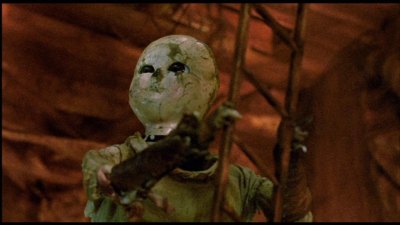 The most famous film that the Quays have made is Street of Crocodiles, based on a story by Bruno Schulz. (Terry Gilliam has stated that this is one of ten best animated works of all time.) In an old theater, a (live action) watchman spits into an old Kinetoscope which brings the machine to life. Watching through the viewer, the man sees the trials of an odd puppet that follows a string though a labyrinth of strange and unusual rooms and places. Vaguely reminiscent of Tarkovsky's Stalker, this surreal film is filled with eerie eyeless dolls, dancing screws, and pocket watches that have meat where their gears should be.
All of these films are very visually stimulating and thought provoking though they are best taken in small doses. It can be a bit of a trail to watch more than one or two at a time. Looking for the meanings behind the actions and objects can become exhausting, and like a fine wine, these films are best savored in small sips.
The films included in this collection are:
The Cabinet of Jan Svankmajer
This Unnameable Little Broom (The Epic of Gilgamesh)
Street of Crocodiles
Rehearsals for Extinct Anatomies
Stille Nacht I (Dramolet)
The Comb
Anamorphosis
Stille Nacht II (Are We Still Married?)
Stille Nacht III (Tales From Vienna Woods)
Stille Nacht IV (Can't Go Wrong Without You)
In Absentia
The Phantom Museum
Nocturna Artificialia (their oldest surviving film)
The Calligrapher (a series of BBC 2 idents)
The Summit (a live action pilot done for Channel 4 directed by the Quay Brothers.)
The DVD:
These films are presented on a two disc set. The DVDs come in a fold out case that includes a 28-page insert with a list of films, a Quay Brothers Dictionary and an essay about the brother's work. This case is housed in a slipcase.
Audio:
Music plays a large role in giving these films their unique feel and this set reproduces the soundtracks magnificently. The stereo audio that accompanies the shorts has a wide range and is clear and clean. The syncopated rhythms and odd instruments come through with a sharp precision that adds another dimension to the films. A great sounding set.
Video:
The video quality to these films is superb. The films are all presented with their original aspect ratio intact, 1.33:1 for all of them save four (Rehearsals for Extinct Anatomies, The Comb, In Absentia and The Phantom Museum which are anamorphically enhanced), and look great. The images are crystal clear with a great amount of detail. Some of these films were shot in black and white, but even the color shorts have a narrow color palate with browns, grays, and dark reds predominating. The blacks are deep and even and there is a wide range of shades of gray. There are some spots, grain, and other imperfections present in some of these films but those were intentional and give the films an old look and feel to them.
Digitally things also look great. Aliasing and macroblocking are not a problem and compression artifacts are at a minimum. All around a nice looking set.
Extras:
This is a wonderfully crafted set of DVDs that not only showcases the Quay Brother's work, but includes some wonderful supplementary material too. One of the most exciting bonus items are the commentaries that the brothers provide to some of their films. In these they talk about not only how the production got off the ground and some of the technical difficulties, but they explain what they were trying to accomplish with some of their shots and images. These commentary tracks provide a lot of information and are a lot of fun to listen to. Commentary tracks are provided for the following films: This Unnameable Little Broom, Street of Crocodiles, Stille Nacht I (Dramolet), Stille Nacht II (Are We Still Married?), Stille Nacht III (Tales From Vienna Woods), In Absentia.
The second disc contains most of the goodies. It is packed with items that are sure to please fans of the Quay brothers. There are alternate versions to Rehearsals for Extinct Anatomies, and In Absentia, an excerpt from The Fall, a British Film Institute Indent that the brothers created in 1991 along with trailers for Institute Benjamenta and Piano Tuner of Earthquakes.
There is also a 20-minute introduction by the brothers was very interesting. They discuss how they became interested in animation, (their father told them that they could either be gymnasts or artists...), their emigration to Europe, how they got interested in puppets, their influences, the music they use, and the genesis of their style. (It will come as no surprise that the writings of Kafka had a big influence on the pair.) An interview with the brothers that was conducted in 2000 and runs nearly half an hour is also included.
Final Thoughts:
This is an amazing collection. Stephen and Timothy Quay have created some absolutely wonderful films and their most important work is found in this omnibus set. With a beautiful looking picture and some marvelous bonus features this compilation of their work belongs in every complete animation library. Highly Recommended.
|



| Popular Reviews |
| Sponsored Links |
|
|
| Sponsored Links |
|
|
| Release List | Reviews | Shop | Newsletter | Forum | DVD Giveaways | Blu-Ray | Advertise |
|
Copyright 2024 DVDTalk.com All Rights Reserved. Legal Info, Privacy Policy, Terms of Use,
Manage Preferences,
Your Privacy Choices 
| |||||||